
Chip Stocks Rebound as Strong US Jobs Data Lifts December Fed Rate-Hike Bets and Pressures Bonds
Why it matters
The divergence between surging semiconductor equities and falling bond prices signals that institutional investors are prioritizing artificial intelligence infrastructure growth over the headwind of sustained monetary tightening.
What happened (in 30 seconds)
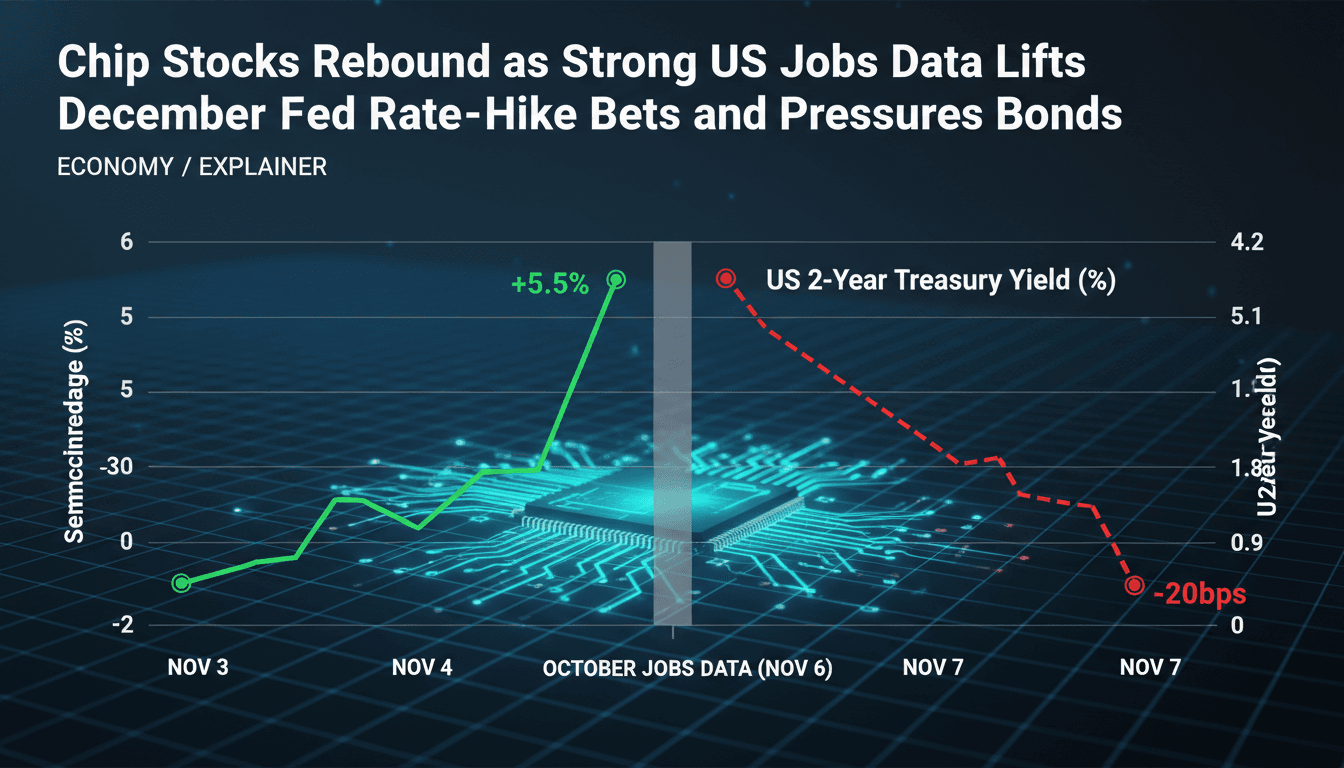
- Semiconductor equities surged: A dedicated benchmark gauge tracking chip manufacturers gained 5.5% on November 6, 2026, paced by sharp advances in Advanced Micro Devices (+11.2%) and Lam Research (+10%+).
- Macro data reinforced Fed tightening bets: Strong US jobs figures and lower unemployment for October prompted traders to increase the probability of a Federal Reserve benchmark interest rate hike at the December policy meeting.
- Treasuries declined as tech defied yields: Short-dated government bonds fell, driving yields higher, yet dip buyers lifted the tech-heavy Nasdaq 100 by approximately 2% even as the broader S&P 500 showed underlying constituent weakness.
The context you actually need
- Prior bubble concerns sparked heavy positioning unwind: The November 6 rally followed sharp multi-day losses driven by investor anxiety surrounding the sustainability of hyperscale data-center capital expenditure and crowded thematic positioning.
- Labor metrics revealed ongoing macroeconomic momentum: The US Bureau of Labor Statistics reported robust job additions alongside falling unemployment, demonstrating that aggregate demand remains resilient enough to sustain inflationary pressure.
- Narrative dynamics decoupled from discount rates: Multi-asset research from HSBC noted that the artificial intelligence trade has increasingly traded on corporate development narratives rather than standard macroeconomic fundamentals or conventional bond-yield discount models.
What's really happening
The November 6 market dynamic highlights a structural tension between monetary policy realities and high-conviction thematic capital deployment. Standard financial theory dictates that rising sovereign debt yields compress equity valuation multiples. Because higher interest rates increase the discount rate applied to corporate earnings projected years into the future, growth-oriented tech businesses historically suffer when bond prices decline.
Instead, the market experienced a decoupling. Robust October employment figures removed any lingering expectation that the Federal Reserve would pause or ease monetary conditions to support asset prices. Instead, the data reinforced expectations of an outright rate increase at the December policy meeting. Fixed-income desks reacted predictably: short-term Treasuries sold off rapidly, lifting yields to reflect a higher-for-longer capital cost environment.
Yet equity capital moved aggressively into the very sector theoretically most vulnerable to high discount rates: hardware and semiconductor manufacturers. Rather than retreating in the face of rising yields, institutional dip buyers stepped in to reverse the prior sessions' selloffs. The catalyst was not monetary easing, but an aggressive reassessment of enterprise balance sheets and AI infrastructure expenditure.
Market participants recognized that despite anxiety regarding data-center return on investment, underlying purchase orders for advanced silicon remain fully intact. Consequently, equities like AMD and Lam Research rallied between 8% and 11.2%. This dynamic pulled the tech-weighted Nasdaq 100 index up by 2%, effectively offsetting the downward pressure seen across non-tech constituents within the broader S&P 500.
This behavior illustrates the incentive framework currently governing institutional portfolio allocations. Asset allocators are caught between two opposing forces: the risk of owning high-duration equities amid rising risk-free yields, and the risk of underperforming their benchmarks if structural AI deployment accelerates without them. HSBC Chief Multi-Asset Strategist Max Kettner noted that the AI trade has frequently obeyed shifting market narratives rather than strictly adhering to macroeconomic fundamentals. The November 6 reversal confirms that narrative-driven capital continues to override the traditional gravitational pull of sovereign debt markets.
Who feels it first (and how)
- Equity multi-asset portfolio managers: Face widening tracking error between growth-heavy indices and traditional balanced portfolios as tech diverges from bond market direction.
- Fixed-income traders: Absorb immediate price losses on short-duration US Treasuries as yields adjust upward to reflect December Fed rate-hike probabilities.
- Global family offices and sovereign wealth funds: Investors based in hubs such as Dubai with international equity mandates encounter heightened factor volatility, balancing offshore technology exposure against declining debt valuations.
- Corporate finance executives at hardware suppliers: Experience temporary relief in equity valuations, even as their cost of future corporate debt issuance rises alongside Treasury yields.
What to watch next
- The Federal Reserve's December policy decision: Determines whether persistent labor market strength forces central bankers to enact another rate increase, testing the limits of tech sector resilience.
- Forward enterprise guidance on AI data-center expenditure: Signals whether semiconductor order books justify current equity multiples in the absence of broader market multiple expansion.
- Short-dated Treasury yield resistance levels: Identifies the precise yield threshold at which sovereign fixed-income yields begin to siphon liquidity away from risk assets.
October US labor data came in strong, Treasury bond prices fell, the semiconductor gauge rose 5.5%, and AMD advanced 11.2% on November 6, 2026.
The Federal Reserve will treat sustained labor resilience as justification for pricing elevated odds of a benchmark rate hike during its December meeting.
Whether institutional dip buying can sustainably defend semiconductor multiples if benchmark borrowing costs remain elevated through early 2027.
Frequently Asked Questions
- Why it matters?
- The divergence between surging semiconductor equities and falling bond prices signals that institutional investors are prioritizing artificial intelligence infrastructure growth over the headwind of sustained monetary tightening.
- What happened (in 30 seconds)?
- Semiconductor equities surged: A dedicated benchmark gauge tracking chip manufacturers gained 5.5% on November 6, 2026, paced by sharp advances in Advanced Micro Devices (+11.2%) and Lam Research (+10%+). Macro data reinforced Fed tightening bets: Strong US jobs figures and lower unemployment for October prompted traders to increase the probability of a Federal Reserve benchmark interest rate hike at the December policy meeting. Treasuries declined as tech defied yields: Short-dated government b
- What's really happening?
- The November 6 market dynamic highlights a structural tension between monetary policy realities and high-conviction thematic capital deployment. Standard financial theory dictates that rising sovereign debt yields compress equity valuation multiples. Because higher interest rates increase the discount rate applied to corporate earnings projected years into the future, growth-oriented tech businesses historically suffer when bond prices decline. Instead, the market experienced a decoupling. Rob
- Who feels it first (and how)?
- Equity multi-asset portfolio managers: Face widening tracking error between growth-heavy indices and traditional balanced portfolios as tech diverges from bond market direction. Fixed-income traders: Absorb immediate price losses on short-duration US Treasuries as yields adjust upward to reflect December Fed rate-hike probabilities. Global family offices and sovereign wealth funds: Investors based in hubs such as Dubai with international equity mandates encounter heightened factor volatility, ba
- What to watch next?
- The Federal Reserve's December policy decision: Determines whether persistent labor market strength forces central bankers to enact another rate increase, testing the limits of tech sector resilience. Forward enterprise guidance on AI data-center expenditure: Signals whether semiconductor order books justify current equity multiples in the absence of broader market multiple expansion. Short-dated Treasury yield resistance levels: Identifies the precise yield threshold at which sovereign fixed-in
Global markets, investing, and macroeconomics from a premier financial newsroom.
"Bloomberg is respected for in-depth financial reporting and data-driven analysis."
— A47 Editor
Chip Stocks Roar Back as Strong Data Sink Bonds
Chipmaker shares rebounded on Wall Street as dip buyers stepped in, even as solid economic data reinforced speculation that the Federal Reserve will raise interest rates in December, according to Bloomberg reporting on the base story.
Technology business and AI-related headlines.
"Data-driven tech newsroom with global scope."
— A47 Editor
HSBC’s Max Kettner: The AI Trade Hasn’t Fundamentally Changed
HSBC's Chief Multi-Asset Strategist Max Kettner argues that the sharp selloff in AI and US equities does not yet signal a fundamental break in the AI trade, attributing much of the volatility to positioning and forced selling after Wall Street's call...
Technology business news, market impacts, and innovation trends.
"Bloomberg is a premier financial and tech news provider, respected for its in-depth reporting and analytical rigor."
— A47 Editor
HSBC’s Max Kettner: The AI Trade Hasn’t Fundamentally Changed
HSBC's Chief Multi-Asset Strategist Max Kettner argues that the sharp selloff in AI and US equities does not yet signal a fundamental break in the AI trade, attributing much of the volatility to positioning and forced selling after Wall Street's call...
Technology business and AI-related headlines.
"Data-driven tech newsroom with global scope."
— A47 Editor
HSBC's Kettner: We're in Full on P&L Protection
HSBC's chief multi-asset strategist Max Kettner told Bloomberg Television that the global stocks rout is deepening amid mounting uncertainty over the AI trade, and that market stabilization could hinge on whether Anthropic's IPO goes through in the n...
Technology business news, market impacts, and innovation trends.
"Bloomberg is a premier financial and tech news provider, respected for its in-depth reporting and analytical rigor."
— A47 Editor
HSBC's Kettner: We're in Full on P&L Protection
HSBC's chief multi-asset strategist Max Kettner told Bloomberg Television that the global stocks rout is deepening amid mounting uncertainty over the AI trade, and that market stabilization could hinge on whether Anthropic's IPO goes through in the n...