
OPEC+ Weighs 2027 Output Targets as Global Oil Surplus Builds and Hormuz Flows Remain Vulnerable
Energy budgets, logistics routing, and regional investment models hinge directly on whether crude producers defend market share or shore up global price floors.
Why it matters
The clash between emerging worldwide crude surpluses and fragile maritime chokepoints directly dictates operational fuel margins, transport risk premiums, and multinational corporate balance sheets into 2027.
What happened (in 30 seconds)
- Ministers convene to set 2027 quotas: OPEC+ convenes in late November 2026 to settle upcoming output targets while evaluating third-party capacity assessments across key member nations.
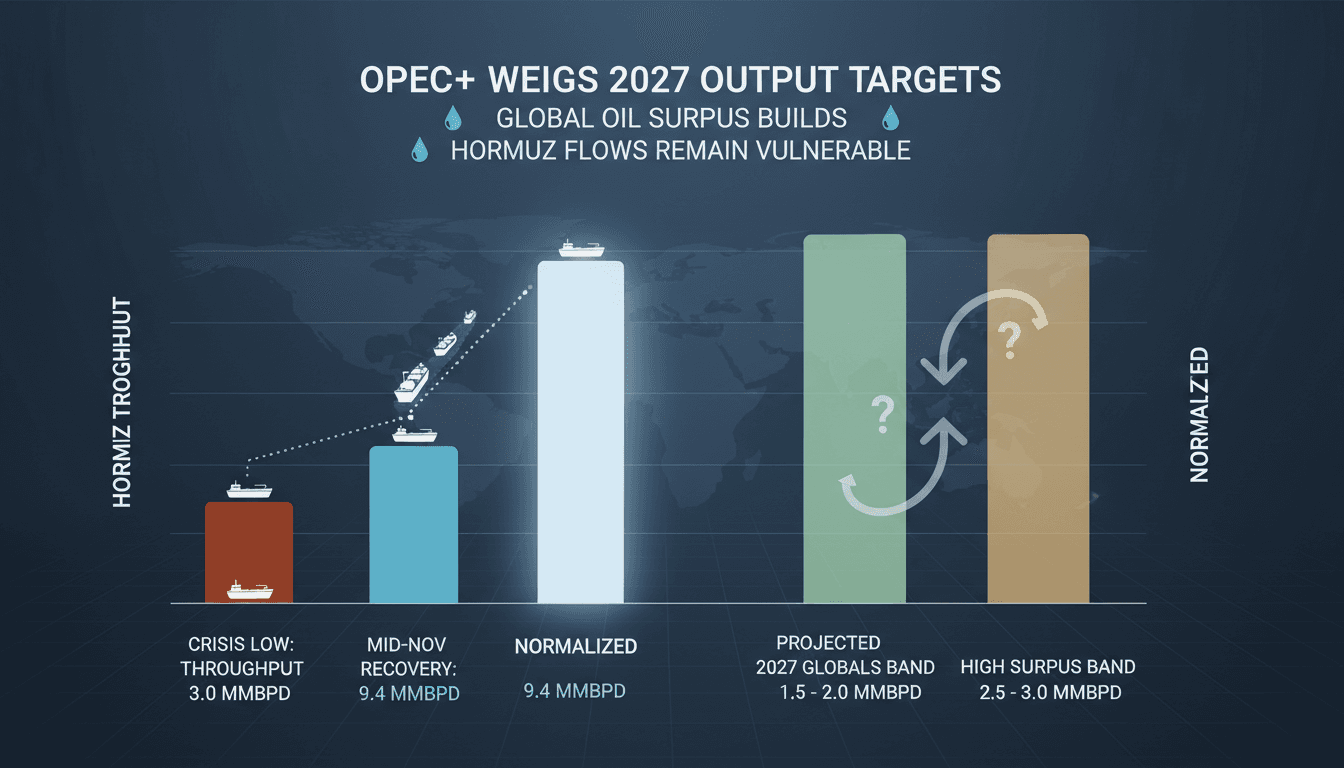
- Physical transits remain below historic capacity: Weekly Hormuz transit levels averaged 9.4 million barrels per day through mid-November 2026, reaching roughly 55% of the 17.1 million pre-war benchmark despite convoy arrangements.
- Supply imbalances emerge ahead of 2027: Independent market analyses project global inventory builds alongside an oil surplus, complicating baseline negotiations as members dispute capacity evaluations.
The context you actually need
- Conflict disrupted Gulf transit corridors: Peak fighting during 2026 cut normal Strait flows down to 3 million barrels daily, forcing operators into alternate pipelines and vessel-to-vessel transfers outside the Gulf.
- The UAE operates outside group rules: Following its departure from OPEC in May 2026, the UAE pushed domestic pumping past 4 million barrels per day, creating distinct commercial dynamics alongside legacy members.
- Capacity reassessments sparked quota friction: External auditors DeGolyer and MacNaughton alongside Shri Chandra Group delivered production baseline reports that members such as Iraq have formally contested.
What's really happening
The November 2026 OPEC+ ministerial negotiations represent a confrontation between physical infrastructure constraints and classical market-share preservation. In 2026, armed conflict squeezed maritime transit corridors throughout the Strait of Hormuz, cutting baseline throughput from roughly 17 to 20 million barrels per day down to troughs around 3 million barrels per day. That dislocation insulated crude benchmarks against underlying weakness in end-user consumption. By late 2026, however, bypass pipelines, dark voyages, and military-escorted convoys managed to bring aggregate Gulf export volume back to approximately 80% of pre-war throughput. Kpler tracking data recorded clearance volumes of 9.4 million barrels daily in the week closing November 18, 2026—still 45% short of normalized operations, but sufficient to expose structural oversupply in consumer terminals worldwide.
At the center of the dispute sits the updated capacity audit commissioned from DeGolyer and MacNaughton alongside Shri Chandra Group. Baseline numbers determine maximum sustainable production quotas. Sovereign states rely on higher baseline allocations to protect national treasury revenues, especially as post-conflict repair projects absorb liquidity. Iraq's explicit rejection of its audited capacity demonstrates the structural fragility within the remaining cartel. If ministerial leadership enforces lower baseline figures, non-compliant pumping often rises covertly; conversely, if the bloc yields and grants elevated nominal allocations, physical barrels flood secondary trading hubs, driving prompt contracts into steep contango.
Compounding this structural bind is the unilateral operating position of the UAE. Having stepped outside the OPEC alliance framework in May 2026, Abu Dhabi lifted aggregate capacity beyond 4 million barrels per day. The resulting volumes flow independently of group restrictions, capturing revenue share across key Asian demand hubs while remaining cartel members debate extensions to active 2 million barrel per day output curbs.
As a consequence, Saudi Arabia and Russia face asymmetric incentives. Retaining current curbs shields headline market pricing against the oncoming 2027 surplus projected by the International Energy Agency and Rystad Energy. However, doing so cedes structural commercial share to independent regional operators and non-OPEC suppliers. Shifting to an unconstrained volume strategy, on the other hand, risks precipitating steep balance-sheet contractions across producers dependent on elevated fiscal break-even pricing.
Who feels it first (and how)
- Aviation and Maritime Freight Operators: Bunkering hubs and fleet operators face volatile war-risk surcharges alongside variable refined-product margins while Hormuz security remains uncertain.
- Regional Corporate Finance Directors: Commercial treasuries across Gulf economies encounter diverging public spending patterns depending on whether individual sovereigns pump at elevated volumes or adhere to cartel curbs.
- Global Commodity Procurement Desks: Sourcing teams must navigate volatile physical-versus-paper differentials as actual crude deliveries remain bifurcated between Gulf bypass lines and exposed maritime choke points.
What to watch next
- Baseline dispute resolution in Vienna: Formal adoption or procedural postponement of the DeGolyer and MacNaughton capacity figures will signal whether core members will accept strict output caps.
- Clearance volume rates across Hormuz: Any sustained recovery above the 9.4 million barrel per day threshold recorded in mid-November will accelerate physical market surplus accumulation.
- Commercial compliance tracking: Secondary-source export reports for member countries will show whether members observe assigned baselines or pump unrecorded barrels to offset transit costs.
The ministerial meeting convenes in late November 2026 to resolve baselines; Strait of Hormuz flows recovered to 9.4 million barrels per day in mid-November; the UAE produces outside the cartel above 4 million barrels per day.
Forecasters at the IEA and Rystad Energy anticipate an inventory accumulation cycle pushing the global market into surplus during 2027.
Whether Iraq and dissident alliance participants will accept independent third-party capacity estimates without demanding higher baseline exceptions.
Frequently Asked Questions
- Why it matters?
- The clash between emerging worldwide crude surpluses and fragile maritime chokepoints directly dictates operational fuel margins, transport risk premiums, and multinational corporate balance sheets into 2027.
- What happened (in 30 seconds)?
- Ministers convene to set 2027 quotas: OPEC+ convenes in late November 2026 to settle upcoming output targets while evaluating third-party capacity assessments across key member nations. Physical transits remain below historic capacity: Weekly Hormuz transit levels averaged 9.4 million barrels per day through mid-November 2026, reaching roughly 55% of the 17.1 million pre-war benchmark despite convoy arrangements. Supply imbalances emerge ahead of 2027: Independent market analyses project global
- What's really happening?
- The November 2026 OPEC+ ministerial negotiations represent a confrontation between physical infrastructure constraints and classical market-share preservation. In 2026, armed conflict squeezed maritime transit corridors throughout the Strait of Hormuz, cutting baseline throughput from roughly 17 to 20 million barrels per day down to troughs around 3 million barrels per day. That dislocation insulated crude benchmarks against underlying weakness in end-user consumption. By late 2026, however, byp
- Who feels it first (and how)?
- Aviation and Maritime Freight Operators: Bunkering hubs and fleet operators face volatile war-risk surcharges alongside variable refined-product margins while Hormuz security remains uncertain. Regional Corporate Finance Directors: Commercial treasuries across Gulf economies encounter diverging public spending patterns depending on whether individual sovereigns pump at elevated volumes or adhere to cartel curbs. Global Commodity Procurement Desks: Sourcing teams must navigate volatile physical-v
- What to watch next?
- Baseline dispute resolution in Vienna: Formal adoption or procedural postponement of the DeGolyer and MacNaughton capacity figures will signal whether core members will accept strict output caps. Clearance volume rates across Hormuz: Any sustained recovery above the 9.4 million barrel per day threshold recorded in mid-November will accelerate physical market surplus accumulation. Commercial compliance tracking: Secondary-source export reports for member countries will show whether members observ
U.S. business news, corporate developments, and economy.
"The Wall Street Journal is respected for deep financial and economic reporting with a center-right editorial perspective."
— A47 Editor
OPEC, Allies Face Tough Choices as Surplus Builds, Hormuz Risks Persist
OPEC and its allies are facing a difficult balancing act as existing production agreements approach their year-end deadline, with the group set to decide on output targets for 2027 when it meets on Sunday. The Wall Street Journal reports that the car...
Global business headlines with AI angles.
"General business outlet that frequently covers AI."
— A47 Editor
Iran Claims Two Tankers Hit Mines In Strait Of Hormuz. But Oil Traders Are More Worried About Too Much Crude.
Iran has claimed that two tankers struck mines in the Strait of Hormuz, but oil traders are focused more on the risk of excess crude supply than on the shipping incident itself, as Persian Gulf exports recover and OPEC+ ministers prepare to decide 20...
Global markets, investing, and macroeconomics from a premier financial newsroom.
"Bloomberg is respected for in-depth financial reporting and data-driven analysis."
— A47 Editor
OPEC+ Faces Its Most Consequential Supply Decision of the Year
OPEC+ oil ministers are scheduled to gather at the end of the month to decide how much crude oil to supply to global markets, a decision the article characterizes as the most consequential of the year for the group.