
S&P Revises France Sovereign Outlook to Negative While Affirming A+ Rating Amid Rising Debt and Weak Fiscal Consensus
Why it matters
France sits at the core of the European bond market, meaning fiscal strain in Paris reprices sovereign risk, lifts benchmark yields, and constrains debt-financed economic policy across the monetary union.
What happened (in 30 seconds)
* Outlook lowered to negative: On November 27, 2026, S&P Global Ratings revised its sovereign credit outlook for France from stable to negative, while affirming its long-term credit rating at A+ and short-term rating at A-1. * Fiscal imbalances flagged: The rating agency identified rising public debt, subdued domestic growth, and widening projected budget deficits as key drivers of the downward revision. * Sovereign yields climbed: French 10-year government bond yields moved above 4.7% following the announcement, reflecting immediate market adjustments to heightened fiscal execution risk.
The context you actually need
* Persistent deficit baseline: France operates with an annual fiscal deficit running above 5% of gross domestic product, while sovereign public debt sits near 110% of total economic output. * Rating agency consensus: Fitch Ratings previously adjusted its French outlook to negative in October 2025, underscoring broader institutional scrutiny over Paris's medium-term consolidation trajectory. * Growth engine stalling: National accounts tracked by INSEE show recent quarterly contractions in French gross domestic product, narrowing the state's tax revenue base just as borrowing costs rise.
What's really happening
The core tension driving S&P Global Ratings' outlook revision is not a sudden balance-sheet emergency, but an arithmetic squeeze between rigid spending commitments and institutional fragmentation. S&P projects that without significant corrective fiscal intervention, France's fiscal deficit will settle at 5.3% of GDP by 2027. While French Economy Minister Roland Lescure reaffirmed the executive branch's target to cap the deficit at 5.0%, meeting that ceiling requires legislative passage of targeted cuts and revenue increases through a fragmented parliament.
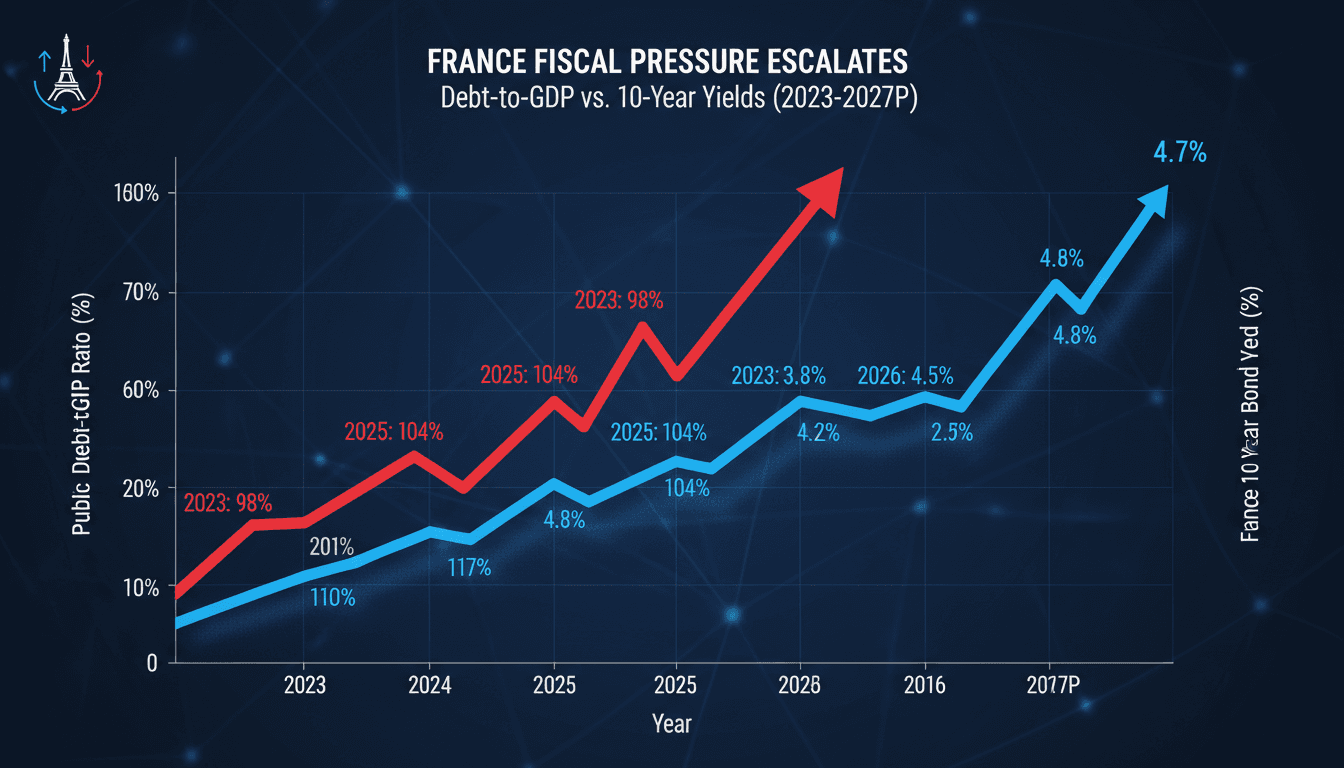
When sovereign debt hovers near 110% of output and borrowing costs rise—evidenced by 10-year sovereign yields clearing 4.7%—the debt-service line item becomes a self-reinforcing burden. Every tenth of a percentage point added to the French sovereign curve directly expands state interest expenditure, siphoning capital away from productive public investment and structural economic support. This dynamic creates an incentive trap for the French government: delivering genuine consolidation demands structural spending reductions, but enacting those cuts risks depressing domestic economic activity at a moment when quarterly GDP numbers already demonstrate contraction.
Furthermore, credit agencies focus heavily on governance certainty. S&P's statement explicitly cited the risk of polarization extending past the 2027 presidential election. In practical terms, credit analysts see little incentive for rival parliamentary blocs to build a durable consensus around austerity. Investors are pricing the reality that structural deficit repair will face legislative resistance through the remainder of the election cycle.
For international capital markets, this shifts French sovereign paper from a frictionless proxy for core European stability toward an asset class carrying an idiosyncratic fiscal risk premium. The negative outlook serves as a formal mechanical signal: unless the executive branch delivers an enforceable consolidation path that visibly bends the debt-to-GDP trajectory, an outright downgrade from A+ to A becomes the base operational case for portfolio risk committees.
Who feels it first (and how)
* Eurozone fixed-income portfolio managers: Asset allocators holding French sovereign bonds face direct capital losses as 10-year yields surpass 4.7%, forcing duration recalibrations against German benchmarks. * French public finance officials: Ministry budget negotiators face narrower policy room as rising debt-servicing outlays consume an expanding share of expected tax receipts. * Corporate treasurers in Western Europe: Private enterprises issuing debt benchmarked to French sovereign yields face higher corporate borrowing spreads and elevated refinancing expenses. * Global multi-asset allocators in Dubai and cross-border hubs: While direct local market fallout in the UAE remains minimal, international family offices and sovereign funds must adjust portfolio risk parameters for broader European asset volatility.
What to watch next
* The 2027 deficit projection trajectory: Track whether official budget amendments pull the projected deficit below the 5.3% threshold flagged by S&P analysts. * The 10-year yield spread against German Bunds: Monitoring French 10-year bond yields above 4.7% will determine whether institutional investors demand a wider structural risk premium over core European benchmarks. * Parliamentary budget votes in Paris: Watch the legislative passage of upcoming budget reconciliation bills to assess whether cross-party coalitions can deliver binding fiscal consolidation.
S&P affirmed France's rating at A+ while setting the outlook to negative; national debt sits near 110% of GDP; 10-year borrowing yields increased beyond 4.7%.
French government financing expenses will absorb a larger portion of state revenues through 2027 as existing debt rolls over into higher prevailing interest rate structures.
Whether the French parliament can form a stable fiscal consensus ahead of the 2027 presidential election to prevent an actual rating downgrade to A.
Frequently Asked Questions
- Why it matters?
- France sits at the core of the European bond market, meaning fiscal strain in Paris reprices sovereign risk, lifts benchmark yields, and constrains debt-financed economic policy across the monetary union.
- What happened (in 30 seconds)?
- Outlook lowered to negative: On November 27, 2026, S&P Global Ratings revised its sovereign credit outlook for France from stable to negative, while affirming its long-term credit rating at A+ and short-term rating at A-1. Fiscal imbalances flagged: The rating agency identified rising public debt, subdued domestic growth, and widening projected budget deficits as key drivers of the downward revision. Sovereign yields climbed: French 10-year government bond yields moved above 4.7% following the a
- What's really happening?
- The core tension driving S&P Global Ratings' outlook revision is not a sudden balance-sheet emergency, but an arithmetic squeeze between rigid spending commitments and institutional fragmentation. S&P projects that without significant corrective fiscal intervention, France's fiscal deficit will settle at 5.3% of GDP by 2027. While French Economy Minister Roland Lescure reaffirmed the executive branch's target to cap the deficit at 5.0%, meeting that ceiling requires legislative passage of target
- Who feels it first (and how)?
- Eurozone fixed-income portfolio managers: Asset allocators holding French sovereign bonds face direct capital losses as 10-year yields surpass 4.7%, forcing duration recalibrations against German benchmarks. French public finance officials: Ministry budget negotiators face narrower policy room as rising debt-servicing outlays consume an expanding share of expected tax receipts. Corporate treasurers in Western Europe: Private enterprises issuing debt benchmarked to French sovereign yields face hi
- What to watch next?
- The 2027 deficit projection trajectory: Track whether official budget amendments pull the projected deficit below the 5.3% threshold flagged by S&P analysts. The 10-year yield spread against German Bunds: Monitoring French 10-year bond yields above 4.7% will determine whether institutional investors demand a wider structural risk premium over core European benchmarks. Parliamentary budget votes in Paris: Watch the legislative passage of upcoming budget reconciliation bills to assess whether cros
Arabic-language coverage of international news and geopolitics.
"RT Arabic is a Russian state-funded outlet often criticized for promoting Kremlin-aligned narratives."
— A47 Editor
S&P تخفض توقع تصنيف فرنسا الائتماني من مستقر إلى سلبي مع تثبيت التصنيف عند +A
S&P Global Ratings has revised its outlook on France's sovereign credit rating from stable to negative while affirming the rating at A+, according to a statement from the international rating agency as reported by RT Arabic.
Editor-curated FT homepage stories spanning markets, business, world, and opinion.
"The Financial Times is a globally respected business publication with a centrist/center-left tone and strong markets focus."
— A47 Editor
S&P cuts France outlook to negative
S&P has revised its outlook on France to negative, with the rating agency saying political instability will make it harder for the country to tackle its public deficit, according to the Financial Times.
Global political, business, and cultural coverage from WSJ international desks.
"The Wall Street Journal offers extensive international reporting with a reputation for financial insight and a center-right editorial stance."
— A47 Editor
S&P Revises Outlook on France’s Credit Rating to Negative From Stable
S&P has revised its outlook on France's credit rating from stable to negative, a move that paves the way for a possible downgrade as mounting public debt and political uncertainty weigh on the country's finances. The agency cited growing budget press...
24/7 international news from a French perspective in multiple languages.
"France 24 is viewed as a globally focused outlet with balanced coverage and a European perspective."
— A47 Editor
S&P revises France's outlook from 'stable' to 'negative'
Rating agency S&P revised France's credit outlook from "stable" to "negative" on Friday, citing growing budget pressures. Weak economic growth and higher interest costs are making it harder for the government to reduce its deficit.
Macro commentary, policy analysis, growth/inflation themes, and global outlooks.
"Contextual macro coverage that complements day-to-day market headlines."
— A47 Editor
S&P revises France outlook to ’negative’ on mounting budget pressures, weak growth
S&P has revised its outlook on France to 'negative' from stable, citing mounting budget pressures and weak economic growth, according to Investing.com. The move follows confirmation that France has entered a technical recession after its economy shra...