
Russia Extends Jet Fuel Export Ban to March 2027 Amid Ukrainian Refinery Strikes
Why it matters
The move confirms that persistent infrastructure attrition is forcing a top global energy producer to wall off refined products to sustain its internal transport network.
What happened (in 30 seconds)
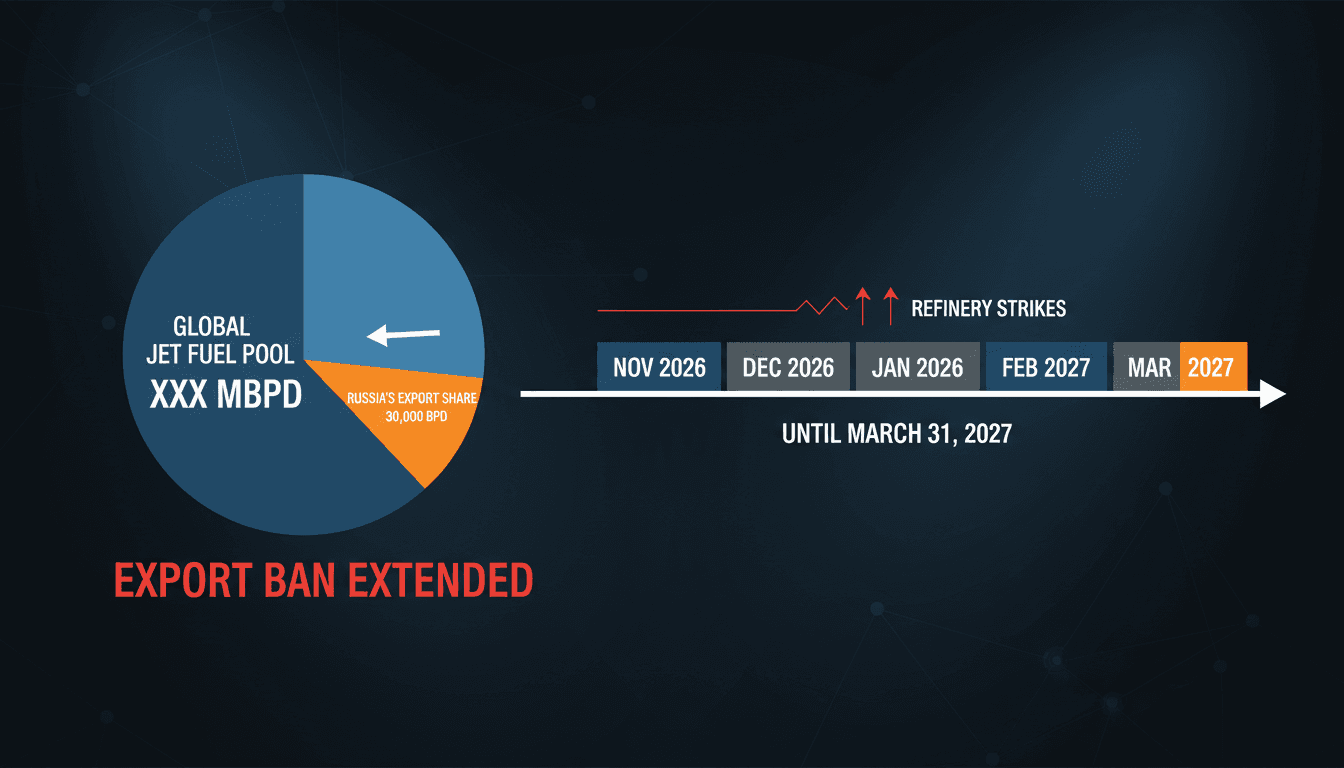
- A four-month extension: On November 27, 2026, the Russian government announced via Telegram that it is extending its ban on most jet fuel exports through March 31, 2027.
- Scope and carve-outs: The restriction covers exchange-traded volumes and general commercial shipments, while retaining specific exemptions for intergovernmental bilateral agreements.
- The operational driver: The extension directly addresses domestic aviation fuel deficits caused by sustained drone strikes targeting primary refining infrastructure since late October 2026.
The context you actually need
- A rolling containment strategy: Russia initially imposed jet fuel export curbs in June 2026 with a scheduled expiration of November 30, 2026; this new decree prevents an abrupt supply drain ahead of winter.
- Refining throughput constraints: Systematic strikes on critical oil processing units forced Russian crude processing volumes down to multi-decade lows, necessitating parallel export curbs across diesel and gasoline.
- A tiny global trade footprint: Russian jet fuel exports averaged roughly 30,000 barrels per day in 2025, which represents less than 2% of total international seaborne aviation fuel supply.
What's really happening
The extension of the jet fuel export ban reveals a distinct economic and logistical calculation: Moscow is prioritizing internal operational continuity over foreign exchange generation from secondary refined distillates.
When upstream crude extraction remains steady but downstream refining capacity is compromised, the primary risk shifts from revenue deficits to domestic distribution failure. Since late October 2026, targeted strikes on distillation columns and secondary refining units have diminished the volume of crude that Russian facilities can turn into usable aviation kerosene. This dynamic pushed domestic processing runs down to multi-decade lows. In response, policymakers faced a clear trade-off: allow refiners to chase higher international spot prices, or force product retention inside domestic borders.
The decision to retain product domestically illustrates the functional reality described by Deputy Prime Minister Alexander Novak, who noted that maintaining equilibrium in a strained market requires not just supply conservation, but active product management and imports. Aviation fuel is non-negotiable for administrative, cargo, and internal commercial links across nine time zones. Unlike crude oil, which can be rerouted to alternative maritime buyers via shadow logistics, refined jet fuel cannot easily be replaced on the fly if regional storage hubs run dry.
For global commodity desks, the market mechanics are defined by structural containment rather than outright volume shocks. Because Russian jet fuel exports stood at approximately 30,000 barrels per day prior to the restrictions—less than 2% of the international market—the global aviation balance sheet can absorb the absolute volume loss through marginal refinery run adjustments in Asia and the Middle East. Consequently, international benchmark prices are experiencing modest upward friction rather than an acute physical squeeze.
However, the systemic signal is significant. By stretching restrictions through the first quarter of 2027, the Russian government is conceding that refinery repair timelines, spare parts procurement, and unit turnaround schedules cannot keep pace with operational attrition. The retention of intergovernmental exemptions also shows how remaining outward energy flows are being repurposed strictly as diplomatic leverage rather than commercial market transactions.
Who feels it first (and how)
- Russian regional airlines: Experience managed fuel allocation and government-directed distribution quotas rather than open-market bidding, preventing localized airport groundings.
- Independent Russian refiners and fuel traders: Lose access to international commercial margins on exchange-traded volumes, locking balance sheets strictly to regulated domestic settlement rates.
- Eurasian neighboring states: Non-exempt regional buyers without bilateral government-to-government pacts must source replacement aviation kerosene from alternative Gulf or Asian refiners at full spot premiums.
- International airline procurement teams: Absorb fractional cost increments across jet fuel paper contracts as regional distillate cracks incorporate prolonged regional supply displacement.
What to watch next
- Refinery turnaround and crude throughput figures: Track whether Russian primary processing rates stay at multi-decade lows or show recovery, which will determine if curbs extend past March 2027.
- Intergovernmental agreement quota volumes: Watch the scale of jet fuel cleared through government-to-government exemptions to assess how Moscow balances diplomatic commitments against internal transport minimums.
- Asian and Middle Eastern refinery crack spreads: Monitor the margin of jet fuel over crude in key bunkering hubs to see if regional refiners ramp up utilization to offset missing Eurasian distillates.
The export ban is legally extended from December 1, 2026, to March 31, 2027, maintaining carve-outs only for state-level bilateral pacts as domestic processing rates hit multi-decade lows.
Russian authorities will keep parallel restrictions on other refined fuels, such as diesel, in place through early 2027 to prevent domestic inventory erosion.
Whether domestic refining repairs can outpace continuous infrastructure strikes before the new March 31 expiration date arrives.
Frequently Asked Questions
- Why it matters?
- The move confirms that persistent infrastructure attrition is forcing a top global energy producer to wall off refined products to sustain its internal transport network.
- What happened (in 30 seconds)?
- A four-month extension: On November 27, 2026, the Russian government announced via Telegram that it is extending its ban on most jet fuel exports through March 31, 2027. Scope and carve-outs: The restriction covers exchange-traded volumes and general commercial shipments, while retaining specific exemptions for intergovernmental bilateral agreements. The operational driver: The extension directly addresses domestic aviation fuel deficits caused by sustained drone strikes targeting primary refini
- What's really happening?
- The extension of the jet fuel export ban reveals a distinct economic and logistical calculation: Moscow is prioritizing internal operational continuity over foreign exchange generation from secondary refined distillates. When upstream crude extraction remains steady but downstream refining capacity is compromised, the primary risk shifts from revenue deficits to domestic distribution failure. Since late October 2026, targeted strikes on distillation columns and secondary refining units have di
- Who feels it first (and how)?
- Russian regional airlines: Experience managed fuel allocation and government-directed distribution quotas rather than open-market bidding, preventing localized airport groundings. Independent Russian refiners and fuel traders: Lose access to international commercial margins on exchange-traded volumes, locking balance sheets strictly to regulated domestic settlement rates. Eurasian neighboring states: Non-exempt regional buyers without bilateral government-to-government pacts must source replacem
- What to watch next?
- Refinery turnaround and crude throughput figures: Track whether Russian primary processing rates stay at multi-decade lows or show recovery, which will determine if curbs extend past March 2027. Intergovernmental agreement quota volumes: Watch the scale of jet fuel cleared through government-to-government exemptions to assess how Moscow balances diplomatic commitments against internal transport minimums. Asian and Middle Eastern refinery crack spreads: Monitor the margin of jet fuel over crude i
Sports reporting with a focus on Saudi and regional competitions.
"Okaz sports coverage is broad and audience-friendly, with strong attention to Saudi teams and leagues."
— A47 Editor
دولة كبرى تمدد حظر معظم صادرات وقود الطائرات 120 يوماً
Russia has extended its ban on most jet fuel exports for four months, until the end of March, to secure supplies for its domestic market, according to a government statement published on Telegram, as Ukraine continues attacks on Russian refineries; t...
Global markets, investing, and macroeconomics from a premier financial newsroom.
"Bloomberg is respected for in-depth financial reporting and data-driven analysis."
— A47 Editor
Russia Extends Jet Fuel Export Ban to March on Refinery Attacks
Russia has extended its ban on most jet fuel exports by four months, through March, to keep its domestic market supplied as Ukraine continues to attack the country's refineries, according to Bloomberg.
Arabic-language coverage of international news and geopolitics.
"RT Arabic is a Russian state-funded outlet often criticized for promoting Kremlin-aligned narratives."
— A47 Editor
روسيا تمدد حظر تصدير وقود الطائرات حتى مارس 2027
Russia has extended its ban on exports of aviation fuel, including jet engine fuel, until March 31, 2027, according to an announcement by the Russian government. The measure is aimed at ensuring stability in the domestic market.