
Brent Slips 1.5% to $90.26 as Gulf Export Flows Recover Despite Houthi Strikes on Saudi Refineries
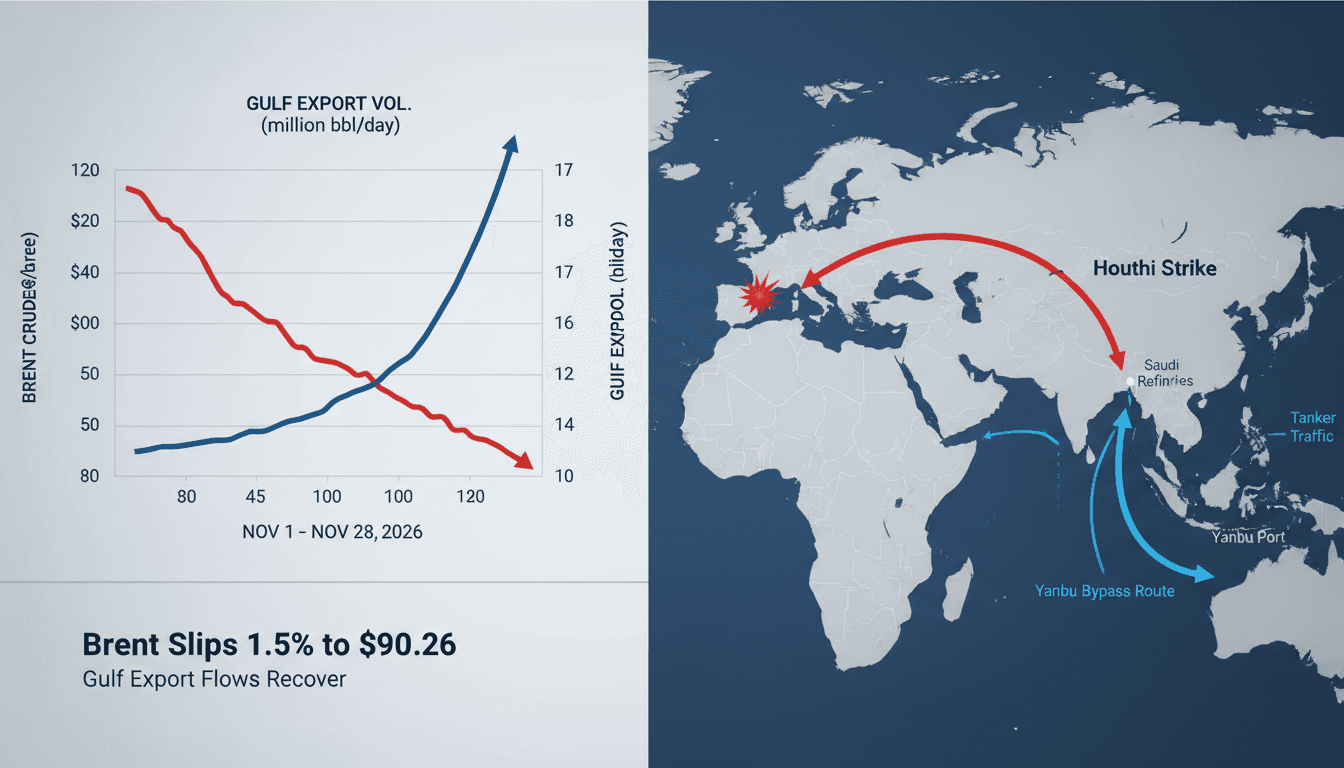
Persistent physical energy flows and alternative pipeline routes are neutralizing geopolitical risk premiums, shielding your operational logistics and capital budgets from headline-driven energy spikes.
Why it matters
The decoupling of physical crude flows from regional security incidents signals that operational rerouting and rising maritime volumes can suppress global commodity price shocks even during sustained localized conflict.
What happened (in 30 seconds)
* Crude benchmarks dropped intraday as Brent fell 1.5% to $90.26 per barrel and West Texas Intermediate (WTI) slipped 0.9% to $82.93, despite active strikes across regional energy infrastructure. * Infrastructure and shipping faced direct disruptions, including a Houthi attack on Saudi Arabia’s Jazan refinery that killed one worker, an incident damaging a tanker in the Strait of Hormuz, and a fatal drone strike in Kuwait. * Physical export resilience contained prices, with rising vessel transits through the Strait of Hormuz and Saudi crude rerouting to the Red Sea port of Yanbu keeping total supply stable.
The context you actually need
* Prices remain sharply lower over the month, with Brent sliding nearly 20% across November from late-October highs near $118 per barrel as regional exports recovered toward pre-war volumes of 17 million barrels per day. * Regional pricing structures flipped to contango, with the Dubai crude curve shifting to a discount of approximately $1.20 per barrel between November and January contracts, down from a prior backwardation premium of $5 to $7 per barrel. * Forecasters anticipate market surpluses, with the International Energy Agency (IEA) projecting fourth-quarter excess inventories as Persian Gulf flows rebound ahead of the November 29 OPEC+ ministerial meeting.
What's really happening
The market reaction reveals a structural shift in how oil pricing digests regional instability. Historically, direct kinetic strikes against sovereign refining assets, commercial tankers, and export corridors triggered immediate, compounding supply-risk premiums. Today, trading desks are pricing physical volume balances over operational disruption headlines.
The primary mechanism driving this insulation is export rerouting capacity. When Houthi militants targeted the Jazan refinery on the Red Sea and previously targeted Ras Tanura, alongside naval mine reports and projectile strikes in the Strait of Hormuz, physical barrels did not vanish from the market. Instead, Saudi Arabia leveraged domestic infrastructure to direct export volumes toward Yanbu on the western coast, while maritime traffic through Hormuz continued to log net gains. Because Persian Gulf exports successfully trended back toward normal baseline volumes of roughly 17 million barrels per day, the physical availability of crude eclipsed the psychological impact of the attacks.
Simultaneously, the Dubai crude futures curve underwent a substantial shift, moving from a tight backwardation of $5 to $7 per barrel into a contango of roughly $1.20 per barrel between prompt November and forward January contracts. Backwardation signals immediate scarcity, prompting buyers to pay steep premiums for spot delivery. A flip to contango indicates prompt inventory comfort, showing that regional buyers and Asian refiners have access to sufficient immediate volumes. This dynamic is further reinforced by Asian importers steadily diversifying purchase agreements away from concentrated Middle Eastern supply routes.
Institutional incentives also anchor this price ceiling. With the IEA forecasting a fourth-quarter supply surplus, macroeconomic traders are unwilling to sustain long positions without tangible export curtailments. Furthermore, major market participants are balancing positions directly ahead of the November 29 OPEC+ meeting, where baseline production policies face formal review. Even with analysts at ANZ observing oversold conditions that could allow Brent to rebound above $100 if conflict expands, the current balance of rising export volumes, quiet diplomatic postures—including U.S. restraint regarding direct retaliatory strikes—and surplus expectations continues to override security concerns.
Who feels it first (and how)
* Aviation and Fleet Operators: Fleet managers benefit directly from softening fuel surcharges and stable refined product access as Brent consolidates near $90 per barrel rather than testing October's $118 peak. * Asian Refinery Procurement Teams: Sourcing directors capture lower prompt acquisition costs due to Dubai crude’s $1.20 contango, allowing them to balance regional purchases with alternative global imports. * Regional Maritime Logistics and Insurers: Marine freight operators face higher war-risk insurance premiums in the Strait of Hormuz, requiring dynamic rerouting strategies to Red Sea terminals like Yanbu despite lower underlying benchmark crude prices.
What to watch next
* The November 29 OPEC+ Output Policy: The ministerial decision will establish whether members enforce baseline restraint or permit additional volume into the projected IEA market surplus. * Yanbu Port Export Throughput: Loadings at Saudi Arabia's Red Sea terminal serve as the critical barometer for the kingdom's capacity to bypass Strait of Hormuz transit friction. * Dubai Crude Prompt Spreads: Any reversal from the current $1.20 contango back toward backwardation will signal that physical prompt volumes are tightening for Asian refiners.
Brent crude declined nearly 20% across November to $90.26 per barrel, physical Middle East exports recovered toward 17 million barrels per day, and regional attacks affected Jazan, Kuwait, and Hormuz vessels.
Crude prices will encounter technical resistance near the $100 threshold unless physical tanker traffic through the Strait of Hormuz experiences a prolonged, measurable halt.
Whether OPEC+ will adjust production quotas to absorb the anticipated IEA fourth-quarter surplus, or if maritime insurance rate increases will eventually force commercial tankers to alter Gulf transit routes.
Frequently Asked Questions
- Why it matters?
- The decoupling of physical crude flows from regional security incidents signals that operational rerouting and rising maritime volumes can suppress global commodity price shocks even during sustained localized conflict.
- What happened (in 30 seconds)?
- Crude benchmarks dropped intraday as Brent fell 1.5% to $90.26 per barrel and West Texas Intermediate (WTI) slipped 0.9% to $82.93, despite active strikes across regional energy infrastructure. Infrastructure and shipping faced direct disruptions, including a Houthi attack on Saudi Arabia’s Jazan refinery that killed one worker, an incident damaging a tanker in the Strait of Hormuz, and a fatal drone strike in Kuwait. Physical export resilience contained prices, with rising vessel transits throu
- What's really happening?
- The market reaction reveals a structural shift in how oil pricing digests regional instability. Historically, direct kinetic strikes against sovereign refining assets, commercial tankers, and export corridors triggered immediate, compounding supply-risk premiums. Today, trading desks are pricing physical volume balances over operational disruption headlines. The primary mechanism driving this insulation is export rerouting capacity. When Houthi militants targeted the Jazan refinery on the Red
- Who feels it first (and how)?
- Aviation and Fleet Operators: Fleet managers benefit directly from softening fuel surcharges and stable refined product access as Brent consolidates near $90 per barrel rather than testing October's $118 peak. Asian Refinery Procurement Teams: Sourcing directors capture lower prompt acquisition costs due to Dubai crude’s $1.20 contango, allowing them to balance regional purchases with alternative global imports. Regional Maritime Logistics and Insurers: Marine freight operators face higher war-r
- What to watch next?
- The November 29 OPEC+ Output Policy: The ministerial decision will establish whether members enforce baseline restraint or permit additional volume into the projected IEA market surplus. Yanbu Port Export Throughput: Loadings at Saudi Arabia's Red Sea terminal serve as the critical barometer for the kingdom's capacity to bypass Strait of Hormuz transit friction. Dubai Crude Prompt Spreads: Any reversal from the current $1.20 contango back toward backwardation will signal that physical prompt vol
Oil, metals, and agriculture: supply/demand headlines, OPEC chatter, inventories, and price action.
"Solid tape for energy and metals traders tracking macro and micro catalysts."
— A47 Editor
Oil trades lower as Middle East strikes collide with rising Gulf flows
Oil prices traded lower as Middle East strikes collided with rising Gulf oil flows, according to Investing.com, with the market weighing renewed regional hostilities against a recovery in shipments from the Gulf that has eased supply concerns.
English-language digital publication covering business, politics, technology, and current affairs.
"The Arabian Post mixes original and syndicated-style coverage with a broad regional and global business-news orientation."
— A47 Editor
Crude heads for November’s first weekly advance
Oil prices were on course for their first weekly gain in November as attacks on Middle Eastern energy infrastructure and commercial shipping heightened concerns over global crude supplies. Brent traded near $97 a barrel in Asian trading, marking a we...
UAE-based English-language newspaper covering regional politics, economics, and global affairs.
"The National reflects Emirati policy perspectives while maintaining international editorial standards."
— A47 Editor
Oil prices on pace for sharp monthly decline as Middle East attacks stoke supply concerns
Oil prices were on track for a sharp monthly decline as attacks in the Middle East stoked concerns about supply, according to The National. The base report places the late-November move against persistent regional tensions affecting energy shipping a...
Global markets, investing, and macroeconomics from a premier financial newsroom.
"Bloomberg is respected for in-depth financial reporting and data-driven analysis."
— A47 Editor
Latest Oil Market News and Analysis for Nov. 27
Oil prices swung in thin trading as increasing attacks on energy infrastructure and tankers in the Middle East heightened supply fears, according to Bloomberg's markets coverage of the latest oil market developments.