
Israeli Election Yields Deadlock as Netanyahu Bloc Falls Short of 61-Seat Majority
Why it matters
The failure of any single coalition to cross the 61-seat threshold extends caretaker governance, elevating geopolitical risk premiums across Middle Eastern corridors without an immediate domestic policy resolution.
What happened (in 30 seconds)
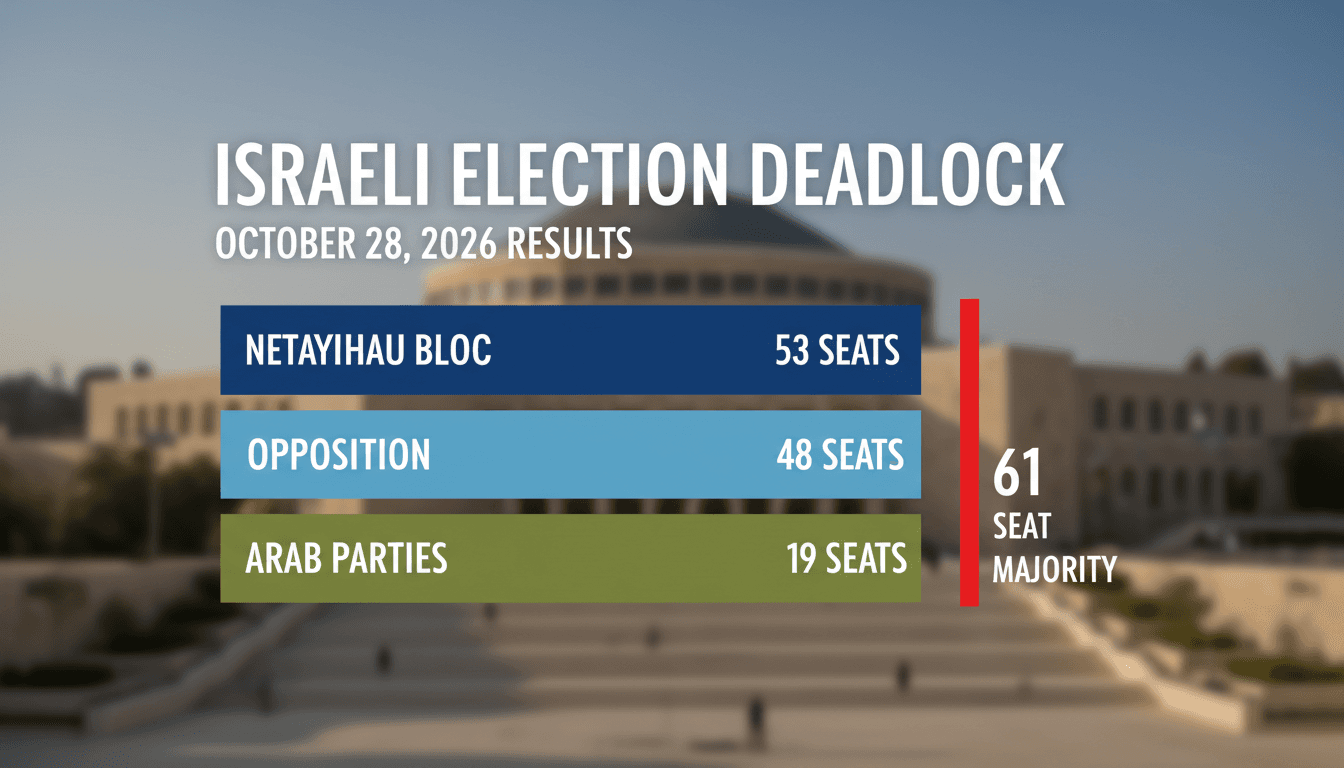
- A split electorate delivered no functional majority: The October 28, 2026 parliamentary election ended with Benjamin Netanyahu’s right-wing bloc capturing 53 seats, remaining short of the 61 needed to govern.
- The opposition bloc secured 48 seats: The centrist and left-leaning coalition led by Gadi Eisenkot’s Yashar party won 48 seats, failing to build an autonomous governing alternative.
- Arab parties emerged with 19 seats: Holding the balance of power, the Arab factions control the numbers required to theoretically unlock a 67-seat opposition-led government or sustain prolonged gridlock.
The context you actually need
- Pre-election projections diverged from Likud’s tally: Polling systematically underestimated Likud’s individual party performance, which reached 27 seats and propelled Netanyahu's camp to its 53-seat total.
- Security legacies shaped voter alignment: The vote took place against persistent political polarization linked to the structural security challenges emerging from the October 7, 2023 events.
- Caretaker protocols keep the status quo operational: Prime Minister Netanyahu remains in executive control under transitional rules while President Isaac Herzog oversees required cross-party consultations.
What's really happening
The election results formalize an arithmetic impasse inside the 120-seat Knesset. With Netanyahu's bloc at 53 seats, the Eisenkot-led opposition at 48 seats, and Arab parties holding 19 seats, the mechanics of power distribution force three divergent paths, as outlined by analyst Yoav Limor.
The first structural pathway is an opposition-led coalition comprising 67 seats. This requires Eisenkot’s Yashar party (which won 21 seats) to combine the 48-seat opposition framework with external or direct support from the 19 seats controlled by Arab parties. While numerically viable, this formulation requires significant structural compromises. The platform's primary legislative objectives would centre on passing judicial revisions and establishing statutory inquiries into the October 7 security failures. However, maintaining cohesion across such an ideologically disparate 67-seat grouping creates operational fragility, exposing any potential cabinet to abrupt dissolution over day-to-day policy execution.
The second path involves a Zionist national unity government. This arrangement relies on centrist factions and Likud constructing a broad governing coalition while excluding both ultra-Orthodox and Arab political parties. Structurally, such an outcome necessitates external diplomatic pressure, including leverage from international actors such as U.S. President Donald Trump, to force domestic adversaries into a power-sharing compromise. The institutional barrier remains intense mutual distrust between party leaderships, which prevents straightforward bilateral horse-trading.
The third strategic path focuses on incentives driving the caretaker executive. In an analysis published by *Israel Hayom*, Limor notes that the caretaker prime minister's operational preference may tilt toward managing external tensions, specifically potential military friction involving Iran. Under this framework, an emergency security environment serves an institutional purpose: it permits the formal postponement of the newly elected Knesset's swearing-in, freezes coalition negotiations, and positions the executive to seek fresh parliamentary elections from a posture of managed regional conflict. The political objective of this path is securing a decisive right-wing majority in a subsequent vote, avoiding the compromises inherent in scenarios one and two.
Until President Herzog’s consultations yield a mandate, the executive apparatus operates without fresh legislative oversight, leaving regional diplomacy and broader strategic relationships in a holding pattern.
Who feels it first (and how)
- Regional corporate strategists: Cross-border business operators and trade desks face extended planning horizons due to unpredictable regulatory timelines and bilateral dialogue pauses.
- Gulf-based expatriate professionals: Expatriates exposed to regional capital flows must navigate prolonged headline friction that influences localized security assessments and asset allocation.
- Israeli parliamentary leadership: Party whips in Likud and Yashar face immediate pressure to enforce caucus discipline or negotiate high-stakes defections to reach the 61-seat baseline.
What to watch next
- President Herzog’s consultation schedule: The sequencing and duration of presidential meetings will signal whether any party leader has assembled the initial momentum required to claim a mandate.
- Security actions along northern and regional axes: Any escalation concerning Iran will indicate whether the caretaker administration is operating under emergency executive protocols that delay parliamentary formation.
- Arab bloc voting pacts: Specific public conditions set by the 19-seat Arab party bloc will determine whether an Eisenkot-led 67-seat legislative path is practically executable.
Netanyahu’s bloc holds 53 seats, the opposition holds 48 seats, Arab parties hold 19 seats, and no faction controls an outright 61-seat majority.
The caretaker administration will remain in place for months as complex multiparty coalition negotiations face initial deadlocks.
Whether international actors will intervene to force a unity government, or if the country will default to an additional national election cycle.
Frequently Asked Questions
- Why it matters?
- The failure of any single coalition to cross the 61-seat threshold extends caretaker governance, elevating geopolitical risk premiums across Middle Eastern corridors without an immediate domestic policy resolution.
- What happened (in 30 seconds)?
- A split electorate delivered no functional majority: The October 28, 2026 parliamentary election ended with Benjamin Netanyahu’s right-wing bloc capturing 53 seats, remaining short of the 61 needed to govern. The opposition bloc secured 48 seats: The centrist and left-leaning coalition led by Gadi Eisenkot’s Yashar party won 48 seats, failing to build an autonomous governing alternative. Arab parties emerged with 19 seats: Holding the balance of power, the Arab factions control the numbers requi
- What's really happening?
- The election results formalize an arithmetic impasse inside the 120-seat Knesset. With Netanyahu's bloc at 53 seats, the Eisenkot-led opposition at 48 seats, and Arab parties holding 19 seats, the mechanics of power distribution force three divergent paths, as outlined by analyst Yoav Limor. The first structural pathway is an opposition-led coalition comprising 67 seats. This requires Eisenkot’s Yashar party (which won 21 seats) to combine the 48-seat opposition framework with external or direc
- Who feels it first (and how)?
- Regional corporate strategists: Cross-border business operators and trade desks face extended planning horizons due to unpredictable regulatory timelines and bilateral dialogue pauses. Gulf-based expatriate professionals: Expatriates exposed to regional capital flows must navigate prolonged headline friction that influences localized security assessments and asset allocation. Israeli parliamentary leadership: Party whips in Likud and Yashar face immediate pressure to enforce caucus discipline or
- What to watch next?
- President Herzog’s consultation schedule: The sequencing and duration of presidential meetings will signal whether any party leader has assembled the initial momentum required to claim a mandate. Security actions along northern and regional axes: Any escalation concerning Iran will indicate whether the caretaker administration is operating under emergency executive protocols that delay parliamentary formation. Arab bloc voting pacts: Specific public conditions set by the 19-seat Arab party bloc
Arabic-language coverage of international news and geopolitics.
"RT Arabic is a Russian state-funded outlet often criticized for promoting Kremlin-aligned narratives."
— A47 Editor
"الفوضى العارمة والمسار الثالث"".. كاتب إسرائيلي يحدد سيناريوهات ما بعد الانتخابات وما يفضله نتنياهو
Israel's parliamentary election has left the Knesset in a hung state, with neither Prime Minister Benjamin Netanyahu's bloc nor the opposition led by Eisenkot securing the majority needed to form a government, according to RT Arabic's reporting on th...
Arabic-language coverage of international news and geopolitics.
"RT Arabic is a Russian state-funded outlet often criticized for promoting Kremlin-aligned narratives."
— A47 Editor
الكنيست بلا حسم.. ونتنياهو يختبر البقاء
Israel's Knesset election has produced an unresolved political landscape, as the camp led by Benjamin Netanyahu failed to secure a clear majority that would guarantee him the ability to form a government.
Jordanian news and regional updates.
"Roya News is a Jordanian outlet focused on breaking news and local affairs."
— A47 Editor
انتهاء فرز أصوات انتخابات الكنيست بلا فائز.. معسكر نتنياهو يتقدم بـ 53 مقعدا مقابل 48 لآيزنكوت و19 للعرب
The final counting of votes in Israel's Knesset elections ended without a clear winner, according to the base report from Ru'ya News. The camp led by Benjamin Netanyahu leads with 53 seats, compared with 48 for the camp associated with Eisenkot and 1...
Arabic-language reporting focused on domestic developments in Saudi Arabia.
"Okaz is a mainstream Saudi newspaper that often reflects domestic priorities and official-facing coverage."
— A47 Editor
انتخابات إسرائيل.. إعادة إنتاج التشدد
Preliminary results of Israel's elections show that right-wing nationalist and religious hardline parties continue to hold significant influence, indicating difficulty in achieving a substantial political shift despite growing criticism of Benjamin N...
Pan-Arab political news and analysis.
"Al-Quds Al-Arabi is a London-based Arabic newspaper known for political coverage."
— A47 Editor
السلطة الفلسطينية تترقب نتائج الانتخابات الإسرائيلية بصمت
The Palestinian Authority is quietly awaiting the results of the Israeli Knesset elections, despite Palestinians hoping that the right-wing government led by Benjamin Netanyahu will fall as a consequence of policies affecting many aspects of Palestin...
Arabic-language reporting on global and regional news.
"BBC Arabic is part of the BBC, generally regarded for editorial standards and broad international coverage."
— A47 Editor
نتنياهو وآيزنكوت يواجهان طرقاً صعبة للوصول إلى السلطة في إسرائيل
Israel's political leaders, Prime Minister Benjamin Netanyahu and former army chief Gadi Eisenkot, face difficult routes to power as the country heads into a tightly contested general election, with neither main bloc appearing to hold enough seats to...
Arabic-language political and world news coverage for UAE readers.
"Emarat Al Youm world coverage usually presents international developments through a UAE and Arab audience lens."
— A47 Editor
توقعات برئاسة نتنياهو حكومة تصريف أعمال بعد انتخابات غير حاسمة توقعات برئاسة نتنياهو حكومة تصريف أعمال بعد انتخابات غير حاسمة
Netanyahu is expected to remain prime minister in a caretaker government in Israel after an inconclusive election that gave him unexpectedly strong support, according to a report by Emarat Al Youm published on October 28, 2026.
Pan-Arab political news and analysis.
"Al-Quds Al-Arabi is a London-based Arabic newspaper known for political coverage."
— A47 Editor
لآيزنكوت: فرصة لن تعود… إلى متى ستبقى في شباك نتنياهو؟
The Alquds Al-Arabi newspaper reports on an electoral sample in which the opposition reportedly won 70 seats compared with 50 for Netanyahu's coalition, which the article frames as a clear withdrawal of confidence from a large majority of Israelis wh...
Arabic-language coverage of international news and geopolitics.
"RT Arabic is a Russian state-funded outlet often criticized for promoting Kremlin-aligned narratives."
— A47 Editor
إسرائيل.. فرز 50% من الأصوات يظهر تقدم تحالف نتنياهو على المعارضة
Israel's Central Elections Committee announced that after 50% of votes were counted, the Likud party led with 27 seats, followed by the Yesh Atid party with 21 seats and the Together party with 11 seats, showing the lead of Benjamin Netanyahu's allia...