
Israeli Parliamentary Election Ends in Deadlock as Voters Weigh Netanyahu's Wartime Leadership
Why it matters
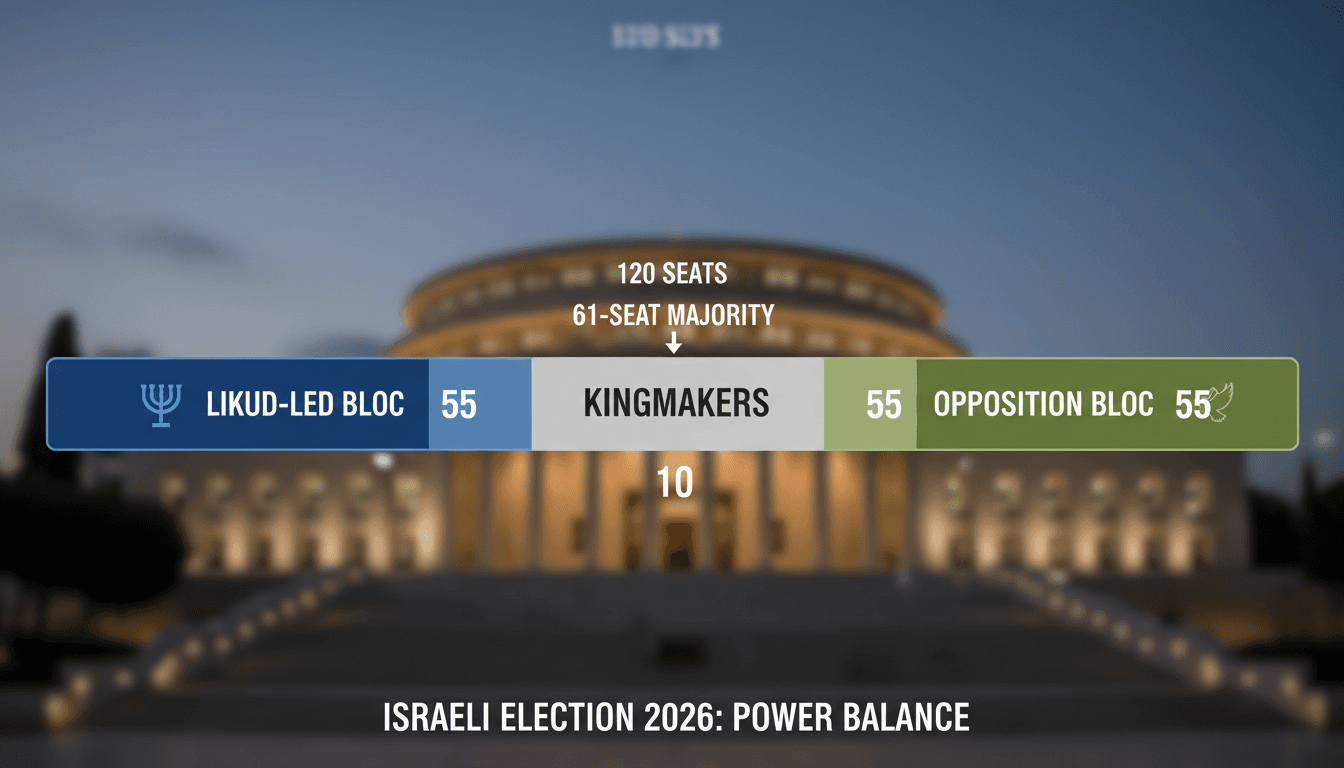
A fractured 120-seat legislature prevents either major bloc from securing an immediate working majority, stalling clear diplomatic outcomes and extending caretaker governance across critical regional files.
What happened (in 30 seconds)
- A deadlock at the ballot box: The national parliamentary election on October 27, 2026, closed with Prime Minister Benjamin Netanyahu’s Likud-led bloc and Gadi Eisenkot’s opposition bloc tied at approximately 50 to 52 seats each, falling short of the 61-seat threshold.
- Historic voter participation: Voter turnout reached 77.7%, marking the highest civic participation rate in over two decades as citizens evaluated wartime leadership.
- Interim governance continues: With no party reaching an outright mandate, Netanyahu remains in place as caretaker prime minister while multi-party negotiations begin across smaller factions and Arab lists.
The context you actually need
- First post-October 7 ballot: This election represents the first nationwide vote since the October 7, 2023 attacks, functioning as an assessment of leadership following prolonged conflict in Gaza, tension with Hezbollah, and friction with Iran.
- Competing security credentials: The race pitted Netanyahu’s emphasis on direct defense actions and coordination with international allies against Eisenkot’s alignment on security combined with calls for institutional reform.
- The mathematical ceiling: Israel’s proportional representation system requires a minimum coalition of 61 Knesset seats, forcing both major alliances to bargain with independent factions and non-aligned lists to resolve the arithmetic impasse.
What's really happening
The October 27, 2026 electoral outcome demonstrates the limits of security polarization when structural domestic disputes remain unresolved. While voter engagement surged to 77.7%, the distribution of seats highlights an institutional stalemate where neither camp commands sufficient legislative leverage to dictate policy independently.
The deadlock centers on fundamental governance trade-offs. The Likud-led alliance anchored its campaign on operational actions taken since late 2023, framing defense continuity and close alignment with Washington under the Trump administration as vital for counterbalancing Iran. However, the inability to capture more than 50 to 52 seats shows that security achievements alone could not offset voter friction surrounding broader administrative decisions. Domestic debates regarding military exemptions for the ultra-Orthodox community, earlier border defense postures, and diplomatic pressure curtailed the governing coalition's capacity to build a standalone majority.
Conversely, the opposition bloc organized around Gadi Eisenkot failed to translate broad administrative critiques into a decisive legislative sweep. By matching Netanyahu’s hawkish stance on national security while promoting moderate domestic reforms, Eisenkot sought to peel away traditional center-right voters. While this strategy captured roughly 50 to 52 seats, it hit an arithmetic ceiling.
Because both primary blocs fall roughly 9 to 11 seats short of the 61-seat threshold, power shifts entirely toward peripheral factions. Smaller sector-specific parties and Arab lists, which picked up seats due to high participation, now occupy the balance of power. Consequently, forming a durable cabinet will require severe policy compromises. Any administration cobbled together through fragmented coalitions faces internal instability, while the alternative—failure to reach an agreement—locks the system into an extended caretaker structure under Netanyahu, preventing definitive legislative overhauls.
Who feels it first (and how)
- Regional corporate strategists: Operators managing cross-border commercial links and Abraham Accords infrastructure experience delayed ministerial approvals and extended regulatory wait times during caretaker governance.
- Sovereign debt and macro analysts: Fixed-income specialists must navigate sovereign credit risk spreads that factor in prolonged domestic spending disputes and an unpassed fiscal budget.
- Domestic defense and security personnel: Military leadership faces sustained uncertainty regarding personnel policy and conscription exemptions while the Knesset remains split on defense legislation.
- Gulf trade intermediaries: Commercial enterprises based in hubs like Dubai see regional economic integration initiatives proceed on existing tracks without immediate expansion or official ministerial milestones.
What to watch next
- Coalition alignment deadlines: The formal negotiation period allocated to party leaders will determine whether third-party factions defect to provide a 61-seat working majority or trigger another election round.
- Arab list negotiation leverage: The tactical position taken by non-aligned Arab parties will indicate whether external parliamentary backing can be leveraged for legislative concessions.
- Financial market pricing: Movements in domestic bond yields and the shekel over the final certification window will signal investor tolerance for prolonged cabinet formation talks.
Neither major bloc secured the 61 Knesset seats required for a majority on October 27, 2026; voter turnout reached 77.7%; Benjamin Netanyahu continues as caretaker prime minister pending government formation.
Coalition negotiations will extend for several weeks as both Likud and the opposition attempt to recruit smaller domestic and sector-specific parties.
Whether any negotiated coalition can establish long-term legislative stability without collapsing into subsequent snap elections.
Frequently Asked Questions
- Why it matters?
- A fractured 120-seat legislature prevents either major bloc from securing an immediate working majority, stalling clear diplomatic outcomes and extending caretaker governance across critical regional files.
- What happened (in 30 seconds)?
- A deadlock at the ballot box: The national parliamentary election on October 27, 2026, closed with Prime Minister Benjamin Netanyahu’s Likud-led bloc and Gadi Eisenkot’s opposition bloc tied at approximately 50 to 52 seats each, falling short of the 61-seat threshold. Historic voter participation: Voter turnout reached 77.7%, marking the highest civic participation rate in over two decades as citizens evaluated wartime leadership. Interim governance continues: With no party reaching an outright
- What's really happening?
- The October 27, 2026 electoral outcome demonstrates the limits of security polarization when structural domestic disputes remain unresolved. While voter engagement surged to 77.7%, the distribution of seats highlights an institutional stalemate where neither camp commands sufficient legislative leverage to dictate policy independently. The deadlock centers on fundamental governance trade-offs. The Likud-led alliance anchored its campaign on operational actions taken since late 2023, framing def
- Who feels it first (and how)?
- Regional corporate strategists: Operators managing cross-border commercial links and Abraham Accords infrastructure experience delayed ministerial approvals and extended regulatory wait times during caretaker governance. Sovereign debt and macro analysts: Fixed-income specialists must navigate sovereign credit risk spreads that factor in prolonged domestic spending disputes and an unpassed fiscal budget. Domestic defense and security personnel: Military leadership faces sustained uncertainty reg
- What to watch next?
- Coalition alignment deadlines: The formal negotiation period allocated to party leaders will determine whether third-party factions defect to provide a 61-seat working majority or trigger another election round. Arab list negotiation leverage: The tactical position taken by non-aligned Arab parties will indicate whether external parliamentary backing can be leveraged for legislative concessions. Financial market pricing: Movements in domestic bond yields and the shekel over the final certificati
Editorials, commentary, and opinion pieces on political, economic, and global issues.
"The Wall Street Journal's opinion section is known for its conservative-leaning editorial stance, offering perspectives on major political and economic developments."
— A47 Editor
Israel Votes, Weighing the Leadership of Benjamin Netanyahu
Israelis went to the polls in their first national election since the Oct. 7, 2023 attacks, a vote widely framed as a referendum on Prime Minister Benjamin Netanyahu and his Likud party. Challenger Gadi Eisenkot has positioned himself as equally toug...
Editor-curated FT homepage stories spanning markets, business, world, and opinion.
"The Financial Times is a globally respected business publication with a centrist/center-left tone and strong markets focus."
— A47 Editor
Israel election turnout highest in decades
Israel's election has drawn its highest turnout in decades, the first national vote since the October 7, 2023 Hamas-led attack, pitting Prime Minister Benjamin Netanyahu's far-right coalition against an opposition bloc in a knife-edge contest, accord...
Coverage of current events and conflicts in the Middle East.
"France 24 is viewed as a globally focused outlet with balanced coverage and a European perspective."
— A47 Editor
Israel elections: voter turnout reaches 55% by 4pm local time
Israelis went to the polls on Tuesday, October 27, in turnout unseen in decades, with about 55% of voters having cast ballots by 4pm local time. The first national election since the October 7, 2023 Hamas attack is widely seen as a referendum on vete...
European coverage of Middle East politics and security issues.
"France 24 offers international reporting with a European editorial perspective."
— A47 Editor
Israel elections: voter turnout reaches 55% by 4pm local time
Israelis went to the polls on Tuesday, October 27, in turnout unseen in decades, with about 55% of voters having cast ballots by 4pm local time. The first national election since the October 7, 2023 Hamas attack is widely seen as a referendum on vete...
24/7 international news from a French perspective in multiple languages.
"France 24 is viewed as a globally focused outlet with balanced coverage and a European perspective."
— A47 Editor
Turnout high as Israeli voters deliver verdict on Netanyahu
Israelis turned out in unusually high numbers on Tuesday, October 27, in the first national election since Hamas's October 7, 2023 attack, delivering a deeply divided verdict on Prime Minister Benjamin Netanyahu's leadership. Turnout had reached 16.7...
European coverage of Middle East politics and security issues.
"France 24 offers international reporting with a European editorial perspective."
— A47 Editor
Turnout high as Israeli voters deliver verdict on Netanyahu
Israelis turned out in unusually high numbers on Tuesday, October 27, in the first national election since Hamas's October 7, 2023 attack, delivering a deeply divided verdict on Prime Minister Benjamin Netanyahu's leadership. Turnout had reached 16.7...
Focused political reporting and governmental affairs.
"NBC News is a mainstream media outlet known for comprehensive national and international news coverage with a centrist to slightly left-leaning editorial tone."
— A47 Editor
Voting Underway in Israel as Netanyahu Faces Battle for Survival
Israelis began voting Tuesday in their first nationwide election since the Oct. 7, 2023 attacks, a contest widely viewed as a referendum on Prime Minister Benjamin Netanyahu and his Likud party, according to NBC News reporting from Tel Aviv by Richar...
News from the United States including domestic politics, society, and culture.
"The Guardian is known for its progressive editorial stance and in-depth analysis, often advocating for social justice, environmental issues, and liberal values."
— A47 Editor
These four elections could change the world in 10 days – Stateside with Kai and Carter
Israelis are voting on Tuesday, October 27, in their first national election since the Oct. 7, 2023 attacks, a contest widely seen as a referendum on Prime Minister Benjamin Netanyahu and his Likud party. The vote arrives as Netanyahu faces a battle ...
News and current affairs from across Europe.
"The Guardian is known for its progressive editorial stance and in-depth analysis."
— A47 Editor
These four elections could change the world in 10 days – Stateside with Kai and Carter
Israelis are voting on Tuesday, October 27, in their first national election since the Oct. 7, 2023 attacks, a contest widely seen as a referendum on Prime Minister Benjamin Netanyahu and his Likud party. The vote arrives as Netanyahu faces a battle ...
Global news coverage with extensive reporting on Middle Eastern conflicts and geopolitics.
"Al Jazeera is a Qatar-based broadcaster known for wide regional coverage and alternative perspectives."
— A47 Editor
Israelis begin voting as Netanyahu fights for political survival
Israelis went to the polls on October 27, 2026, in the first national election since the October 7, 2023 Hamas attacks, as Prime Minister Benjamin Netanyahu fights for political survival against challenger Gadi Eisenkot amid divisions over the wars i...
Comprehensive coverage of Middle Eastern and global issues.
"Al Jazeera is a prominent voice from the Global South, especially the Middle East, with an emphasis on underreported stories."
— A47 Editor
Israelis begin voting as Netanyahu fights for political survival
Israelis went to the polls in a general election widely seen as a referendum on Prime Minister Benjamin Netanyahu, the first national vote since the October 7, 2023 Hamas attacks. Netanyahu faces a fight for political survival after three years of wa...
European coverage of Middle East politics and security issues.
"France 24 offers international reporting with a European editorial perspective."
— A47 Editor
Israelis vote in tense election seen as a referendum on Netanyahu
Israelis are voting on Tuesday in the first general election since the October 7, 2023 Hamas attack, with Prime Minister Benjamin Netanyahu facing a fight for political survival after three years of regional wars. He is running neck and neck with cen...
Coverage of current events and conflicts in the Middle East.
"France 24 is viewed as a globally focused outlet with balanced coverage and a European perspective."
— A47 Editor
Israelis vote in tense election seen as a referendum on Netanyahu
Israelis went to the polls on Tuesday, October 27, in the first national election since Hamas's October 7, 2023 attack, a vote widely seen as a referendum on Prime Minister Benjamin Netanyahu's political survival after three years of regional wars; N...
European coverage of Middle East politics and security issues.
"France 24 offers international reporting with a European editorial perspective."
— A47 Editor
Israel braces for national elections seen as a referendum on Netanyahu
Israelis are preparing to vote on October 27 in the first national elections since the October 7, 2023 Hamas attacks, a contest widely seen as a referendum on Prime Minister Benjamin Netanyahu's leadership. Expatriate citizens, who cannot vote from a...
24/7 international news from a French perspective in multiple languages.
"France 24 is viewed as a globally focused outlet with balanced coverage and a European perspective."
— A47 Editor
Israel braces for national elections seen as a referendum on Netanyahu
Israelis are preparing to vote on October 27 in the first national elections since the October 7, 2023 Hamas attacks, a contest widely seen as a referendum on Prime Minister Benjamin Netanyahu's leadership. Expatriate citizens, who cannot vote from a...
Coverage of current events and conflicts in the Middle East.
"France 24 is viewed as a globally focused outlet with balanced coverage and a European perspective."
— A47 Editor
A look at the main issues in Israeli elections seen as a referendum on Netanyahu
Israelis head to the polls on October 27 in the first national elections since Hamas's October 7, 2023 attack, a vote widely seen as a referendum on Prime Minister Benjamin Netanyahu's leadership. Netanyahu has rejected International Criminal Court w...
European coverage of Middle East politics and security issues.
"France 24 offers international reporting with a European editorial perspective."
— A47 Editor
A look at the main issues in Israeli elections seen as a referendum on Netanyahu
Israelis head to the polls on October 27 in the first national elections since Hamas's October 7, 2023 attack, a vote widely seen as a referendum on Prime Minister Benjamin Netanyahu's leadership. Netanyahu has rejected International Criminal Court w...
Regional coverage and analysis focused on politics, diplomacy, and business across the Middle East.
"Al-Monitor is known for analytical reporting on Middle East politics and policy developments."
— A47 Editor
Netanyahu faces reckoning for October 7 in Israel's first vote since attack
Israeli voters head to the polls on Tuesday, October 27, 2026, in the country's first election since the Hamas attack of October 7, 2023, which killed around 1,200 people and saw 251 taken hostage, with Prime Minister Benjamin Netanyahu facing a reck...
National headlines across the United States including breaking stories and societal issues.
"NBC News is a mainstream media outlet known for comprehensive national and international news coverage with a centrist to slightly left-leaning editorial tone."
— A47 Editor
Israelis Set to Vote in First Election Since Oct. 7 Attacks
Israelis are set to vote in their first national election since the Oct. 7, 2023 attacks, deciding whether to keep Prime Minister Benjamin Netanyahu in office or replace him, according to NBC News reporting by Richard Engel. New polls show a tight ra...
Breaking news, politics, business, and entertainment from the U.S. and around the world.
"The New York Post is a tabloid-format newspaper known for its sensationalist headlines and conservative-leaning editorial tone."
— A47 Editor
Israelis set to decide whether Netanyahu still deserves to lead after Oct. 7 attacks
Israel's general elections, set for Tuesday, October 27, will determine whether Prime Minister Benjamin Netanyahu and his Likud Party remain in power, with polls showing a near tie between Likud and the opposition coalition as voters weigh whether he...
Regional coverage and analysis focused on politics, diplomacy, and business across the Middle East.
"Al-Monitor is known for analytical reporting on Middle East politics and policy developments."
— A47 Editor
Israel's Eisenkot vows unity as Netanyahu paints him as soft on Iran
Israeli election contender Gadi Eisenkot held his final major rally before the October 27, 2026 vote, pledging to unite the country, while Prime Minister Benjamin Netanyahu received fresh backing from US President Donald Trump. Eisenkot has pledged a...
Conservative-leaning political and national coverage.
"The Washington Times is a conservative-leaning newspaper known for its political coverage and advocacy of right-of-center viewpoints."
— A47 Editor
Israeli election could dramatically impact U.S. economy, military operations, analysts say
Voters in Israel head to the polls Tuesday to decide whether to keep Prime Minister Benjamin Netanyahu and his Likud party in power or back opposition leader Gadi Eisenkot and his Yashar party, a contest analysts say could reshape U.S. economic and m...
International stories from NPR’s global desk.
"NPR is an American public media organization known for thoughtful reporting and a slightly left-leaning editorial tone."
— A47 Editor
Israelis have changed. Will they change their leadership?
Israel is holding a general election this week, the first major national vote since the Oct. 7, 2023, Hamas attacks that killed about 1,200 people and triggered a prolonged war in Gaza. The base report, published by NPR, describes many Israelis as sh...