
Le Pen Poll Lead Triggers Accelerated Bidding for French Renewable Power Contracts
Why it matters
The compression of renewable power procurement in Europe's second-largest economy demonstrates how electoral timelines directly distort clean energy pricing, project pipelines, and capital allocation years before any formal legislative changes take effect.
What happened (in 30 seconds)
- Developers rushed state auctions: Energy firms including EDF and Reden Solar accelerated submissions for French state-backed power purchase agreements following October 2026 polling that showed Marine Le Pen leading the May 2027 presidential race.
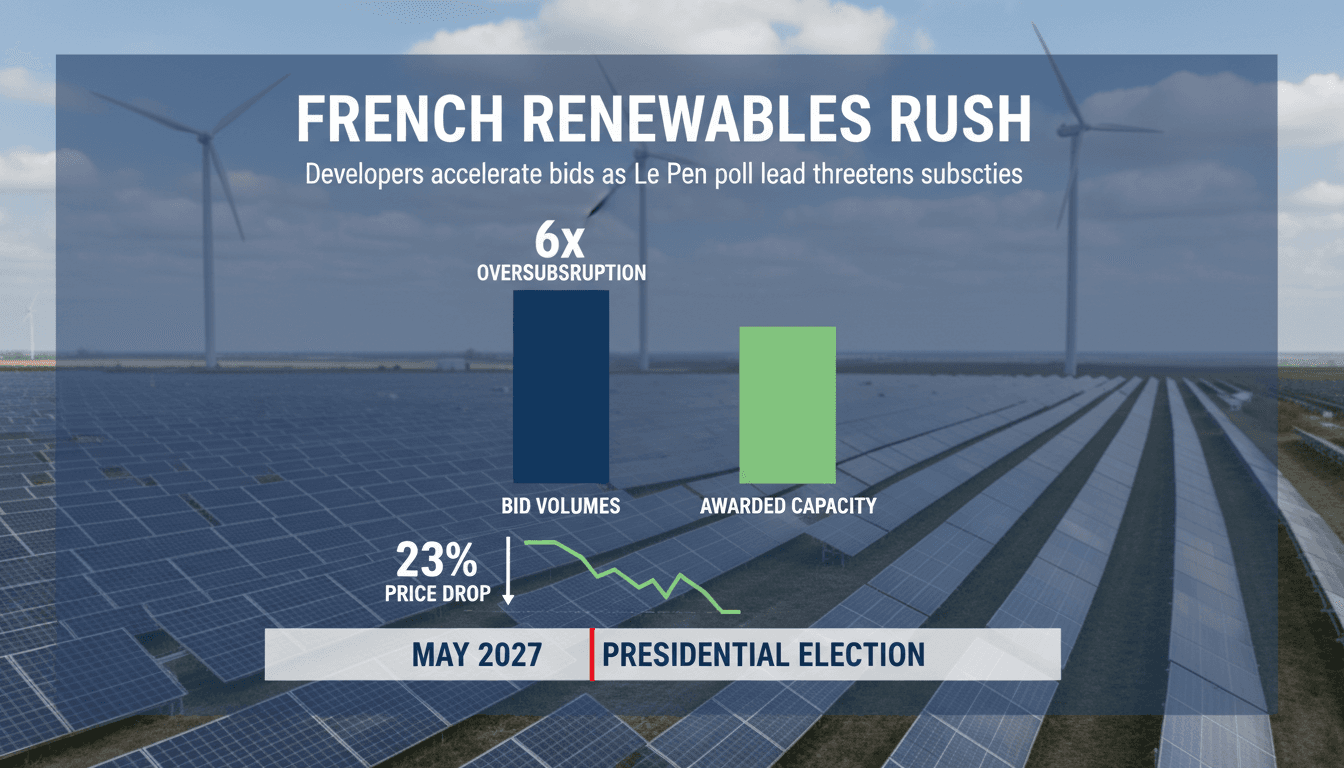
- Auction competition drove down prices: The latest large-scale solar tender received bids totaling nearly six times the available capacity, pushing winning tariff prices down by an average of 23% compared to previous auction rounds.
- Smaller solar projects mirrored the drop: A parallel procurement round for smaller-scale installations saw winning power contract prices decline 15% as developers prioritized revenue certainty over margin preservation.
The context you actually need
- The policy platform targets current subsidies: Le Pen’s platform proposes a freeze on new onshore wind and solar installations alongside reductions to state clean-energy subsidies, which totaled €6 billion last year.
- The alternate technology preference favors baseload: The National Rally framework shifts state support away from variable renewables toward nuclear power, existing hydroelectric facilities, and hydrogen development.
- Utility equity valuations absorbed early pressure: European utility shares experienced downward valuation pressure during October 2026 as financial markets priced in long-term revenue uncertainties for French renewable portfolios.
What's really happening
The sudden drop in French solar contract prices is not the result of technological cost breakthroughs. Instead, it is an economic response to regulatory risk. In project finance, developers require predictable long-term cash flows to secure low-cost debt. Under France's contract-for-difference regime, state-backed power purchase agreements guarantee fixed power tariffs for up to 20 years. When a leading presidential candidate pledges to halt new permits and trim a €6 billion annual subsidy budget, the value of securing a binding contract prior to May 2027 increases sharply.
Developers face an asymmetrical equation. Missing the current procurement cycle leaves greenfield portfolios exposed to potential permit freezes, legal moratoria, or canceled future tenders. Conversely, winning an award today locks in a sovereign counterparty for two decades, regardless of who governs from the Élysée Palace.
This dynamic created an oversubscribed solar tender where bids exceeded available volume by almost 600%. To secure capacity allocations, developers cut margins aggressively, driving clearing tariffs 23% lower for utility-scale developments and 15% lower for smaller installations. Firms like EDF and Reden Solar are accepting narrower operational margins in exchange for political insulation.
The broader consequence is a market bifurcation. Because current tenders are moving forward under existing European Union and French administrative rules, developers are exhausting their shovel-ready pipelines ahead of schedule. At the same time, companies are preparing contingency plans that pivot strategic capital away from French wind and solar.
Firms are rerouting long-term balance sheet capacity toward unregulated private power purchase agreements, co-located battery storage systems, and international cross-border markets where regulatory continuity is more stable. This dynamic pulls development activity forward into late 2026 and early 2027, setting up a sharp decline in domestic project initiations thereafter.
Who feels it first (and how)
- Infrastructure debt providers: Lenders face a compressed closing window through early 2027 as project sponsors demand fast financing to meet auction milestones, followed by lower interest margins due to depressed power purchase rates.
- European utility equity holders: Investors in French-exposed operators absorb near-term margin compression from hyper-competitive auction bids, alongside portfolio discount risks tied to future pipeline viability.
- Solar equipment supply chains: Engineering, procurement, and construction contractors experience an immediate surge in French panel orders and delivery contracts before 2027, followed by an uncertain domestic pipeline.
- Industrial power consumers in France: Corporate off-takers will see a brief surplus of cheap, state-backed green power supply come online, while long-term access to private merchant power purchase contracts tightens.
What to watch next
- French government tender volumes for early 2027: Track whether the energy ministry maintains, curtails, or expands scheduled auction volumes as political debate intensifies over the €6 billion annual subsidy cost.
- Capital reallocation filings from major utilities: Watch full-year 2026 earnings disclosures from operators like EDF and Engie for capital expenditure shifts toward battery storage or projects outside France.
- Grid interconnection backlogs: Monitor French transmission operator (RTE) connection queues to see if contracted capacity faces administrative bottlenecks prior to the May 2027 election date.
October 2026 solar tenders were oversubscribed by nearly 600%, clearing tariffs dropped by up to 23%, and French renewable subsidies totaled €6 billion annually.
French renewable project approvals and auctions will see declining developer participation by late 2027 if legislative policy pivots toward nuclear-only funding.
Whether legally executed 20-year power purchase contracts could face retroactive statutory revisions or windfall adjustments under a potential future administration.
Frequently Asked Questions
- Why it matters?
- The compression of renewable power procurement in Europe's second-largest economy demonstrates how electoral timelines directly distort clean energy pricing, project pipelines, and capital allocation years before any formal legislative changes take effect.
- What happened (in 30 seconds)?
- Developers rushed state auctions: Energy firms including EDF and Reden Solar accelerated submissions for French state-backed power purchase agreements following October 2026 polling that showed Marine Le Pen leading the May 2027 presidential race. Auction competition drove down prices: The latest large-scale solar tender received bids totaling nearly six times the available capacity, pushing winning tariff prices down by an average of 23% compared to previous auction rounds. Smaller solar projec
- What's really happening?
- The sudden drop in French solar contract prices is not the result of technological cost breakthroughs. Instead, it is an economic response to regulatory risk. In project finance, developers require predictable long-term cash flows to secure low-cost debt. Under France's contract-for-difference regime, state-backed power purchase agreements guarantee fixed power tariffs for up to 20 years. When a leading presidential candidate pledges to halt new permits and trim a €6 billion annual subsidy budge
- Who feels it first (and how)?
- Infrastructure debt providers: Lenders face a compressed closing window through early 2027 as project sponsors demand fast financing to meet auction milestones, followed by lower interest margins due to depressed power purchase rates. European utility equity holders: Investors in French-exposed operators absorb near-term margin compression from hyper-competitive auction bids, alongside portfolio discount risks tied to future pipeline viability. Solar equipment supply chains: Engineering, procure
- What to watch next?
- French government tender volumes for early 2027: Track whether the energy ministry maintains, curtails, or expands scheduled auction volumes as political debate intensifies over the €6 billion annual subsidy cost. Capital reallocation filings from major utilities: Watch full-year 2026 earnings disclosures from operators like EDF and Engie for capital expenditure shifts toward battery storage or projects outside France. Grid interconnection backlogs: Monitor French transmission operator (RTE) con
Global markets, investing, and macroeconomics from a premier financial newsroom.
"Bloomberg is respected for in-depth financial reporting and data-driven analysis."
— A47 Editor
Le Pen’s Rise Spurs Rush for French Renewable Contracts
French renewable developers are rushing to lock in state-backed contracts ahead of next year's presidential election, according to Bloomberg, amid fears that a Marine Le Pen government could halt new renewable projects.
Comprehensive coverage of Middle Eastern and global issues.
"Al Jazeera is a prominent voice from the Global South, especially the Middle East, with an emphasis on underreported stories."
— A47 Editor
Marine Le Pen vows French ‘renaissance’ as far right eyes seat of power
Marine Le Pen, leader of France's far-right National Rally, launched her presidential campaign at a party congress in Orléans, framing her bid as a "renaissance" for France, as the event unfolded amid protests and social and economic discontent over ...
Global news coverage with extensive reporting on Middle Eastern conflicts and geopolitics.
"Al Jazeera is a Qatar-based broadcaster known for wide regional coverage and alternative perspectives."
— A47 Editor
Marine Le Pen launches French presidential campaign
Marine Le Pen, leader of France's far-right National Rally, officially launched her presidential campaign at a party congress in Orléans on Sunday, 25 October, before around 10,000 supporters, framing her bid as a "renaissance" for France. The launch...
Comprehensive coverage of Middle Eastern and global issues.
"Al Jazeera is a prominent voice from the Global South, especially the Middle East, with an emphasis on underreported stories."
— A47 Editor
Marine Le Pen launches French presidential campaign
Marine Le Pen, leader of France's far-right National Rally, officially launched her presidential campaign at a party congress in Orléans on Sunday, 25 October, before around 10,000 supporters, framing her bid as a "renaissance" for France. The launch...
Global political, business, and cultural coverage from WSJ international desks.
"The Wall Street Journal offers extensive international reporting with a reputation for financial insight and a center-right editorial stance."
— A47 Editor
Le Pen Pitches Herself as France’s Unifier After Another Weekend of Protests
Marine Le Pen, leader of France's far-right National Rally, positioned herself as a unifying figure after another weekend of nationwide protests and violent unrest, launching her presidential campaign at a party congress in Orléans; the Wall Street J...
Right-of-center views on political news.
"The Washington Times is a conservative-leaning newspaper known for its political coverage and advocacy of right-of-center viewpoints."
— A47 Editor
Le Pen vows to revive oil prospecting in France, calling 2017 ban 'stupid'
Far-right presidential candidate Marine Le Pen vowed on Sunday to allow France to resume oil prospecting on its territory if she wins the May election, describing the 2017 ban as "stupid" and drawing comparisons to Donald Trump's "drill, baby, drill"...
Editor-curated FT homepage stories spanning markets, business, world, and opinion.
"The Financial Times is a globally respected business publication with a centrist/center-left tone and strong markets focus."
— A47 Editor
France’s Le Pen vows national ‘renewal’ in campaign launch
Marine Le Pen launched her campaign for France's upcoming presidential election, casting herself as the only candidate able to restore order and unity and promising national 'renewal'. The base report, published by the Financial Times, presents the l...