
Israeli Opposition Leaders Open Coalition Talks After Inconclusive 53-48 Election Result
Why it matters
The arithmetic of a hung parliament stalls regulatory overhauls and budget allocations, directly shaping how international capital evaluates stability across broader Middle Eastern commercial corridors.
What happened (in 30 seconds)
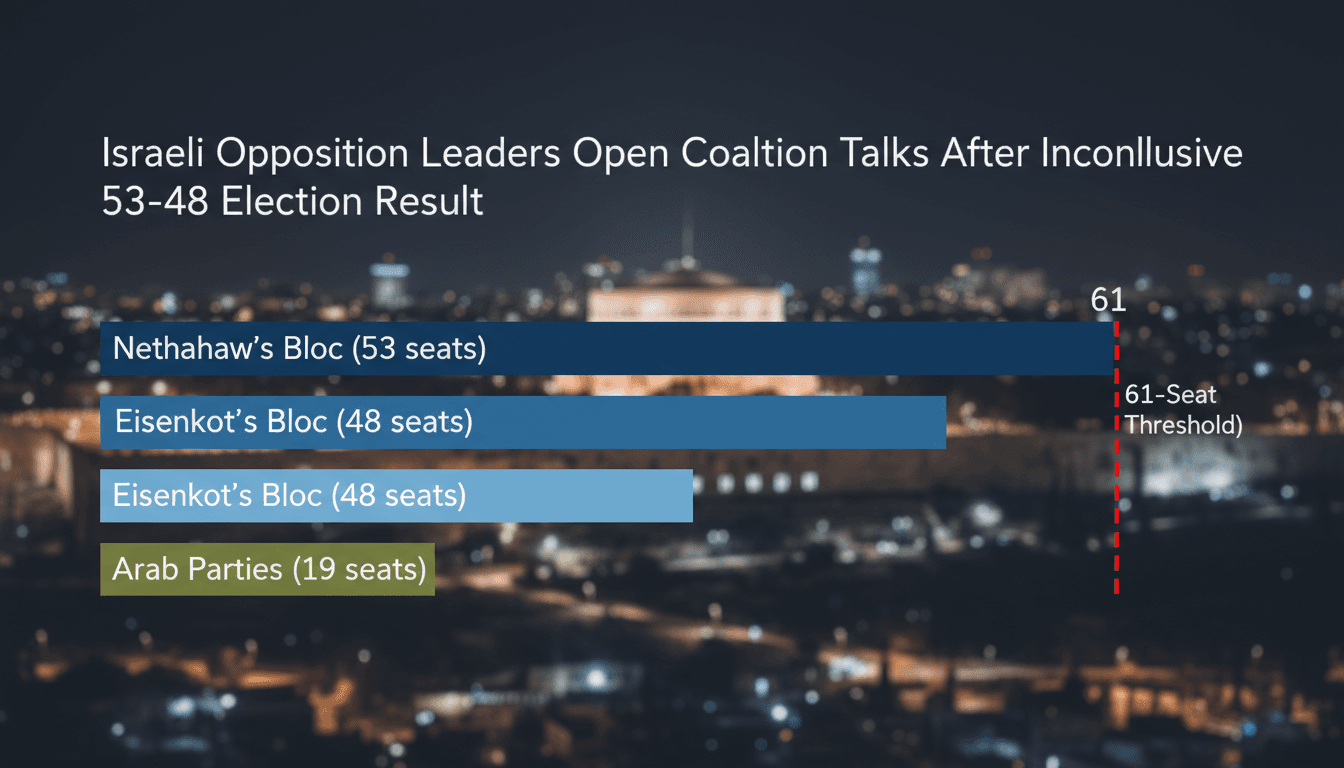
- A split parliament emerged: Final vote tallies on October 29–30, 2026, confirmed Benjamin Netanyahu’s right-wing bloc secured 53 seats, while Gadi Eisenkot’s opposition bloc gained 48 seats in the 120-seat Knesset.
- The majority threshold remained out of reach: With neither camp securing the 61 seats required to govern, Arab parties captured a pivotal 19 seats, establishing a numerical barrier to unilateral coalition building.
- Opposition leadership opened negotiations: On October 30, 2026, Yair Golan of the Democrats convened exploratory talks with Gadi Eisenkot, Yair Lapid, and Mansour Abbas of Ra'am to assess options for a unified anti-Netanyahu governing platform.
The context you actually need
- The 61-seat threshold dictates leverage: In Israel’s proportional electoral system, executive authority requires a minimum of 61 Knesset seats, leaving both primary blocs reliant on fragmented factions to build a working government.
- Arab parties hold the balance of power: Capturing 19 seats gives Arab factions collective veto power over legislative math, though internal resistance within portions of the opposition presents structural friction to formal pacts.
- Presidential consultations structure the calendar: President Isaac Herzog must consult with all elected party leaders before granting an official mandate to an individual candidate to attempt formal coalition formation.
What's really happening
The mechanics behind the October 30 meetings are driven by structural incentives rather than ideological alignment. Under Israeli electoral rules, the failure to secure 61 seats triggers an intensive game of leverage. The baseline numbers—53 for Netanyahu’s right-wing bloc, 48 for Eisenkot’s opposition bloc, and 19 for Arab parties—mean that neither conventional camp can govern autonomously.
For Gadi Eisenkot and Yair Lapid, engaging Mansour Abbas of Ra'am represents a tactical necessity to expand their working base beyond 48 seats. Yet the arithmetic creates an operational dilemma: incorporating Arab factions requires concessions that risk alienating more conservative elements within the broader opposition, potentially fracturing their fragile alignment before a formal governing agreement is signed. Yair Golan’s role as an intermediary is aimed at bridging these platform gaps before official consultations with President Isaac Herzog conclude.
Simultaneously, Netanyahu’s camp faces clear incentive constraints. Holding 53 seats preserves public alignment with existing partners, but leaves the bloc eight votes short of an executive majority. To resolve this deficit, political pressure is being applied to the periphery—specifically via messaging targeting Arab parties regarding external financing. The objective is twofold: raise the political cost for opposition leaders attempting to formalize a partnership with Ra'am, while testing whether individual members of rival factions can be persuaded to defect.
From a capital and market standpoint, prolonged exploratory talks defer fiscal clarity. When parliamentary deadlocks occur, interim administrations operate under restricted budgetary constraints, freezing long-term infrastructure appropriations and state tenders. For global operators monitoring the eastern Mediterranean, this institutional pause shifts attention to the stability of statutory frameworks. If neither side can assemble 61 signatures, the legal default leads toward repeat elections, institutionalizing a period of caretaker governance that delays structural economic policy decisions.
Who feels it first (and how)
- Regional macro strategists and risk desks: Managing portfolio exposures requires pricing the potential for protracted legislative drift and recurring election cycles.
- Cross-border infrastructure developers: Statutory freezes on national tenders and long-term capital outlays halt public-private partnership timelines.
- Gulf-based commercial operators: While direct trade flows to hubs like Dubai show negligible immediate friction, regional venture funding and institutional investment models depend on sustained policy predictability.
- Domestic municipal administrators: Relying on discretionary national appropriations, regional bodies face budgetary restrictions until an official budget passes a 61-seat vote.
What to watch next
- President Herzog’s mandate designation: Identifying which bloc leader receives the initial 28-day window to assemble a cabinet will establish who dictates terms in bilateral policy talks.
- Internal opposition voting thresholds: Tracking whether center-right members of Eisenkot’s 48-seat bloc publicly reject a formal agreement with Ra'am will indicate if an alternative government is viable.
- Sovereign debt spreads and FX stability: Monitoring institutional responses in regional bond pricing will signal whether markets price in extended caretaker administration or impending snap elections.
Neither Netanyahu’s 53-seat bloc nor Eisenkot’s 48-seat opposition commands the 61 seats needed for a parliamentary majority, with Arab parties securing 19 seats.
Exploratory negotiations will extend through the full statutory allocation of presidential consultation days before any leader attempts to present a governing cabinet.
Whether the opposition can overcome policy differences to form an executive coalition with Arab factions, or whether unresolved gridlock will force a return to the polls.
Frequently Asked Questions
- Why it matters?
- The arithmetic of a hung parliament stalls regulatory overhauls and budget allocations, directly shaping how international capital evaluates stability across broader Middle Eastern commercial corridors.
- What happened (in 30 seconds)?
- A split parliament emerged: Final vote tallies on October 29–30, 2026, confirmed Benjamin Netanyahu’s right-wing bloc secured 53 seats, while Gadi Eisenkot’s opposition bloc gained 48 seats in the 120-seat Knesset. The majority threshold remained out of reach: With neither camp securing the 61 seats required to govern, Arab parties captured a pivotal 19 seats, establishing a numerical barrier to unilateral coalition building. Opposition leadership opened negotiations: On October 30, 2026, Yair G
- What's really happening?
- The mechanics behind the October 30 meetings are driven by structural incentives rather than ideological alignment. Under Israeli electoral rules, the failure to secure 61 seats triggers an intensive game of leverage. The baseline numbers—53 for Netanyahu’s right-wing bloc, 48 for Eisenkot’s opposition bloc, and 19 for Arab parties—mean that neither conventional camp can govern autonomously. For Gadi Eisenkot and Yair Lapid, engaging Mansour Abbas of Ra'am represents a tactical necessity to exp
- Who feels it first (and how)?
- Regional macro strategists and risk desks: Managing portfolio exposures requires pricing the potential for protracted legislative drift and recurring election cycles. Cross-border infrastructure developers: Statutory freezes on national tenders and long-term capital outlays halt public-private partnership timelines. Gulf-based commercial operators: While direct trade flows to hubs like Dubai show negligible immediate friction, regional venture funding and institutional investment models depend o
- What to watch next?
- President Herzog’s mandate designation: Identifying which bloc leader receives the initial 28-day window to assemble a cabinet will establish who dictates terms in bilateral policy talks. Internal opposition voting thresholds: Tracking whether center-right members of Eisenkot’s 48-seat bloc publicly reject a formal agreement with Ra'am will indicate if an alternative government is viable. Sovereign debt spreads and FX stability: Monitoring institutional responses in regional bond pricing will si
Arabic-language coverage of international news and geopolitics.
"RT Arabic is a Russian state-funded outlet often criticized for promoting Kremlin-aligned narratives."
— A47 Editor
"إسرائيل على المحك".. اجتماع لمنافسي نتنياهو لتشكيل ائتلاف حكومي
Israeli opposition politicians met following the parliamentary election to discuss available options for forming a governing coalition, as the results have left the Knesset without a clear majority for either Prime Minister Benjamin Netanyahu's bloc ...
Arabic-language coverage of political affairs and current events.
"Okaz political coverage typically follows mainstream Saudi framing on national and regional affairs."
— A47 Editor
19 مقعدًا للأحزاب العربية في انتخابات إسرائيل.. هل تتحد المعارضة لإسقاط نتنياهو؟
Israel has entered a new phase of political uncertainty after preliminary results of the parliamentary election, with about 91% of votes counted, showed Prime Minister Benjamin Netanyahu's bloc projected to win 53 seats against 48 for the opposition ...
Pan-Arab political news and analysis.
"Al-Quds Al-Arabi is a London-based Arabic newspaper known for political coverage."
— A47 Editor
انتخابات إسرائيل… نتنياهو 53 مقعدا والمعارضة 48 والعرب 19
Israel's election count, with 91 percent of votes sorted, shows Prime Minister Benjamin Netanyahu's bloc at 53 seats, the opposition Change bloc at 48, and the Arab parties at 19, leaving no side with a majority to form a government. Channel 12 repor...
Arabic-language reporting on global and regional news.
"BBC Arabic is part of the BBC, generally regarded for editorial standards and broad international coverage."
— A47 Editor
نتنياهو وآيزنكوت يواجهان طرقاً صعبة للوصول إلى السلطة في إسرائيل
Israel's political leaders, Prime Minister Benjamin Netanyahu and former army chief Gadi Eisenkot, face difficult routes to power as the country heads into a tightly contested general election, with neither main bloc appearing to hold enough seats to...
Arabic-language reporting on global and regional news.
"BBC Arabic is part of the BBC, generally regarded for editorial standards and broad international coverage."
— A47 Editor
الانتخابات الإسرائيلية: ماذا لو لم يفز أي معسكر بأغلبية المقاعد؟
Israeli voters went to the polls in a tightly contested general election, with the bloc led by Prime Minister Benjamin Netanyahu facing off against an opposition bloc headed by former army chief Gadi Eisenkot. The base report, published by BBC Arabic...
Pan-Arab political news and analysis.
"Al-Quds Al-Arabi is a London-based Arabic newspaper known for political coverage."
— A47 Editor
انتخابات إسرائيل… المعارضة تدعو للتصويت لإنهاء حقبة نتنياهو
Israeli opposition leaders on Tuesday called on voters to turn out in large numbers in the Knesset parliamentary elections, with the aim of ending the era of Prime Minister Benjamin Netanyahu. Voting began at 7 a.m. Jerusalem time and runs until 10 p...