
DOJ Launches Criminal Grand Jury Probe into California Voter Rolls Over Alleged Noncitizen Registrations
Why it matters
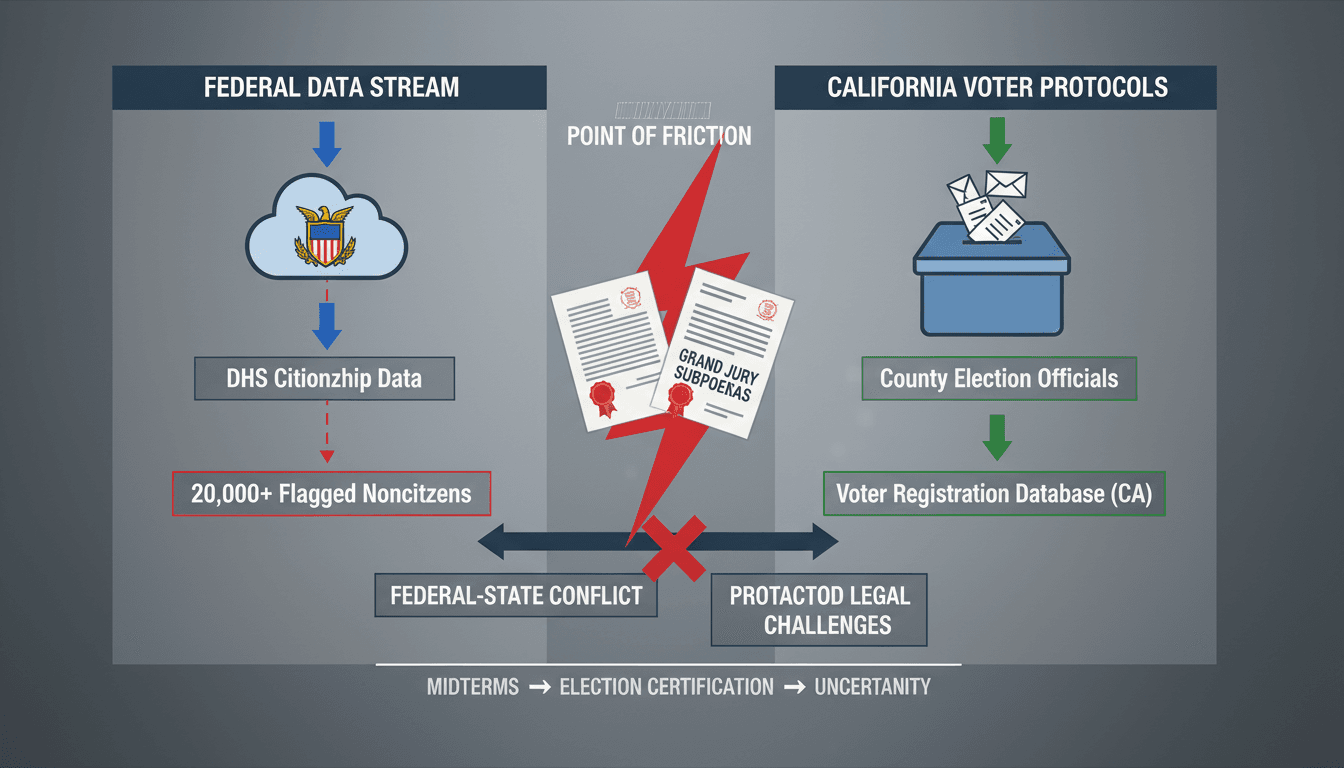
The expansion of federal criminal authority into state-managed administrative databases establishes an operational clash over statutory jurisdiction, public record integrity, and cross-agency data verification.
What happened (in 30 seconds)
- Federal subpoenas issued: On October 29, 2026, the U.S. Department of Justice escalated an inquiry into California voter rolls by serving grand jury subpoenas to local election officials in Los Angeles County and adjacent jurisdictions.
- Specific data target: The investigation centers on federal claims that over 20,000 individuals flagged as suspected noncitizens via Department of Homeland Security records remain on registration rolls and received mail-in ballots.
- Mandated testimony: The grand jury subpoenas demand appearance dates on November 4, 2026, compelling officials to produce registration workflows, screening protocols, and communications regarding citizenship checks.
The context you actually need
- Preceding civil actions: The criminal subpoenas follow earlier federal requests to segregate approximately 20,000 ballots and prior administrative demands seeking voter records dating back to 2020.
- Judicial intervention: U.S. District Judge David O. Carter previously denied federal requests to segregate the contested ballots, citing operational risks and potential disruptions to standard election procedures.
- Data reliability disputes: California election administrators, led by Secretary of State Shirley Weber, maintain that federal citizenship match lists rely on unverified screening criteria that conflict with established state registration laws.
What's really happening
The core structural mechanism driving this dispute is the technical misalignment between federal immigration databases and state-level voter registration systems. Under existing legal frameworks, state election offices manage voter rolls according to local and state statutes, relying on specific verification pathways such as motor vehicle records, signature verification, and voluntary attestations. The federal intervention, directed by U.S. Attorney Bill Essayli, bypasses routine administrative audits by introducing Department of Homeland Security datasets directly into a grand jury framework.
This move alters institutional incentives. For federal prosecutors, deploying Title 18 investigative powers—enforced by grand jury subpoenas—compels immediate administrative transparency and applies direct pressure on local registrars under threat of criminal non-compliance. For state and county administrators, complying with mid-election record demands presents operational liabilities: altering ballot verification rules or segregating registrations days before certification risks violating established statutory deadlines and local procedural codes.
The tension centers on the threshold of data accuracy. The Department of Justice’s claim relies on cross-referencing Department of Homeland Security records against county registration databases, identifying over 20,000 matches deemed questionable. Conversely, local officials argue that federal citizenship databases frequently lag behind naturalization timelines, meaning individuals legally registered may appear as noncitizens in outdated federal files. When administrative matching rates carry a margin of error, using those datasets to initiate criminal document demands forces municipal offices to divert operational bandwidth toward legal defense during active voting periods.
Because local governments have resisted demands to change ballot counting protocols, the conflict shifts from a debate over record maintenance into a contest over institutional authority. The federal government is testing whether executive agencies can establish jurisdiction over local election administration through the enforcement of federal citizenship verification statutes. If grand jury mechanisms can be used to subpoena local election workers regarding standard processing workflows, the administrative autonomy traditionally held by county registrars becomes subject to immediate federal oversight whenever cross-agency data discrepancies emerge.
Who feels it first (and how)
- County election administrators: Staff within the Los Angeles County Registrar-Recorder’s office and surrounding jurisdictions face immediate compliance burdens, legal costs, and mandatory appearances before a grand jury on November 4, 2026.
- Municipal legal counsels: City and county legal divisions must navigate conflicting directives between federal grand jury demands and state statutory frameworks governing record confidentiality and voter roll maintenance.
- State regulatory authorities: The California Secretary of State’s office must commit institutional resources toward defending established verification methodologies in federal court while managing certification timelines.
What to watch next
- November 4 grand jury appearances: Whether county officials provide requested documents or file motions to quash the subpoenas will determine if federal prosecutors initiate formal criminal contempt proceedings.
- Certification timeline impacts: Watch whether pending civil litigation affects statutory post-election canvassing deadlines across Los Angeles, Orange, and San Diego counties.
- Federal data disclosure: Any judicial ruling requiring the Department of Justice to reveal the precise matching criteria used by the Department of Homeland Security will clarify the actual error rate of the 20,000 flagged registrations.
Grand jury subpoenas have been served to California election officials requiring testimony and documentation on November 4, 2026, regarding over 20,000 registrations flagged by federal authorities.
Local election offices will maintain existing ballot counting and canvassing procedures absent a direct court order compelling procedural changes.
It remains undetermined whether the Department of Homeland Security data matches reflect verified noncitizen status or administrative lags in naturalization reporting.
Frequently Asked Questions
- Why it matters?
- The expansion of federal criminal authority into state-managed administrative databases establishes an operational clash over statutory jurisdiction, public record integrity, and cross-agency data verification.
- What happened (in 30 seconds)?
- Federal subpoenas issued: On October 29, 2026, the U.S. Department of Justice escalated an inquiry into California voter rolls by serving grand jury subpoenas to local election officials in Los Angeles County and adjacent jurisdictions. Specific data target: The investigation centers on federal claims that over 20,000 individuals flagged as suspected noncitizens via Department of Homeland Security records remain on registration rolls and received mail-in ballots. Mandated testimony: The grand ju
- What's really happening?
- The core structural mechanism driving this dispute is the technical misalignment between federal immigration databases and state-level voter registration systems. Under existing legal frameworks, state election offices manage voter rolls according to local and state statutes, relying on specific verification pathways such as motor vehicle records, signature verification, and voluntary attestations. The federal intervention, directed by U.S. Attorney Bill Essayli, bypasses routine administrative
- Who feels it first (and how)?
- County election administrators: Staff within the Los Angeles County Registrar-Recorder’s office and surrounding jurisdictions face immediate compliance burdens, legal costs, and mandatory appearances before a grand jury on November 4, 2026. Municipal legal counsels: City and county legal divisions must navigate conflicting directives between federal grand jury demands and state statutory frameworks governing record confidentiality and voter roll maintenance. State regulatory authorities: The Cal
- What to watch next?
- November 4 grand jury appearances: Whether county officials provide requested documents or file motions to quash the subpoenas will determine if federal prosecutors initiate formal criminal contempt proceedings. Certification timeline impacts: Watch whether pending civil litigation affects statutory post-election canvassing deadlines across Los Angeles, Orange, and San Diego counties. Federal data disclosure: Any judicial ruling requiring the Department of Justice to reveal the precise matching
Breaking news, politics, business, and entertainment from the U.S. and around the world.
"The New York Post is a tabloid-format newspaper known for its sensationalist headlines and conservative-leaning editorial tone."
— A47 Editor
Trump DOJ launches criminal probe into California voter rolls, subpoenas election officials
The Justice Department has launched a criminal investigation into California's voter rolls and served grand jury subpoenas on local election officials over more than 20,000 suspected noncitizens listed as registered voters. In related rulings, federa...
Conservative-leaning political and national coverage.
"The Washington Times is a conservative-leaning newspaper known for its political coverage and advocacy of right-of-center viewpoints."
— A47 Editor
Judge taps special master to evaluate DOJ's claims of noncitizens on California voter rolls
A federal judge appointed a special master on Thursday to evaluate Trump administration and Justice Department claims that roughly 20,000 noncitizens are on California's voter rolls, less than 24 hours after rejecting the department's demand that Cal...
U.S. political news and right-leaning commentary.
"Fox News is a highly influential conservative news outlet known for right-leaning political commentary and coverage."
— A47 Editor
Trump DOJ's fight over 20K suspected noncitizen voters takes sharp turn as California ballots pour in
A federal judge, David Carter, declined to order California to stop counting roughly 20,000 mail ballots from voters the Justice Department claims may be noncitizens, rejecting the department's demand to set those ballots aside while the broader case...
U.S. political news and right-leaning commentary.
"Fox News is a highly influential conservative news outlet known for right-leaning political commentary and coverage."
— A47 Editor
Judge rejects DOJ request to block California from immediately counting ballots linked to alleged noncitizens
A federal judge, David Carter, declined to order California to stop counting roughly 20,000 mail ballots from voters the Justice Department claims may be noncitizens, rejecting the department's demand to set those ballots aside while the broader case...
Comprehensive coverage of Middle Eastern and global issues.
"Al Jazeera is a prominent voice from the Global South, especially the Middle East, with an emphasis on underreported stories."
— A47 Editor
Judge rejects Trump effort to block California ‘noncitizen’ ballots
A federal judge declined to halt California from counting roughly 20,000 mail ballots that the Trump administration says belong to suspected noncitizen voters, rejecting a government effort to block the tabulation of those ballots. The Justice Depart...
Global news coverage with extensive reporting on Middle Eastern conflicts and geopolitics.
"Al Jazeera is a Qatar-based broadcaster known for wide regional coverage and alternative perspectives."
— A47 Editor
Judge rejects Trump effort to block California ‘noncitizen’ ballots
A federal judge declined to halt California from counting roughly 20,000 mail ballots that the Trump administration says belong to suspected noncitizen voters, rejecting a government effort to block the tabulation of those ballots. The Justice Depart...
News from the United States including domestic politics, society, and culture.
"The Guardian is known for its progressive editorial stance and in-depth analysis, often advocating for social justice, environmental issues, and liberal values."
— A47 Editor
Judge rebuffs Trump DoJ’s bid to force California to set aside 20,000 ballots
A federal judge, David Carter, declined to order California election officials to segregate and not count roughly 20,000 mail ballots from voters the Justice Department claims are non-citizens, rejecting a request made after the department delivered ...
International coverage from The Guardian's global desks.
"The Guardian is known for its progressive editorial stance and in-depth analysis."
— A47 Editor
Judge rebuffs Trump DoJ’s bid to force California to set aside 20,000 ballots
A federal judge, David Carter, declined to order California election officials to segregate and not count roughly 20,000 mail ballots from voters the Justice Department claims are non-citizens, rejecting a request made after the department delivered ...
Capitol Hill news, legislation, and policy insight.
"The Hill specializes in U.S. politics and policy, with a focus on Capitol Hill developments and a reputation for insider reporting."
— A47 Editor
DOJ's California ballot fight rejected by another judge
A federal judge, David Carter, ruled that California may continue accepting roughly 20,000 questioned mail ballots like any other, rejecting a Trump administration and Justice Department bid to set those ballots aside over claims that the voters may ...