
Israeli Election Produces No Governing Majority as Netanyahu and Eisenkot Blocs Fall Short of 61 Seats
Why it matters
The inability of either primary bloc to command a 61-seat parliamentary majority injects fresh asset volatility into regional markets while testing the durability of cross-border commercial pacts like the Abraham Accords.
What happened (in 30 seconds)
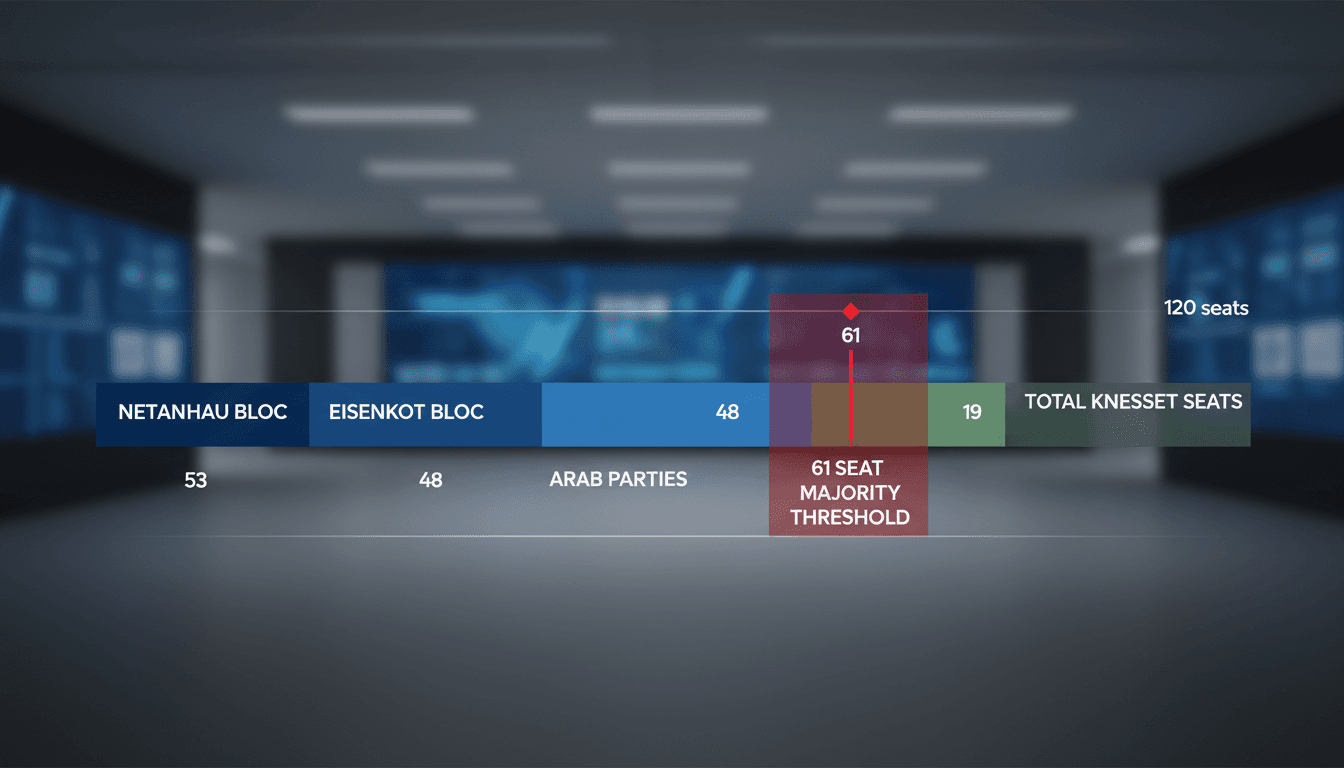
- Neither bloc secured a governing majority: In the October 27, 2026 election, Benjamin Netanyahu’s right-wing bloc secured 53 seats, while challenger Gadi Eisenkot’s opposition alliance captured 48 seats in the 120-seat Knesset.
- Arab parties reached record representation: Independent Arab parties won a collective 19 seats, establishing a pivotal mathematical leverage point despite explicit campaign pledges from both major camps refusing their direct inclusion.
- The formal formation clock has started: President Isaac Herzog is scheduled to open formal party consultations, preparing to grant an initial 28-day coalition mandate (with a potential 14-day extension) to break the stalemate.
The context you actually need
- A pattern of repeated legislative impasses: Israel entered this vote following multiple cycles of electoral friction driven by deep divisions over judicial reforms, military conscription exemptions for ultra-Orthodox communities, and broader security challenges.
- The mathematical threshold remains non-negotiable: Reaching the mandatory 61-seat threshold requires cross-bloc alliances, significant political defections, or structured rotation agreements between rivals who ran on mutually exclusive platforms.
- Caretaker governance preserves the operational baseline: Benjamin Netanyahu remains interim prime minister during consultations, retaining administrative authority while international partners assess potential policy continuity.
What's really happening
- An expanded national unity government: Incorporating centrist elements from the opposition into a broader administration would easily cross the 61-seat line. However, this structure demands substantial policy compromises on judicial framework disputes and military conscription rules.
- A prime ministerial rotation framework: Similar to past arrangements, Netanyahu and Eisenkot could structure an alternating tenure. This mechanism resolves the immediate leadership question but hinges entirely on mutual legal and institutional guarantees that both factions historically distrust.
- Targeted factional defections: Securing individual party departures—such as peeling away Avigdor Lieberman’s Israel Beiteinu, Naftali Bennett’s Together, or Yair Golan’s Democrats—could yield the requisite eight seats for Netanyahu. Yet the ideological concessions required to attract these figures risk alienating his existing religious and right-wing partners.
- A minority government backed by external support: Eisenkot mathematically requires the passive or active votes of the 19 Arab party lawmakers. Because mainstream campaigns across both major camps made explicit commitments against formal partnerships with Arab parties, this route entails high political vulnerability and domestic pushback.
Who feels it first (and how)
- Regional corporate leaders and trade desks: Executives managing commercial ties between Tel Aviv and Gulf hubs face operational delays in newly negotiated bilateral trade and investment expansions until regulatory leadership stabilizes.
- Public markets and currency traders: Foreign exchange desks and sovereign debt investors experience short-term volatility in Israeli assets as markets price in the duration of negotiations and the risk of repeat elections.
- Security and administrative planners: Defense and civil service leaders must navigate interim statutory budgets and delayed long-term capital appropriations during the caretaker period.
What to watch next
- The initial presidential mandate allocation: Watch which leader President Herzog formally tasks first following faction consultations, as this establishes the primary timeline and leverage baseline for the initial 28-day negotiating window.
- Shifts in red lines from centrist faction heads: Monitor public messaging from key figures like Naftali Bennett and Avigdor Lieberman, which will signal whether cross-bloc defections or a unity formula are structurally viable.
- Arab parliamentary bloc coordination: Track whether the 19 Arab lawmakers vote as a unified front during procedural motions or signal outside support to block an automatic dissolution.
Netanyahu holds 53 seats, Eisenkot holds 48 seats, and Arab parties hold 19 seats; no single bloc commands the 61-seat threshold required to govern without external support.
Initial rounds of negotiations will run the full 28-day mandate duration, with financial markets registering ongoing pricing friction until a concrete governing framework emerges.
Whether major party leaders will accept a rotation compromise or opt to trigger another round of national elections within 21 days of procedural failure.
Frequently Asked Questions
- Why it matters?
- The inability of either primary bloc to command a 61-seat parliamentary majority injects fresh asset volatility into regional markets while testing the durability of cross-border commercial pacts like the Abraham Accords.
- What happened (in 30 seconds)?
- Neither bloc secured a governing majority: In the October 27, 2026 election, Benjamin Netanyahu’s right-wing bloc secured 53 seats, while challenger Gadi Eisenkot’s opposition alliance captured 48 seats in the 120-seat Knesset. Arab parties reached record representation: Independent Arab parties won a collective 19 seats, establishing a pivotal mathematical leverage point despite explicit campaign pledges from both major camps refusing their direct inclusion. The formal formation clock has start
- What's really happening?
- The mechanics of Israel's 120-seat Knesset mean that government formation is fundamentally an incentive problem governed by rigid arithmetic. With Benjamin Netanyahu’s bloc commanding 53 seats and Gadi Eisenkot’s bloc holding 48 seats, neither side possesses an organic path to the 61-seat threshold without compromising core campaign commitments. The immediate dynamic centers on President Isaac Herzog’s mandate process. The party leader who receives the initial mandate obtains 28 days to negoti
- Who feels it first (and how)?
- Regional corporate leaders and trade desks: Executives managing commercial ties between Tel Aviv and Gulf hubs face operational delays in newly negotiated bilateral trade and investment expansions until regulatory leadership stabilizes. Public markets and currency traders: Foreign exchange desks and sovereign debt investors experience short-term volatility in Israeli assets as markets price in the duration of negotiations and the risk of repeat elections. Security and administrative planners: De
- What to watch next?
- The initial presidential mandate allocation: Watch which leader President Herzog formally tasks first following faction consultations, as this establishes the primary timeline and leverage baseline for the initial 28-day negotiating window. Shifts in red lines from centrist faction heads: Monitor public messaging from key figures like Naftali Bennett and Avigdor Lieberman, which will signal whether cross-bloc defections or a unity formula are structurally viable. Arab parliamentary bloc coordina
Arabic political reporting and analysis.
"Arabic Post is a digital outlet focused on politics and regional affairs."
— A47 Editor
سيناريوهات الحكومة الإسرائيلية المقبلة.. بين حكومة وحدة موسعة وانتخابات مبكرة وخيار التناوب
Israel's elections have left the political landscape in a complex position, as the two main blocs failed to secure the parliamentary majority needed to form a government. The Arab parties won an unprecedented 19 of the 120 Knesset seats, giving them ...
Arabic-language coverage of international news and geopolitics.
"RT Arabic is a Russian state-funded outlet often criticized for promoting Kremlin-aligned narratives."
— A47 Editor
انتخابات إسرائيل تفرز برلمانا معلقا
Israel's parliamentary election, held amid an ongoing war, has produced a hung Knesset in which neither Prime Minister Benjamin Netanyahu's bloc nor the Zionist opposition holds a majority capable of forming a government, according to RT Arabic repor...
Arabic-language coverage of political affairs and current events.
"Okaz political coverage typically follows mainstream Saudi framing on national and regional affairs."
— A47 Editor
بعد فرز 94% من الأصوات.. الكنيست الإسرائيلي بلا أغلبية لتشكيل الحكومة
Israel has entered a new phase of political uncertainty after Knesset elections failed to give either rival bloc a parliamentary majority. With 94% of votes counted and results unchanged, Netanyahu's bloc led with 53 seats in the 91% count, against 4...
Arabic-language coverage of political affairs and current events.
"Okaz political coverage typically follows mainstream Saudi framing on national and regional affairs."
— A47 Editor
الليكود يتهم الأحزاب العربية بـ«سرقة» الانتخابات والخلافات تتصعد.. من يشكل حكومة إسرائيل؟
Israel's parliamentary election has entered a decisive phase amid mutual accusations and a fierce struggle over forming the next government. Likud, led by Prime Minister Benjamin Netanyahu, accused Arab parties of "stealing" the election, alleging co...
Arabic-language coverage of political affairs and current events.
"Okaz political coverage typically follows mainstream Saudi framing on national and regional affairs."
— A47 Editor
تقارب النتائج يضع إسرائيل أمام مأزق سياسي
Israel's Knesset election produced no clear outcome, with preliminary counts after 84.5% of votes showing Netanyahu's bloc at 54 seats, the opposition led by Gadi Eisenkot at 49, and Arab-majority parties at 17 out of 120, leaving the 61-seat majorit...
Jordanian news and regional updates.
"Roya News is a Jordanian outlet focused on breaking news and local affairs."
— A47 Editor
إعلام عبري: مقاعد الأحزاب العربية ترتفع إلى 18 ومعسكر نتنياهو يتراجع إلى 54
Official preliminary results of the Israeli Knesset elections, as reported by Israeli media and cited by Roya News, show Arab parties' seats rising to 18 while Netanyahu's camp declines to 54.
Arabic-language reporting on global and regional news.
"BBC Arabic is part of the BBC, generally regarded for editorial standards and broad international coverage."
— A47 Editor
استطلاعات الرأي لا تحسم فائزاً واضحاً في الانتخابات العامة في إسرائيل والأحزاب العربية قد ترجّح الكفة
Polls ahead of Israel's general election show a very tight race between the camps led by Benjamin Netanyahu and Gadi Eisenkot, with neither side securing a parliamentary majority. Arab parties are recording significant gains amid record voter turnout...
Pan-Arab political news and analysis.
"Al-Quds Al-Arabi is a London-based Arabic newspaper known for political coverage."
— A47 Editor
استطلاعات الخروج في إسرائيل… تعادل معسكري نتنياهو والمعارضة والأحزاب العربية تحقق مكاسب لافتة- (صور وفيديو)
Exit polls released after Israel's parliamentary elections held on Tuesday showed a near tie between the bloc led by Prime Minister Benjamin Netanyahu and the opposition coalition led by former army chief of staff Gadi Eisenkot, with neither side rea...
Arabic-language coverage of political affairs and current events.
"Okaz political coverage typically follows mainstream Saudi framing on national and regional affairs."
— A47 Editor
حرب التقديرات تشعل انتخابات إسرائيل.. هل يطيح آيزنكوت بنتنياهو؟
Preliminary estimates of Israel's Knesset election results indicated that President Isaac Herzog could task Yesh Atid-linked party leader Gadi Eisenkot with forming the next government, as the camp of Prime Minister Benjamin Netanyahu showed signs of...