
Algeria Approves First Overseas Military Deployment Since 1973 to Secure Energy Infrastructure in Niger
Why it matters
Algeria’s deployment beyond its borders for the first time in 53 years establishes a hard precedent: strategic energy conduits and exploration acreage in high-risk jurisdictions will now be physically underwritten by sovereign armed forces.
What happened (in 30 seconds)
- Deployment greenlit: On October 26, 2026, Algerian President Abdelmadjid Tebboune formalized the movement of army units into northern Niger following unanimous legislative approval in Algiers.
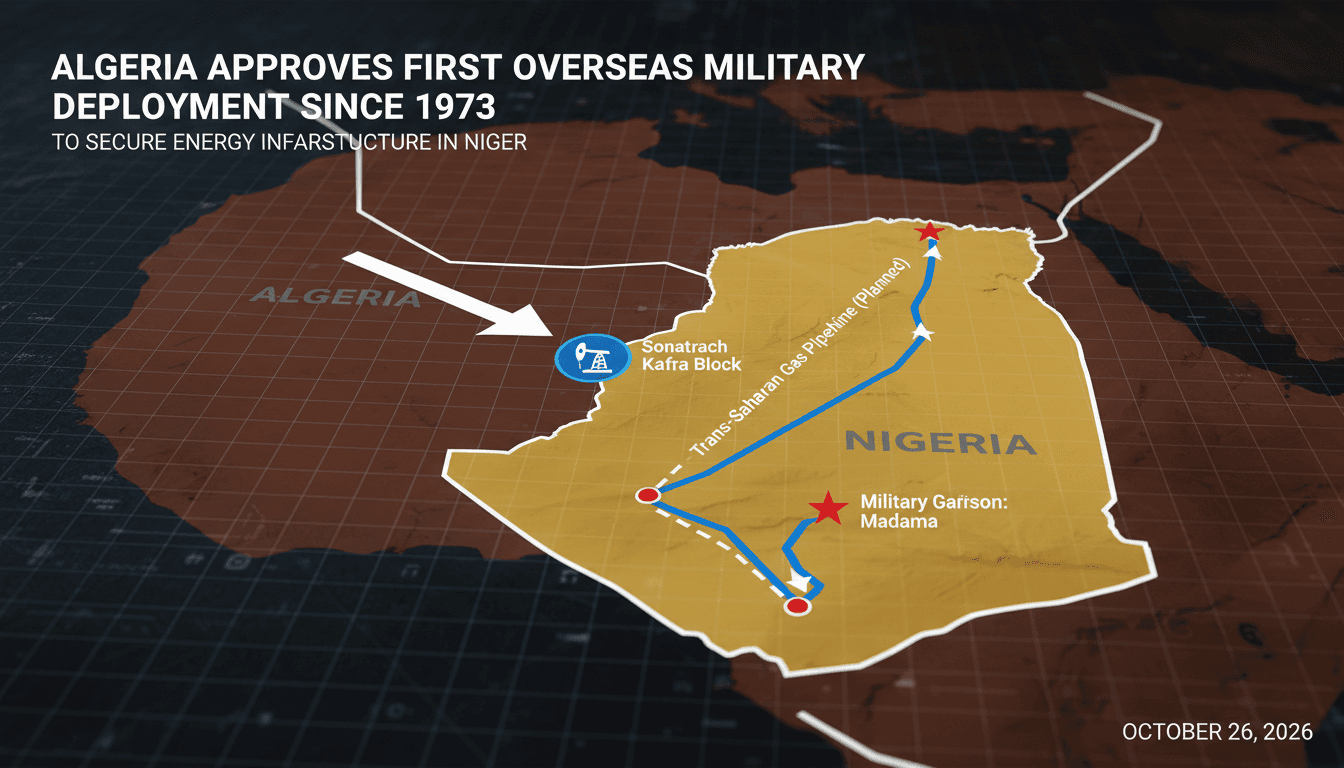
- Critical target: The mission stations People's National Army units at Madama, a former French base near the Libyan frontier, specifically to secure shared infrastructure and Sonatrach operations.
- Defensive perimeter: Officials have explicitly scoped the operation to the non-combat static defense of energy assets rather than offensive counter-insurgency warfare.
The context you actually need
- Historic precedent broken: This deployment marks Algeria’s first foreign troop positioning since the country backed Egypt during the 1973 Yom Kippur War, ending a 53-year operational doctrine of strict non-intervention abroad.
- Asset exposure: Algeria’s state-owned energy company, Sonatrach, holds exploration rights in Niger’s Kafra perimeter, where one exploration well alone holds 168 million barrels of proven oil reserves.
- Strategic transit architecture: The security umbrella directly shelters the corridor for the Trans-Saharan Gas Pipeline, a long-term capital asset designed to transport Nigerian natural gas across Niger and Algeria into European import hubs.
What's really happening
The mechanics behind Algiers’ decision do not stem from sudden adventurism, but from an objective capital-preservation equation. For half a century, Algeria operated under an institutional posture that forbade foreign deployments. However, security conditions in the Sahel following Niger’s 2023 coup altered that calculus. The operational reality on the ground—characterized by activity from regional insurgent factions affiliated with al-Qaeda and ISIS—created an acute physical risk to multi-billion-dollar transit corridors and extraction assets.
The immediate commercial lever is the Kafra concession. With 168 million barrels of proven crude identified in a single exploration well, Sonatrach faces significant balance-sheet exposure if field operations stall due to regional instability. Furthermore, the Trans-Saharan Gas Pipeline represents a structural pillar of North African energy exports. Designed to route volumes from Nigeria across Niger to the Algerian Mediterranean coast, the infrastructure requires absolute physical continuity to remain commercially viable for debt financiers, state off-takers, and downstream buyers.
By deploying forces to Madama near the Libyan border, Algeria is addressing a security gap left in northern Niger. Rather than pursuing kinetic territorial control, the Algerian armed forces are establishing an asset-protection perimeter around pipeline rights-of-way and active exploration fields.
This move also signals a pragmatic reset between Algiers and Niamey. Following a period of strain that included the 2025 recall of Niger’s ambassador, bilateral incentives have realigned around industrial and fiscal stability. Niger requires operating continuity and royalty streams from its extraction blocks, while Algeria requires downstream security to guarantee its role as the dominant energy gateway between Sub-Saharan Africa and the European continent. By packaging the deployment as a formal response to an official Nigerien request, both administrations preserve sovereign balance while substituting commercial vulnerability with direct physical force.
Who feels it first (and how)
- Sahel energy operators: Upstream engineers, seismic teams, and logistics contractors operating across northern Niger receive immediate physical security enhancements around exploration acreage.
- European gas procurement desks: Planners managing multi-year import agreements gain incremental clarity on the long-term feasibility of the Trans-Saharan Gas Pipeline transit corridor.
- Regional transport and logistics networks: Commercial trucking, heavy plant transport, and supply lines moving along the Agadez–Madama corridor operate within a direct military security zone.
- Sovereign risk underwriters: Underwriters pricing political violence and terrorism risk in Niger’s Kafra basin must re-evaluate asset protection models given sovereign army presence.
What to watch next
- Physical mobilization dates: Monitor when the first units of the People’s National Army cross the border into Madama to verify the operational timeline.
- Sonatrach capital resumption: Watch for announcements regarding renewed drilling schedules or rig mobilizations in the Kafra exploration block.
- Pipeline route milestone announcements: Track whether ministerial committees from Algeria, Niger, and Nigeria publish construction timelines for the Trans-Saharan Gas Pipeline corridor.
Algeria’s parliament approved the deployment; President Tebboune confirmed the order on October 26, 2026; the target destination is Madama to protect energy infrastructure; Sonatrach holds 168 million barrels of proven reserves in Kafra.
The operational deployment will remain restricted to fixed installations, static perimeters, and pipeline routes to minimize direct engagement with local insurgent groups.
The exact troop headcount, specific deployment schedule, and total financial cost absorbed by Algiers remain undisclosed.
Frequently Asked Questions
- Why it matters?
- Algeria’s deployment beyond its borders for the first time in 53 years establishes a hard precedent: strategic energy conduits and exploration acreage in high-risk jurisdictions will now be physically underwritten by sovereign armed forces.
- What happened (in 30 seconds)?
- Deployment greenlit: On October 26, 2026, Algerian President Abdelmadjid Tebboune formalized the movement of army units into northern Niger following unanimous legislative approval in Algiers. Critical target: The mission stations People's National Army units at Madama, a former French base near the Libyan frontier, specifically to secure shared infrastructure and Sonatrach operations. Defensive perimeter: Officials have explicitly scoped the operation to the non-combat static defense of energy
- What's really happening?
- The mechanics behind Algiers’ decision do not stem from sudden adventurism, but from an objective capital-preservation equation. For half a century, Algeria operated under an institutional posture that forbade foreign deployments. However, security conditions in the Sahel following Niger’s 2023 coup altered that calculus. The operational reality on the ground—characterized by activity from regional insurgent factions affiliated with al-Qaeda and ISIS—created an acute physical risk to multi-billi
- Who feels it first (and how)?
- Sahel energy operators: Upstream engineers, seismic teams, and logistics contractors operating across northern Niger receive immediate physical security enhancements around exploration acreage. European gas procurement desks: Planners managing multi-year import agreements gain incremental clarity on the long-term feasibility of the Trans-Saharan Gas Pipeline transit corridor. Regional transport and logistics networks: Commercial trucking, heavy plant transport, and supply lines moving along the
- What to watch next?
- Physical mobilization dates: Monitor when the first units of the People’s National Army cross the border into Madama to verify the operational timeline. Sonatrach capital resumption: Watch for announcements regarding renewed drilling schedules or rig mobilizations in the Kafra exploration block. Pipeline route milestone announcements: Track whether ministerial committees from Algeria, Niger, and Nigeria publish construction timelines for the Trans-Saharan Gas Pipeline corridor.
News, politics, and cultural topics across the African continent.
"France 24 is viewed as a globally focused outlet with balanced coverage and a European perspective."
— A47 Editor
Algeria to deploy army units to Niger to protect economic interests
Algeria will deploy army units to neighboring Niger to protect energy and economic interests, according to a statement from the presidency on Monday, October 26. The move follows an emergency vote in Algeria's Parliament on Sunday, marking the countr...
Arabic-language coverage of political affairs and current events.
"Okaz political coverage typically follows mainstream Saudi framing on national and regional affairs."
— A47 Editor
الرئاسة الجزائرية تعلن إرسال قوات عسكرية إلى النيجر
The Algerian Presidency announced that President Abdelmadjid Tebboune has decided to send units of the Algerian army to Niger to protect shared energy and economic interests, in response to a request from the Nigerien authorities. The decision follow...
Global news coverage with extensive reporting on Middle Eastern conflicts and geopolitics.
"Al Jazeera is a Qatar-based broadcaster known for wide regional coverage and alternative perspectives."
— A47 Editor
Algeria’s president orders troop deployment to neighbouring Niger
Algeria's president ordered the deployment of troops to neighbouring Niger at Niamey's request, to help secure shared energy interests. The move follows approval by Algeria's parliament and would mark Algeria's first military deployment abroad since ...
Comprehensive coverage of Middle Eastern and global issues.
"Al Jazeera is a prominent voice from the Global South, especially the Middle East, with an emphasis on underreported stories."
— A47 Editor
Algeria’s president orders troop deployment to neighbouring Niger
Algeria's president ordered the deployment of troops to neighbouring Niger at Niamey's request, to help secure shared energy interests. The move follows approval by Algeria's parliament and would mark Algeria's first military deployment abroad since ...
Arabic-language coverage of international news and geopolitics.
"RT Arabic is a Russian state-funded outlet often criticized for promoting Kremlin-aligned narratives."
— A47 Editor
تبون يقرر إرسال وحدات من الجيش الجزائري إلى النيجر لحماية المصالح المشتركة
Algeria's presidency announced on Monday that President Abdelmadjid Tebboune has decided to deploy units of the National People's Army to Niger, with the stated aim of ensuring the protection of shared energy and economic interests between the two co...
Algerian news with politics, society, and sports coverage.
"Ennahar Online is a high-volume Algerian outlet."
— A47 Editor
الرئيس تبون يقرر إرسال وحدات من الجيش الوطني الشعبي إلى النيجر
President Abdelmadjid Tebboune has decided to send units of the National Popular Army to the Republic of Niger, aimed at protecting shared energy and economic interests between the two countries. According to a statement from the Presidency of the Re...
International coverage of politics, culture, and current affairs.
"BBC News is widely regarded as a reputable international news organization, known for its impartial tone and public service mandate."
— A47 Editor
Algeria to send troops to Niger in first foreign deployment since 1973
Algeria is set to send troops to Niger in its first foreign military deployment since 1973, according to the base report from BBC News. The troops are expected to protect energy facilities in northern Niger, near the Libyan border, following approval...
Comprehensive coverage of Middle Eastern and global issues.
"Al Jazeera is a prominent voice from the Global South, especially the Middle East, with an emphasis on underreported stories."
— A47 Editor
Algeria’s military deployment to Niger: What’s behind the move?
Algeria is preparing to send troops to Niger in its first foreign military deployment in more than 50 years, following approval by Algeria's parliament, after the country's president earlier announced the dispatch of fighter jets to counter a coup at...
Global news coverage with extensive reporting on Middle Eastern conflicts and geopolitics.
"Al Jazeera is a Qatar-based broadcaster known for wide regional coverage and alternative perspectives."
— A47 Editor
Algeria’s military deployment to Niger: What’s behind the move?
Algeria is preparing to send troops to Niger in its first foreign military deployment in more than 50 years, following approval by Algeria's parliament, after the country's president earlier announced the dispatch of fighter jets to counter a coup at...
Arabic-language coverage of international news and geopolitics.
"RT Arabic is a Russian state-funded outlet often criticized for promoting Kremlin-aligned narratives."
— A47 Editor
برلمان الجزائر يقر إرسال قوات إلى النيجر
The Algerian parliament voted to approve a decision to send units of the Algerian army to the Republic of Niger, following a request from Niger under a new military agreement between the two countries, according to a report from RT Arabic published o...
Arabic-language coverage of international news and geopolitics.
"RT Arabic is a Russian state-funded outlet often criticized for promoting Kremlin-aligned narratives."
— A47 Editor
لماذا وافقت الجزائر على إرسال وحدة عسكرية إلى النيجر؟
On a Sunday, Algeria's Council of the Nation, the upper house of parliament, unanimously approved a decision during an emergency closed session to deploy a unit of the National People's Army to Niger, according to a report by RT Arabic.
English-language reporting on Saudi politics, policy, and society.
"Saudi Gazette reflects mainstream Saudi institutional perspectives."
— A47 Editor
Algeria's upper house approves military deployment to Niger
Algeria's Council of the Nation, the upper house of parliament, voted unanimously on Sunday to approve a presidential decision to deploy military forces to neighboring Niger to protect oil projects operated by state-owned energy company Sonatrach, ac...
Arabic-language coverage of international news and geopolitics.
"RT Arabic is a Russian state-funded outlet often criticized for promoting Kremlin-aligned narratives."
— A47 Editor
مجلس الأمة الجزائري يوافق بالإجماع على إرسال وحدة عسكرية إلى النيجر
The Algerian Council of the Nation unanimously approved on Sunday the dispatch of a military unit from the Algerian People's National Army to Niger, according to a report by RT Arabic.
Comprehensive coverage of Middle Eastern and global issues.
"Al Jazeera is a prominent voice from the Global South, especially the Middle East, with an emphasis on underreported stories."
— A47 Editor
Algerian parliament’s upper house approves troop deployment to Niger
Algeria's upper house of parliament has approved the deployment of Algerian troops to Niger, following a defence pact signed between the two neighbouring countries. The vote comes after Algerian President Abdelmadjid Tebboune previously announced the...
Global news coverage with extensive reporting on Middle Eastern conflicts and geopolitics.
"Al Jazeera is a Qatar-based broadcaster known for wide regional coverage and alternative perspectives."
— A47 Editor
Algerian parliament’s upper house approves troop deployment to Niger
Algeria's upper house of parliament has approved the deployment of Algerian troops to Niger, following a defence pact signed between the two neighbouring countries. The vote comes after Algerian President Abdelmadjid Tebboune previously announced the...
Algerian and regional news coverage.
"Echorouk is a major Algerian outlet with broad national reporting."
— A47 Editor
مجلس الأمة يُصوت بالإجماع على قرار إرسال وحدات من الجيش إلى النيجر
The Algerian Council of the Nation voted unanimously on Sunday to notify the President of the Republic of a decision to send a unit from the National Popular Army to the Republic of Niger. The measure aims to protect investment projects of the Sonatr...
Arabic-language coverage of political affairs and current events.
"Okaz political coverage typically follows mainstream Saudi framing on national and regional affairs."
— A47 Editor
بالإجماع.. «الأمة الجزائري» يصادق على إرسال قوات إلى النيجر
The Algerian Council of the Nation, the upper house of parliament, unanimously approved on Sunday a decision to deploy units of the People's National Army to Niger, a first for the Algerian military beyond its borders since the October 1973 war. The ...