
Netanyahu Bloc Falls Short of Knesset Majority as Barak Declares Dramatic Electoral Loss
Why it matters
A fractured parliament without a clear 61-seat majority leaves regional security, budget execution, and foreign policy locked in short-term negotiating postures rather than predictable institutional pathways.
What happened (in 30 seconds)
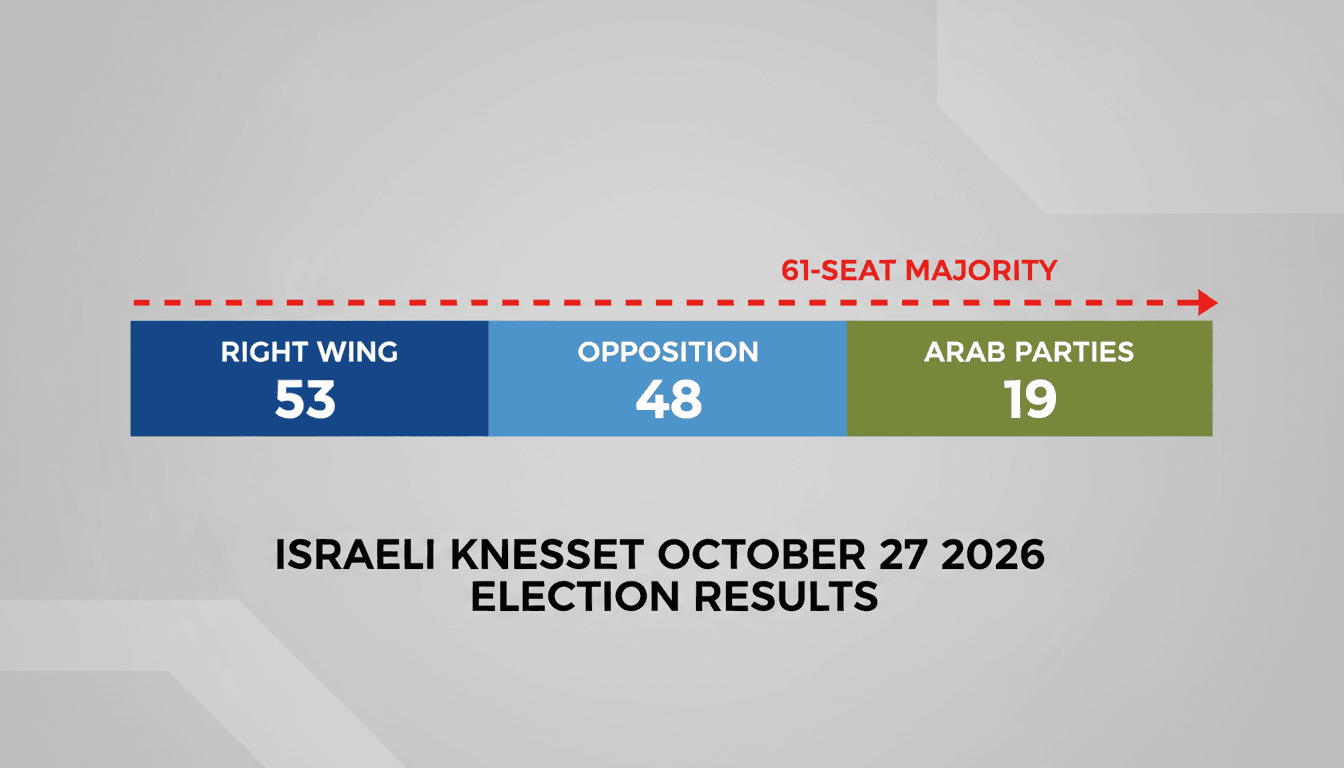
- Netanyahu's right-wing bloc secured 53 seats, falling eight seats short of the 61 needed for a parliamentary majority after losing roughly 15 seats relative to the previous Knesset.
- The main opposition bloc led by Gadi Eisenkot captured 48 seats, while Arab parties expanded their parliamentary representation to a record total of 19 seats.
- Former Prime Minister Ehud Barak declared Netanyahu suffered a dramatic defeat, urging Eisenkot’s opposition to construct an alliance across the 67 non-Netanyahu seats to resolve the stalemate.
The context you actually need
- Record civic participation reshuffled Knesset margins, with the Central Elections Committee registering a 77.9% turnout across 5.7 million votes cast on October 27, 2026.
- The vote followed prolonged post-conflict friction, serving as the electorate's formal review of government performance after the October 7, 2023 security failures and subsequent military operations.
- Institutional fragmentation prevents swift executive formation, prompting President Isaac Herzog to press party leaders for open talks to avert another rapid cycle of repeat general elections.
What's really happening
The mechanics of Israel's 2026 election results expose a structural math problem: while Prime Minister Benjamin Netanyahu’s right-wing bloc secured the single largest unified partisan grouping at 53 seats, the arithmetic of the 120-seat Knesset denies him a working majority. Reaching the necessary 61-seat threshold requires either peeling defectors away from rival factions or reconciling diametrically opposed political platforms. The loss of approximately 15 seats from his prior governing coalition deprives Likud (which retained 27 seats) and its allied parties of the direct legislative control they exercised since 2022.
Simultaneously, the non-Netanyahu camp controls 67 seats on paper, but functions as two ideologically distinct factions rather than an integrated operational alliance. Gadi Eisenkot’s centrist Yashar-led opposition commands 48 seats, while Arab parties—including the Joint List and Ra'am—secured a historic 19 seats, lifted by record voter participation. Former Prime Minister Ehud Barak’s intervention directly addresses this mathematical hurdle. By publicly urging Eisenkot to negotiate terms with Arab factions, Barak is attempting to construct an governing coalition of 67 seats. Yet structural disincentives remain high: past attempts to bridge Jewish centrist-security factions and Arab parties have produced fragile, short-lived arrangements vulnerable to internal ideological vetoes.
This deadlock creates an immediate incentive structure focused on survival and tactical distraction. With corruption trials remaining on the docket and unresolved regional security dynamics surrounding potential operations against Iran, the sitting leadership faces strong motivations to prolong coalition formation talks or exploit divisions across the 67-seat opposition bloc.
For international observers and market operators, the outcome is not a sudden pivot in state behavior, but institutional inertia. A caretaker administration possesses constrained authority to pass comprehensive budgets or implement long-term structural reforms, yet retains executive tools over defense maneuvers. Without 61 seats committed to an alternative program, the distribution of power incentivizes institutional defense over structural compromise, elevating the probability of extended negotiations or return to the ballot box.
Who feels it first (and how)
- Sovereign debt and macro risk analysts: Face prolonged uncertainty around structural deficit reduction, fiscal budget ratification, and institutional policy stability.
- Regional defense and security strategists: Must plan against a domestic Israeli political apparatus where caretaker leadership balances executive defense actions against coalition leverage.
- Arab party leadership and voter coalitions: Gain unprecedented structural leverage with 19 seats, testing whether their expanded parliamentary strength translates into formal executive inclusion.
- Likud and centrist faction backbenchers: Navigate high-pressure defection incentives as party whips search for individual crossover votes to break the 53-to-48-to-19 impasse.
What to watch next
- Eisenkot’s formal posture on Arab bloc negotiations: Whether Yashar opens structured talks with the Joint List and Ra'am to test the viability of a 67-seat governing alternative.
- Defection signals within the 53-seat bloc: Any willingness among moderate Likud figures or right-leaning allies to break ranks will reveal whether Netanyahu’s base can maintain legislative unity.
- President Herzog’s mandate timetable: The sequence and time limits Herzog applies to party leaders will dictate whether a coalition crystallizes or moves toward an immediate snap election.
Netanyahu’s bloc finished with 53 seats, Eisenkot’s bloc secured 48 seats, Arab parties obtained 19 seats, and overall turnout reached 77.9%.
Weeks of protracted political negotiations will delay major fiscal policy initiatives, keeping baseline country risk premiums elevated.
Whether Eisenkot's opposition can overcome ideological divergence to formalize a working partnership with Arab parties to reach 61 seats.
Frequently Asked Questions
- Why it matters?
- A fractured parliament without a clear 61-seat majority leaves regional security, budget execution, and foreign policy locked in short-term negotiating postures rather than predictable institutional pathways.
- What happened (in 30 seconds)?
- Netanyahu's right-wing bloc secured 53 seats, falling eight seats short of the 61 needed for a parliamentary majority after losing roughly 15 seats relative to the previous Knesset. The main opposition bloc led by Gadi Eisenkot captured 48 seats, while Arab parties expanded their parliamentary representation to a record total of 19 seats. Former Prime Minister Ehud Barak declared Netanyahu suffered a dramatic defeat, urging Eisenkot’s opposition to construct an alliance across the 67 non-Netanya
- What's really happening?
- The mechanics of Israel's 2026 election results expose a structural math problem: while Prime Minister Benjamin Netanyahu’s right-wing bloc secured the single largest unified partisan grouping at 53 seats, the arithmetic of the 120-seat Knesset denies him a working majority. Reaching the necessary 61-seat threshold requires either peeling defectors away from rival factions or reconciling diametrically opposed political platforms. The loss of approximately 15 seats from his prior governing coalit
- Who feels it first (and how)?
- Sovereign debt and macro risk analysts: Face prolonged uncertainty around structural deficit reduction, fiscal budget ratification, and institutional policy stability. Regional defense and security strategists: Must plan against a domestic Israeli political apparatus where caretaker leadership balances executive defense actions against coalition leverage. Arab party leadership and voter coalitions: Gain unprecedented structural leverage with 19 seats, testing whether their expanded parliamentary
- What to watch next?
- Eisenkot’s formal posture on Arab bloc negotiations: Whether Yashar opens structured talks with the Joint List and Ra'am to test the viability of a 67-seat governing alternative. Defection signals within the 53-seat bloc: Any willingness among moderate Likud figures or right-leaning allies to break ranks will reveal whether Netanyahu’s base can maintain legislative unity. President Herzog’s mandate timetable: The sequence and time limits Herzog applies to party leaders will dictate whether a coa
24/7 international news from a French perspective in multiple languages.
"France 24 is viewed as a globally focused outlet with balanced coverage and a European perspective."
— A47 Editor
Israeli election: 'Netanyahu did not win, he lost dramatically,' former PM Barak says
Former Israeli prime minister Ehud Barak told FRANCE 24 that Benjamin Netanyahu "did not win" the October 27, 2026 election but "lost dramatically," and urged rival Gadi Eisenkot to ally with Arab parties. Barak also said claims of Qatari funding for...
European coverage of Middle East politics and security issues.
"France 24 offers international reporting with a European editorial perspective."
— A47 Editor
Israeli election: 'Netanyahu did not win, he lost dramatically,' former PM Barak says
Former Israeli prime minister Ehud Barak told FRANCE 24 that Benjamin Netanyahu "did not win" the October 27, 2026 election but "lost dramatically," and urged rival Gadi Eisenkot to ally with Arab parties. Barak also said claims of Qatari funding for...
Conservative-leaning coverage of current events.
"Fox News is a highly influential conservative news outlet known for right-leaning political commentary and coverage."
— A47 Editor
Netanyahu's bloc falls short as longtime allies reportedly weigh move that could end his rule
Netanyahu's bloc secured only 53 Knesset seats in Israel's first national election since the Oct. 7, 2023 attacks, held October 27, 2026, as ultra-Orthodox allies reportedly weigh breaking ranks to back Gadi Eisenkot's opposition bloc.
Capitol Hill news, legislation, and policy insight.
"The Hill specializes in U.S. politics and policy, with a focus on Capitol Hill developments and a reputation for insider reporting."
— A47 Editor
Netanyahu’s fortunes improve but without clear path to outright victory
Israeli Prime Minister Benjamin Netanyahu's Likud party gained ground as vote counting wound down after Israel's first national election since the Oct. 7, 2023 attacks, edging out retired Gen. Gadi Eisenkot, with Likud projected to hold 26 seats in t...
Global news coverage with extensive reporting on Middle Eastern conflicts and geopolitics.
"Al Jazeera is a Qatar-based broadcaster known for wide regional coverage and alternative perspectives."
— A47 Editor
Netanyahu or Eisenkot? Can you form Israel’s next coalition government?
Israel's October 27, 2026 general election, its first since the October 7, 2023 Hamas attacks, ended without a clear winner, with exit polls and partial results showing Prime Minister Benjamin Netanyahu's bloc and opposition leader Gadi Eisenkot's bl...
Comprehensive coverage of Middle Eastern and global issues.
"Al Jazeera is a prominent voice from the Global South, especially the Middle East, with an emphasis on underreported stories."
— A47 Editor
Netanyahu or Eisenkot? Can you form Israel’s next coalition government?
Israel's October 27, 2026 general election, its first since the October 7, 2023 Hamas attacks, ended without a clear winner, with exit polls and partial results showing Prime Minister Benjamin Netanyahu's bloc and opposition leader Gadi Eisenkot's bl...
English-language reporting on Saudi politics, policy, and society.
"Saudi Gazette reflects mainstream Saudi institutional perspectives."
— A47 Editor
Netanyahu’s ultra-Orthodox allies open to joining forces with opposition
Israeli ultra-Orthodox parties allied with Prime Minister Benjamin Netanyahu signaled on Wednesday that they could cooperate with the opposition after exit polls left both blocs short of a parliamentary majority. An unnamed Shas official said the par...