
Israel Election Ends in Deadlock as Netanyahu and Eisenkot Blocs Fall Short of Knesset Majority
Why it matters
The absence of a decisive parliamentary majority extends caretaker governance across Israel, delaying long-term regional economic integrations and holding defense and cross-border commercial strategies in a holding pattern.
What happened (in 30 seconds)
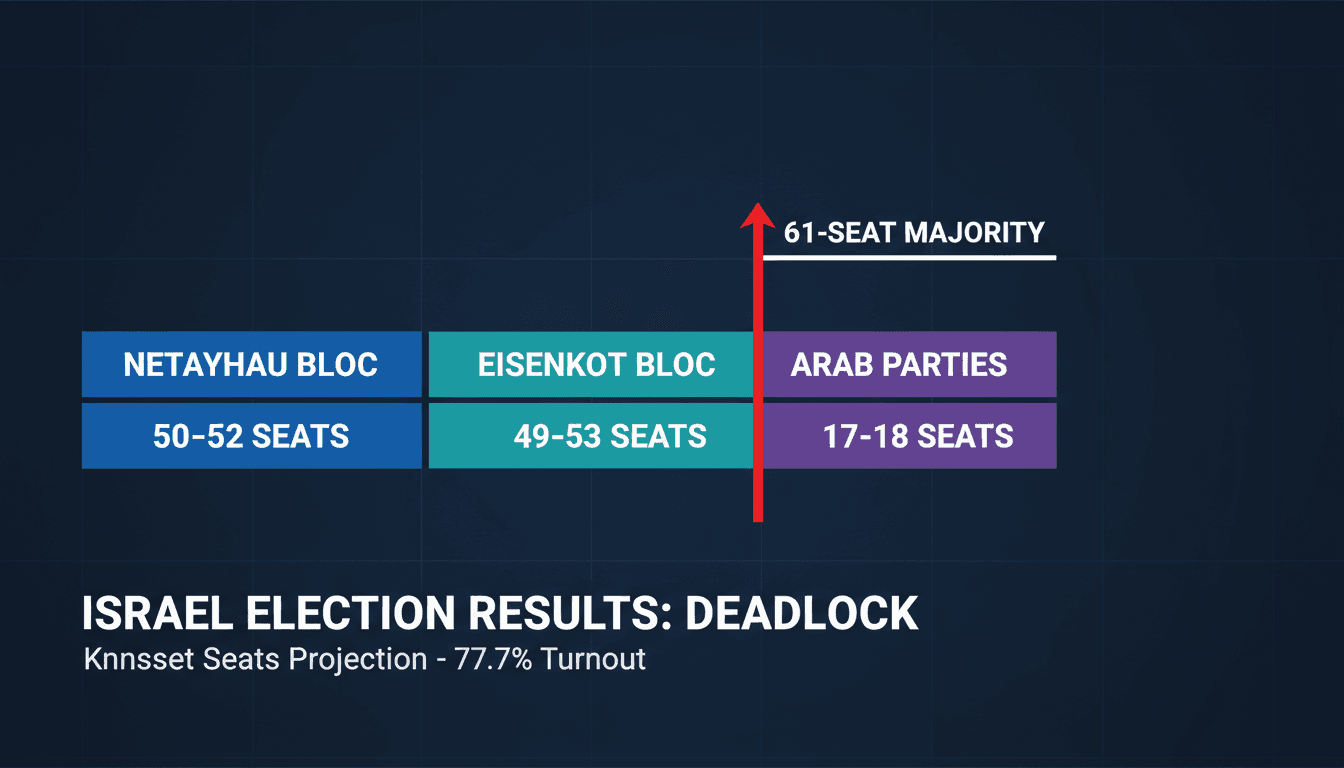
- Voters delivered a split parliament, leaving both Benjamin Netanyahu's right-wing bloc (projected at 50 to 52 seats) and Gadi Eisenkot's opposition bloc (projected at 49 to 53 seats) short of the 61-seat threshold in the 120-seat Knesset.
- Voter participation surged to 77.7%, marking the highest national turnout since 1999—an increase of 7.1 percentage points compared to the 2022 general election.
- Arab parties secured a pivotal position, capturing a projected 17 to 18 seats to emerge as decisive players in coalition negotiations as both primary blocs claimed mandates without securing an outright majority.
The context you actually need
- This vote marks the first national election since October 7, 2023, acting as a direct public assessment of the security framework and military operations that followed the attacks that killed over 1,200 Israelis.
- Netanyahu entered the race under compound pressure, managing domestic political fragmentation and multi-front security operations while seeking to preserve his governing coalition.
- The opposition consolidated under former military chief Gadi Eisenkot, presenting his Yashar party as a stabilizing counterweight to right-wing governance amid international isolation and domestic protests.
What's really happening
The mechanics of this stalemate reflect structural shifts in voter alignment and coalition math. In Israel’s proportional representation system, governing requires building a bloc of at least 61 seats. When neither the sitting right-wing alliance nor the primary opposition coalition crosses that threshold, executive power stays anchored within a transitional framework.
Netanyahu’s incentive structure focuses on political survival and retaining executive initiative. Without an outright 61-seat majority, his baseline pathway relies on pulling individual factions across the aisle or entering an extended period of caretaker administration. A caretaker government maintains executive functions but faces severe legal and operational constraints on passing fresh statutory initiatives, establishing fiscal frameworks, or committing to binding diplomatic agreements.
Eisenkot’s Yashar party faces an equally difficult mathematical barrier. Reaching 61 seats requires either breaking components away from Netanyahu’s traditional base or constructing an unprecedented formal alignment with Arab factions projected at 17 to 18 seats. Arab parties, including Ra'am, operate on distinct domestic agendas and local community priorities. Their structural leverage is now at historic highs, but integrating them into a stable governing coalition requires concessions that risk alienating moderate opposition figures.
For international operators, the direct consequence is political inertia. Long-term commercial normalization frameworks, multilateral infrastructure plans, and regional security initiatives demand clear counterparties in Jerusalem with multi-year mandates. A deadlocked parliament forces the civil service and military leadership to operate on short-term horizons.
Capital markets demonstrated limited immediate volatility upon release of the exit polls, but prolonged negotiations generate a slow-moving drag. When legislative coalitions take months to form—or collapse into repeat elections—institutional decisions on regulatory policy, energy exploration licenses, foreign tech acquisitions, and strategic cross-border infrastructure stay frozen. The immediate mechanism governing Israeli policy is no longer party doctrine, but survival math in a fractured 120-seat chamber.
Who feels it first (and how)
- Gulf-based cross-border dealmakers: Face extended review cycles for bi-lateral agreements, regional technology transfer projects, and institutional joint ventures while Israeli ministries remain in caretaker status.
- Regional logistics and supply chain operators: Must account for persistent security risk pricing across maritime and overland routes as long-term diplomatic integration remains stalled.
- Israeli high-tech and defense firms: Experience legislative pauses on strategic domestic spending programs, national budget allocations, and civil-sector regulatory adjustments during coalition jockeying.
- Institutional investors in Middle East sovereign and corporate debt: Bear prolonged regional geopolitical risk premiums, limiting yield compression across regional fixed-income assets.
What to watch next
- Final certified ballot tallies mid-week: Even a single-seat shift between the exit poll ranges (50–52 versus 49–53) fundamentally alters the math required to reach the 61-seat threshold.
- The formal faction recommendations to the President: Tracking which parties endorse Netanyahu, Eisenkot, or neither determines who receives the primary 28-day mandate to assemble a cabinet.
- Arab party negotiation platforms: Watch whether Ra'am and aligned lists enter direct talks with Eisenkot's bloc or withhold formal backing, which would raise the probability of repeat elections.
Neither major bloc reached the 61-seat threshold in initial projections, national turnout reached 77.7%, and Arab parties expanded their parliamentary presence to 17–18 seats.
Weeks of coalition negotiations will follow, leaving Netanyahu in place as caretaker Prime Minister during the interregnum while both sides test leverage points.
Whether any opposition elements will break ranks to join a narrow right-wing cabinet, or if the deadlock will force the country into another round of national elections in 2027.
Frequently Asked Questions
- Why it matters?
- The absence of a decisive parliamentary majority extends caretaker governance across Israel, delaying long-term regional economic integrations and holding defense and cross-border commercial strategies in a holding pattern.
- What happened (in 30 seconds)?
- Voters delivered a split parliament, leaving both Benjamin Netanyahu's right-wing bloc (projected at 50 to 52 seats) and Gadi Eisenkot's opposition bloc (projected at 49 to 53 seats) short of the 61-seat threshold in the 120-seat Knesset. Voter participation surged to 77.7%, marking the highest national turnout since 1999—an increase of 7.1 percentage points compared to the 2022 general election. Arab parties secured a pivotal position, capturing a projected 17 to 18 seats to emerge as decisive
- What's really happening?
- The mechanics of this stalemate reflect structural shifts in voter alignment and coalition math. In Israel’s proportional representation system, governing requires building a bloc of at least 61 seats. When neither the sitting right-wing alliance nor the primary opposition coalition crosses that threshold, executive power stays anchored within a transitional framework. Netanyahu’s incentive structure focuses on political survival and retaining executive initiative. Without an outright 61-seat
- Who feels it first (and how)?
- Gulf-based cross-border dealmakers: Face extended review cycles for bi-lateral agreements, regional technology transfer projects, and institutional joint ventures while Israeli ministries remain in caretaker status. Regional logistics and supply chain operators: Must account for persistent security risk pricing across maritime and overland routes as long-term diplomatic integration remains stalled. Israeli high-tech and defense firms: Experience legislative pauses on strategic domestic spending
- What to watch next?
- Final certified ballot tallies mid-week: Even a single-seat shift between the exit poll ranges (50–52 versus 49–53) fundamentally alters the math required to reach the 61-seat threshold. The formal faction recommendations to the President: Tracking which parties endorse Netanyahu, Eisenkot, or neither determines who receives the primary 28-day mandate to assemble a cabinet. Arab party negotiation platforms: Watch whether Ra'am and aligned lists enter direct talks with Eisenkot's bloc or withhold
European coverage of Middle East politics and security issues.
"France 24 offers international reporting with a European editorial perspective."
— A47 Editor
Bibi's moment of truth: Israel votes in first general election since October 7
Israelis went to the polls on Tuesday, October 27, 2026, in the first general election since Hamas's October 7, 2023 attack, with turnout reaching 16.7% four hours after polls opened and about 55% by 4pm local time, the highest in decades. The vote i...
24/7 international news from a French perspective in multiple languages.
"France 24 is viewed as a globally focused outlet with balanced coverage and a European perspective."
— A47 Editor
Bibi's moment of truth: Israel votes in first general election since October 7
Israelis went to the polls on Tuesday, October 27, 2026, in the first general election since Hamas's October 7, 2023 attack, with turnout reaching 16.7% four hours after polls opened and about 55% by 4pm local time, the highest in decades. The vote i...
International coverage from The Guardian's global desks.
"The Guardian is known for its progressive editorial stance and in-depth analysis."
— A47 Editor
Legacy of 7 October looms large as a divided Israel goes to the polls in record numbers
Israelis went to the polls on October 27, 2026, in the first national election since Hamas's October 7, 2023 attack that killed about 1,200 people. Bereaved families held a minute of silence at 6.29am in Tel Aviv's hostages square, the moment the att...
Comprehensive coverage of global events, politics, and international issues.
"NBC News is a mainstream outlet known for comprehensive national and international coverage with a centrist to slightly left-leaning editorial tone."
— A47 Editor
Oct. 7 families urge Israelis to vote in national election
Families of victims of the October 7, 2023 Hamas attacks, which killed more than 1,200 people, urged Israelis to vote as polling stations opened in the country's first national election since the assault. The vote follows Israel's military campaign i...