
Israeli Exit Polls Show Opposition Narrow Lead With Neither Bloc Reaching 61-Seat Majority
Why it matters
The absence of a decisive parliamentary majority in the 120-seat Knesset leaves regional policy, foreign trade frameworks, and economic strategy suspended in extended coalition bargaining.
What happened (in 30 seconds)
- High civic participation defined the vote, with voter turnout reaching 77.7 percent on October 27, 2026, marking an increase of approximately 7 percentage points over the 2022 contest and standing as the highest participation rate since 2001.
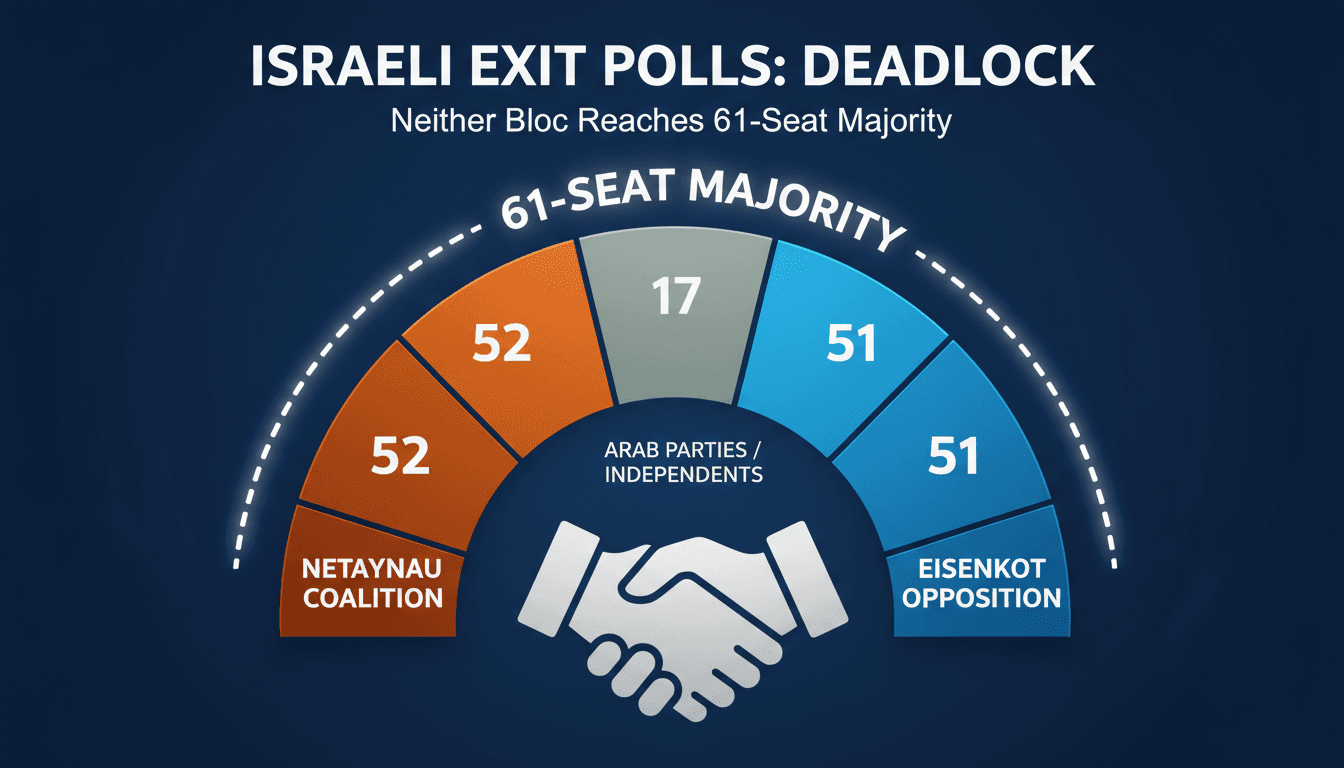
- Neither primary political bloc reached a working majority, as exit polling across Channels 11, 12, and 13 placed Prime Minister Benjamin Netanyahu's coalition at 50 to 52 seats and Gadi Eisenkot's opposition bloc at 49 to 53 seats, leaving both short of the 61-seat threshold.
- Arab parties emerged as critical mathematical players, securing a projected 17 to 19 seats across factions like Ra'am and the Joint List, while Netanyahu's Likud remained the largest individual party with 24 to 27 seats.
The context you actually need
- This legislative race served as the first formal electoral test since the October 7, 2023 attacks and the resulting regional military operations, framing voter choices around national security administration, crisis leadership, and state institutional stability.
- Structural instability has recurred across multiple electoral cycles, following years of domestic disputes regarding judicial reforms, security oversight, and coalition cohesion that repeatedly returned the electorate to the polls.
- The mathematical threshold of 61 seats remains absolute, requiring diverse political groups with conflicting domestic agendas to negotiate compromises or leave the incumbent government operating in a temporary caretaker capacity.
What's really happening
The electoral arithmetic generated by the October 27, 2026 vote exposes structural constraints within Israel's proportional representation model. Under the Knesset's 120-seat framework, governance requires an absolute majority of 61 seats. When the two dominant ideological formations balance each other out—with Likud projecting 24 to 27 seats and Yashar trailing closely behind—the leverage instantly transfers away from legacy leaders and toward non-aligned factions.
In this distribution, Arab parties holding a combined 17 to 19 seats gain disproportionate negotiating weight. Arab party leadership has indicated a willingness to entertain discussions, yet integrating these factions into a formal governing structure presents profound operational and ideological friction for traditional parties on both sides. If neither Eisenkot's bloc nor Netanyahu's right-wing alliance can assemble 61 commitments, institutional protocol mandates that the incumbent prime minister remain in office under a caretaker administration. Caretaker governments operate under strict statutory limitations: they manage routine administrative functions and ongoing defense protocols but lack the legislative backing required to pass multi-year budgets, enact structural regulatory changes, or ratify new international accords.
For global operators tracking Middle Eastern commerce, this dynamic establishes a period of strategic stasis. Immediate financial indicators showed no major shifts upon the release of exit polls, reflecting expectations of a protracted negotiation process rather than an immediate structural rupture. However, a prolonged coalition process—frequently lasting several weeks or months—delays fiscal clarity. Israel’s economic planning, corporate tax adjustments, and regional infrastructure integration require legislative approval to advance beyond current baselines.
Furthermore, the broader commercial architecture established under regional arrangements, including the Abraham Accords, relies on predictable institutional partners. While bilateral economic ties with regional hubs like Dubai continue along established frameworks, unquantified indirect risks persist regarding long-term regional stability, shared logistics channels, and institutional engagement. Until official counting concludes and formal mandates are assigned by the presidency, the operating environment will be shaped by transactional party bargaining rather than unified policy execution.
Who feels it first (and how)
- Multinational corporate planners and treasurers must navigate prolonged regulatory inertia, delaying long-term regional investment allocations until sovereign fiscal policy and departmental appointments are confirmed.
- Regional logistics and cross-border commercial operators maintain existing operational workflows under current Abraham Accords mechanisms, but face uncertainty regarding expanded bilateral trade treaties or synchronized infrastructure initiatives.
- Sovereign debt and macro risk analysts are forced to price in political risk premiums tied to potential credit rating reviews if coalition talks drag on and postpone statutory national budget approvals.
What to watch next
- Certification of final vote tallies by the Central Elections Committee, which will establish the precise seat count and determine whether minor party fluctuations shift either primary bloc closer to the 61-seat threshold.
- Formal coalition consultation recommendations, where faction leaders submit their preferred candidate to the state president, revealing whether Arab parties will formally recommend Eisenkot or abstain.
- Sovereign bond yield movements and currency fluctuations, which will signal whether international financial institutions view a protracted caretaker status as manageable stability or credit-negative paralysis.
Turnout reached 77.7 percent; Likud secured 24 to 27 seats; neither traditional bloc achieved the 61 seats required to form an immediate government based on exit poll figures.
Negotiations will span multiple weeks or months, during which Netanyahu will continue in a caretaker capacity with restricted legislative and budgetary authority.
Whether Arab parties will enter a formal governing coalition, provide outside parliamentary backing to an Eisenkot-led cabinet, or trigger another round of national elections through sustained deadlock.
Frequently Asked Questions
- Why it matters?
- The absence of a decisive parliamentary majority in the 120-seat Knesset leaves regional policy, foreign trade frameworks, and economic strategy suspended in extended coalition bargaining.
- What happened (in 30 seconds)?
- High civic participation defined the vote, with voter turnout reaching 77.7 percent on October 27, 2026, marking an increase of approximately 7 percentage points over the 2022 contest and standing as the highest participation rate since 2001. Neither primary political bloc reached a working majority, as exit polling across Channels 11, 12, and 13 placed Prime Minister Benjamin Netanyahu's coalition at 50 to 52 seats and Gadi Eisenkot's opposition bloc at 49 to 53 seats, leaving both short of the
- What's really happening?
- The electoral arithmetic generated by the October 27, 2026 vote exposes structural constraints within Israel's proportional representation model. Under the Knesset's 120-seat framework, governance requires an absolute majority of 61 seats. When the two dominant ideological formations balance each other out—with Likud projecting 24 to 27 seats and Yashar trailing closely behind—the leverage instantly transfers away from legacy leaders and toward non-aligned factions. In this distribution, Arab p
- Who feels it first (and how)?
- Multinational corporate planners and treasurers must navigate prolonged regulatory inertia, delaying long-term regional investment allocations until sovereign fiscal policy and departmental appointments are confirmed. Regional logistics and cross-border commercial operators maintain existing operational workflows under current Abraham Accords mechanisms, but face uncertainty regarding expanded bilateral trade treaties or synchronized infrastructure initiatives. Sovereign debt and macro risk anal
- What to watch next?
- Certification of final vote tallies by the Central Elections Committee, which will establish the precise seat count and determine whether minor party fluctuations shift either primary bloc closer to the 61-seat threshold. Formal coalition consultation recommendations, where faction leaders submit their preferred candidate to the state president, revealing whether Arab parties will formally recommend Eisenkot or abstain. Sovereign bond yield movements and currency fluctuations, which will signal
Global news coverage with extensive reporting on Middle Eastern conflicts and geopolitics.
"Al Jazeera is a Qatar-based broadcaster known for wide regional coverage and alternative perspectives."
— A47 Editor
Arab parties in Israel accuse Netanyahu of inciting hatred to scare voters
Al Jazeera reports that Arab parties in Israel have accused Prime Minister Benjamin Netanyahu of inciting hatred to scare voters, after he posted on social media that Arab voters were 'raiding the polling stations and stealing the elections' ahead of...
Comprehensive coverage of Middle Eastern and global issues.
"Al Jazeera is a prominent voice from the Global South, especially the Middle East, with an emphasis on underreported stories."
— A47 Editor
Arab parties in Israel accuse Netanyahu of inciting hatred to scare voters
Al Jazeera reports that Arab parties in Israel have accused Prime Minister Benjamin Netanyahu of inciting hatred to scare voters, after he posted on social media that Arab voters were 'raiding the polling stations and stealing the elections' ahead of...
Regional coverage and analysis focused on politics, diplomacy, and business across the Middle East.
"Al-Monitor is known for analytical reporting on Middle East politics and policy developments."
— A47 Editor
Netanyahu warns of Arab voter surge in Israel's election; Arab leaders call tactic racist
Israeli Prime Minister Benjamin Netanyahu and his far-right coalition partners made a final push on Tuesday to mobilize supporters ahead of the October 27, 2026 election, warning of a surge in Arab voter turnout; cars bearing Likud flags drove throug...
UAE-based English-language newspaper covering regional politics, economics, and global affairs.
"The National reflects Emirati policy perspectives while maintaining international editorial standards."
— A47 Editor
Israel election live: Opposition optimism as Netanyahu's party requests extended voting hours
Israelis went to the polls on October 27, 2026, in the first national general election since Hamas's October 7, 2023 attacks, a vote widely framed as a referendum on Prime Minister Benjamin Netanyahu, who has led the country almost continuously for n...
Coverage of current events and conflicts in the Middle East.
"France 24 is viewed as a globally focused outlet with balanced coverage and a European perspective."
— A47 Editor
Live: Israeli exit polls show narrow edge for opposition but no clear majority against Netanyahu
Israeli exit polls for the country's first national election since the October 7, 2023 Hamas attack show a narrow edge for the opposition, but no clear majority against Prime Minister Benjamin Netanyahu, whose leadership is being treated as a referen...
European coverage of Middle East politics and security issues.
"France 24 offers international reporting with a European editorial perspective."
— A47 Editor
Live: Israeli exit polls show narrow edge for opposition but no clear majority against Netanyahu
Israeli exit polls for the country's first national election since the October 7, 2023 Hamas attack show a narrow edge for the opposition, but no clear majority against Prime Minister Benjamin Netanyahu, whose leadership is being treated as a referen...
English-language digital publication covering business, politics, technology, and current affairs.
"The Arabian Post mixes original and syndicated-style coverage with a broad regional and global business-news orientation."
— A47 Editor
Israel votes as Netanyahu faces wartime leadership verdict
Israelis went to the polls on October 27, 2026, in the first national election since the Hamas attacks of October 7, 2023, a vote widely viewed as a referendum on Prime Minister Benjamin Netanyahu, who has led the country almost continuously for near...
Regional coverage and analysis focused on politics, diplomacy, and business across the Middle East.
"Al-Monitor is known for analytical reporting on Middle East politics and policy developments."
— A47 Editor
Benjamin Netanyahu: Israel's longest-serving PM fighting for survival
Israeli voters go to the polls on October 27, 2026, in the first national election since Hamas's October 7, 2023 attack, a vote widely viewed as a referendum on Prime Minister Benjamin Netanyahu, who has led Israel almost continuously for nearly 17 y...
Regional coverage and analysis focused on politics, diplomacy, and business across the Middle East.
"Al-Monitor is known for analytical reporting on Middle East politics and policy developments."
— A47 Editor
Netanyahu's political survival on the line as Israel votes
Israeli voters go to the polls on October 27, 2026, in a general election widely viewed as a referendum on Prime Minister Benjamin Netanyahu, who has led the country almost continuously for nearly 17 years and faces a fight for political survival. It...
Breaking news, politics, business, and entertainment from the U.S. and around the world.
"The New York Post is a tabloid-format newspaper known for its sensationalist headlines and conservative-leaning editorial tone."
— A47 Editor
Israel’s furious Arab parties could oust Netanyahu — if the opposition will break an election promise
Israeli-Arab parties could shift the balance of power in Israel's general elections next week, as the country's two major parties are predicted to fall short of a parliamentary majority. The New York Post reports that the opposition may need to break...