
Arab Parties Win Record 19 Seats in Israeli Election Creating Kingmaker Leverage Against Netanyahu Bloc
Why it matters
The arithmetic of Israel's 120-seat parliament now places cross-bloc governance power in the hands of an expanded Arab parliamentary delegation, recalibrating regional policy incentives.
What happened (in 30 seconds)
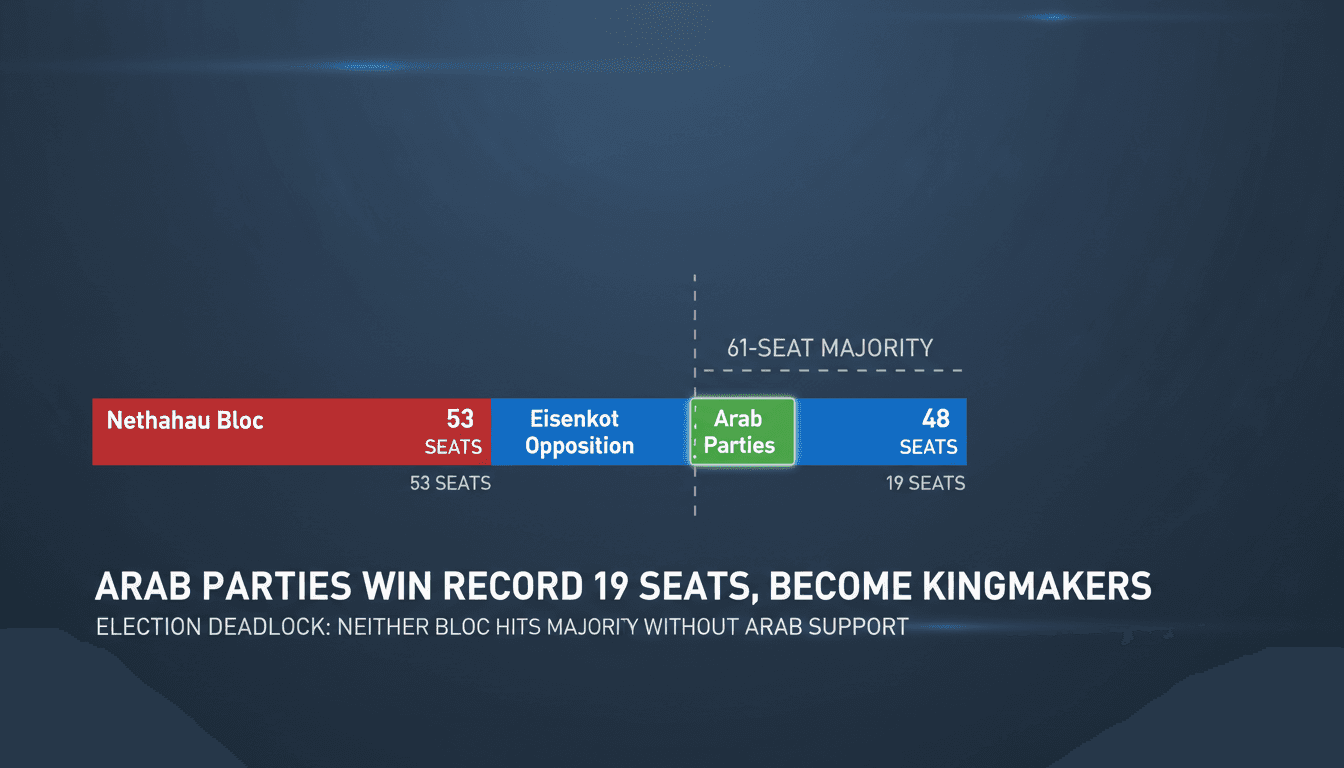
- The election delivered a deadlock: The October 27, 2026, vote left Prime Minister Benjamin Netanyahu's bloc with 53 seats and Gadi Eisenkot's Zionist opposition bloc with 48 seats, leaving both short of the 61-seat threshold.
- Arab parties secured record leverage: Ra'am and the Joint List collectively captured 19 seats, nearly doubling their prior representation following elevated voter turnout.
- Coalition negotiations commenced: Arab party leaders initiated talks with Eisenkot's opposition to explore recommendations for prime minister, while public demonstrations occurred in Tel Aviv demanding an anti-Netanyahu governing pact.
The context you actually need
- A multi-year electoral cycle: Israel has undergone repeated inconclusive legislative elections since 2019, driven by sharp partisan divisions and ongoing corruption trials against the incumbent prime minister.
- Demographic weight versus representation: Arab Israeli citizens comprise approximately 21% of the population, yet their political parties have historically operated outside ruling coalitions, with Ra'am's participation in the 2021 government serving as the primary modern exception.
- Pre-election red lines: Both major political blocs entered the October 2026 race having publicly minimized or rejected formal partnerships with Arab factions, creating immediate tension when final seat counts made a 61-seat majority mathematically unattainable without them.
What's really happening
The mechanics of forming a government in the 120-seat Knesset require a minimum 61-seat majority. Following the October 27, 2026, count, Netanyahu's right-wing bloc holds 53 seats, while Eisenkot's opposition bloc controls 48 seats. Neither traditional grouping can govern independently. The 19 seats secured by Ra'am and the Joint List represent the sole mathematical route for Eisenkot to surpass the 61-seat threshold without fracturing the right-wing bloc.
This dynamic transforms what had been an ideological divide into a structural transaction. To assemble a 67-seat working majority (48 opposition seats plus 19 Arab party seats), both sides face hard operational trade-offs. The Joint List and Ra'am are negotiating on core domestic deliverables, including resource allocation for Arab municipalities, civil policy, and crime mitigation. Concurrently, the Joint List has signaled openness to recommending Eisenkot while negotiating baseline principles, including formal state status frameworks.
For Eisenkot, accepting Arab party backing carries severe exposure to political attacks from the right, which characterizes any Arab-dependent government as illegitimate. Netanyahu has aggressively leveraged this dynamic across media channels, asserting that opposition reliance on Arab factions undermines state stability. Yet for Eisenkot, rejecting an accommodation guarantees an immediate political cul-de-sac: either a return to another costly national election or an inability to challenge the incumbent administration.
The incentive structure has therefore shifted from campaigning on ideological purity to parliamentary bargaining. Elevated turnout among the 21% Arab minority fundamentally expanded their legislative footprint, turning passive demographic weight into decisive legislative leverage. If Eisenkot secures formal recommendations from the 19 Arab lawmakers, the opposition gains the first mandate to attempt coalition formation. However, converting external recommendations into a stable governing pact requires continuous structural alignment between Zionist opposition factions and non-Zionist Arab lawmakers—an arrangement subject to constant legislative friction.
Who feels it first (and how)
- Regional trade and investment desks: Multinationals and Gulf-based enterprises assessing cross-border commercial agreements monitor government stability indicators to calibrate regional risk premiums.
- Municipal and civil administration leaders in Arab communities: Local officials anticipate potential budgetary reallocations, infrastructure funding, and dedicated public safety resources if Arab parties extract formal policy concessions.
- Israeli sovereign debt and currency analysts: Institutional traders track coalition viability to price political volatility, as past deadlock cycles prompted depreciations in local currency and government bond yields.
- Parliamentary whips and party strategists: Lawmakers across all blocs face immediate structural pressure to redefine legislative red lines or risk another national election cycle.
What to watch next
- The formal recommendation to the president: Track whether Ra'am and the Joint List formally present Eisenkot's name to the head of state, which would grant the opposition bloc the first mandate to assemble a cabinet.
- Terms of legislative support: Monitor whether Arab factions seek formal cabinet portfolios or choose an outside-support model, as external confidence-and-supply agreements carry distinct governing durability.
- Public mobilization and parliamentary defections: Watch whether sustained demonstrations in Tel Aviv compel fence-sitting lawmakers from the center-right to join an Eisenkot-led framework to avoid reliance on minority parties.
Netanyahu's bloc holds 53 seats, Eisenkot's opposition holds 48 seats, and Arab parties hold 19 seats in the 120-seat parliament; neither major bloc reaches the 61-seat threshold alone.
The Joint List and Ra'am will leverage their collective 19 seats to secure institutional concessions on domestic funding and community policing as prerequisites for political backing.
Whether Eisenkot's faction can maintain structural cohesion with traditional right-leaning opposition members while formally negotiating terms with non-Zionist Arab lawmakers.
Frequently Asked Questions
- Why it matters?
- The arithmetic of Israel's 120-seat parliament now places cross-bloc governance power in the hands of an expanded Arab parliamentary delegation, recalibrating regional policy incentives.
- What happened (in 30 seconds)?
- The election delivered a deadlock: The October 27, 2026, vote left Prime Minister Benjamin Netanyahu's bloc with 53 seats and Gadi Eisenkot's Zionist opposition bloc with 48 seats, leaving both short of the 61-seat threshold. Arab parties secured record leverage: Ra'am and the Joint List collectively captured 19 seats, nearly doubling their prior representation following elevated voter turnout. Coalition negotiations commenced: Arab party leaders initiated talks with Eisenkot's opposition to exp
- What's really happening?
- The mechanics of forming a government in the 120-seat Knesset require a minimum 61-seat majority. Following the October 27, 2026, count, Netanyahu's right-wing bloc holds 53 seats, while Eisenkot's opposition bloc controls 48 seats. Neither traditional grouping can govern independently. The 19 seats secured by Ra'am and the Joint List represent the sole mathematical route for Eisenkot to surpass the 61-seat threshold without fracturing the right-wing bloc. This dynamic transforms what had been
- Who feels it first (and how)?
- Regional trade and investment desks: Multinationals and Gulf-based enterprises assessing cross-border commercial agreements monitor government stability indicators to calibrate regional risk premiums. Municipal and civil administration leaders in Arab communities: Local officials anticipate potential budgetary reallocations, infrastructure funding, and dedicated public safety resources if Arab parties extract formal policy concessions. Israeli sovereign debt and currency analysts: Institutional
- What to watch next?
- The formal recommendation to the president: Track whether Ra'am and the Joint List formally present Eisenkot's name to the head of state, which would grant the opposition bloc the first mandate to assemble a cabinet. Terms of legislative support: Monitor whether Arab factions seek formal cabinet portfolios or choose an outside-support model, as external confidence-and-supply agreements carry distinct governing durability. Public mobilization and parliamentary defections: Watch whether sustained
Global business headlines with AI angles.
"General business outlet that frequently covers AI."
— A47 Editor
Probability Of Arab-Jewish Coalition To Govern Israel Grows As Pressure On Netanyahu Mounts
Arab parties are expected to back Zionist opposition leader Gadi Eisenkot's bid to form a government after Israel's inconclusive Knesset election left no bloc with the 61 seats needed to govern, increasing pressure on Prime Minister Benjamin Netanyah...
Regional coverage and analysis focused on politics, diplomacy, and business across the Middle East.
"Al-Monitor is known for analytical reporting on Middle East politics and policy developments."
— A47 Editor
Israeli protesters demand opposition ally with Arab parties to oust Netanyahu
Hundreds of Israelis rallied on Saturday urging the opposition to ally with Arab-majority parties to oust Prime Minister Benjamin Netanyahu, after Arab parties made major gains in the October 27, 2026 election, the first national vote since the Octob...
Conservative-leaning political and national coverage.
"The Washington Times is a conservative-leaning newspaper known for its political coverage and advocacy of right-of-center viewpoints."
— A47 Editor
Netanyahu's party calls record Arab turnout the 'Islamization of Israel'
Israel certified its election results Friday, confirming that the Arab minority population will hold a record 19 seats in the Knesset, a total that on paper could break the deadlock between Prime Minister Benjamin Netanyahu and challenger Gadi Eisenk...
Conservative-leaning coverage of current events.
"Fox News is a highly influential conservative news outlet known for right-leaning political commentary and coverage."
— A47 Editor
Netanyahu's bloc falls short as longtime allies reportedly weigh move that could end his rule
Netanyahu's bloc secured only 53 Knesset seats in Israel's first national election since the Oct. 7, 2023 attacks, held October 27, 2026, as ultra-Orthodox allies reportedly weigh breaking ranks to back Gadi Eisenkot's opposition bloc.
24/7 international news from a French perspective in multiple languages.
"France 24 is viewed as a globally focused outlet with balanced coverage and a European perspective."
— A47 Editor
Israel elections: Netanyahu attacks Arab parties as they emerge as potential kingmakers
Israel's October 27, 2026 national election, the first since the October 7, 2023 Hamas attacks, left Prime Minister Benjamin Netanyahu's Likud-led bloc short of the 61-seat Knesset majority, while Arab-led parties made a historic showing that could g...
Corporate leadership, finance, technology, and market trends.
"Fortune covers financial trends, leadership, and innovation with a pragmatic editorial approach."
— A47 Editor
Weakened Netanyahu spreads claims of malfeasance by Arab-led parties as his party claims Israel’s election was ‘stolen’
Netanyahu's Likud party has accused foreign entities of stealing Israel's election after high turnout among Palestinian citizens of Israel prevented an outright victory for the premier, while the opposition accused him of demonizing the Arab populati...
Global news coverage with extensive reporting on Middle Eastern conflicts and geopolitics.
"Al Jazeera is a Qatar-based broadcaster known for wide regional coverage and alternative perspectives."
— A47 Editor
Netanyahu attacks Israel’s Arab parties as he falls short of majority
Israeli Prime Minister Benjamin Netanyahu attacked Palestinian-Israeli parties after Israel's October 27, 2026 general election left his Likud-led bloc short of the 61-seat Knesset majority needed to govern, with official results showing his coalitio...
Comprehensive coverage of Middle Eastern and global issues.
"Al Jazeera is a prominent voice from the Global South, especially the Middle East, with an emphasis on underreported stories."
— A47 Editor
Netanyahu attacks Israel’s Arab parties as he falls short of majority
Israeli Prime Minister Benjamin Netanyahu attacked Palestinian-Israeli parties after Israel's October 27, 2026 general election left his Likud-led bloc short of the 61-seat Knesset majority needed to govern, with official results showing his coalitio...