
Trump Signals Possible Iran Deal as Qatar-Mediated Talks Continue Amid Falling Oil Prices
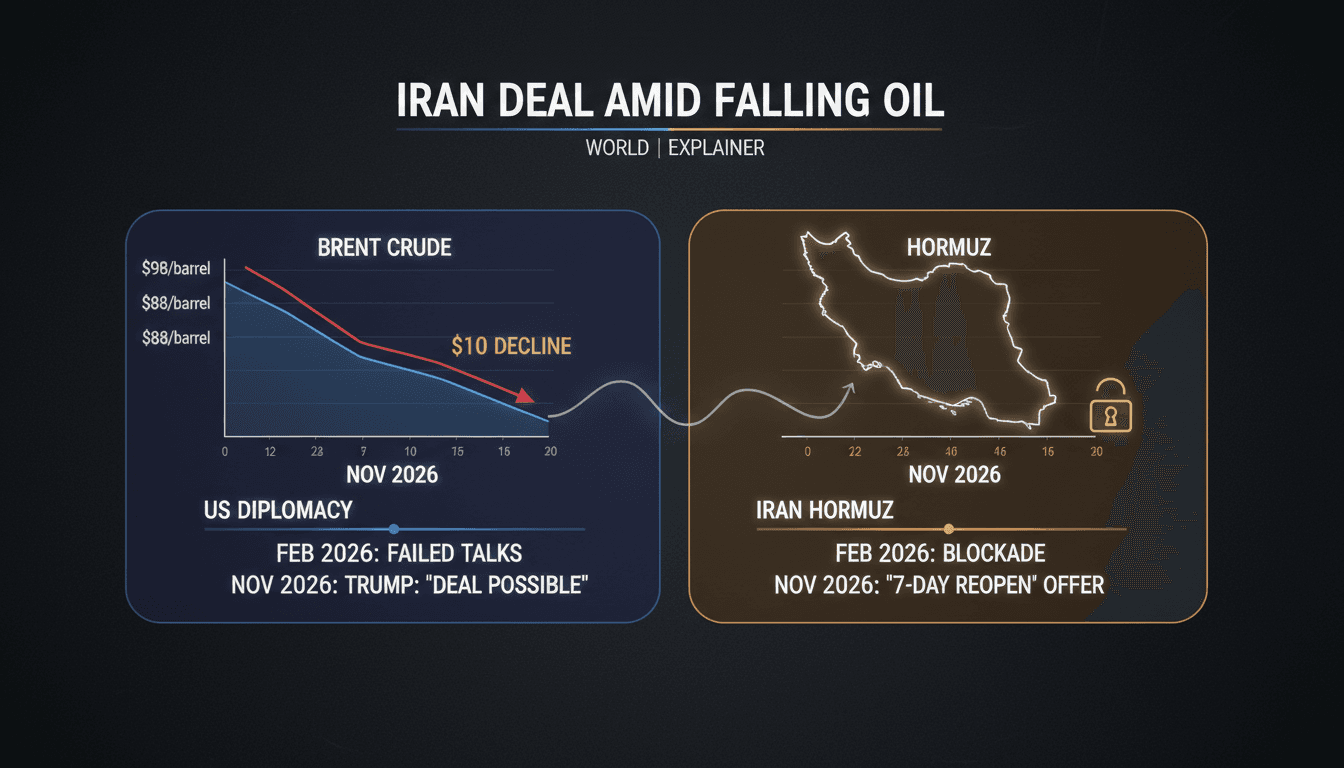
Why it matters
The potential unwinding of an eight-month naval blockade restores stability to 20% of global petroleum transit, triggering a rapid unwinding of wartime risk premiums across commodity and currency markets.
What happened (in 30 seconds)
- Trump signaled potential alignment: US President Donald Trump announced on Truth Social that an agreement with Iran "may be reached," citing tumbling crude benchmarks as evidence of mutual appetite for a settlement ahead of US midterm elections.
- Tehran offered an accelerated timeline: Iranian Foreign Ministry Spokesman Esmaeil Baghaei stated that Iran's plan to reopen the blocked Strait of Hormuz could be compressed from seven days to just two days if core demands regarding sanctions relief and asset releases are executed.
- Markets responded immediately: Brent crude futures fell by nearly $10 per barrel and European natural gas contracts dropped by more than 10% as indirect negotiations facilitated by Qatari mediators advanced despite localized US strikes on Qeshm Island.
The context you actually need
- An eight-month maritime standoff: The confrontation escalated following collapsed nuclear talks, resulting in an Iranian blockade of the Strait of Hormuz, sustained disruption to global maritime routes, and targeted strikes by US and Israeli forces on Iranian infrastructure.
- The mediation framework: Previous diplomatic drafts, including the Islamabad Memorandum, sought to exchange maritime access and Hormuz navigation guarantees for phased sanctions relief, economic reconstruction funding, and unfrozen foreign assets.
- Parallel pressure tracks: While US Vice President JD Vance confirmed measurable progress in negotiated tracks, limited tactical military exchanges continue, demonstrated by recent US strikes on Qeshm Island infrastructure.
What's really happening
The sudden momentum toward a diplomatic settlement is driven by aligned domestic and economic incentives in Washington and Tehran.
For the United States, timing is heavily dictated by domestic economic politics ahead of midterm elections. Sustained inflation tied to energy costs has remained an acute political vulnerability. An eight-month maritime blockade in the Persian Gulf elevated marine hull insurance rates, redirected international shipping around the Cape of Good Hope, and sustained Brent crude at elevated levels. A drop of nearly $10 per barrel provides immediate disinflationary relief at consumer fuel pumps, allowing the administration to point to measurable economic stabilization resulting from its diplomatic posture.
For Tehran, the incentive structure is anchored in fiscal survival and infrastructure preservation. Maintaining a naval blockade in the Strait of Hormuz demonstrated significant asymmetric leverage over global trade lanes, but it exacted severe compounding costs: intensified economic sanctions, frozen international assets, domestic capital strain, and retaliatory infrastructure strikes—such as the recent explosions recorded on Qeshm Island. By offering to compress the reopening timeline of the Strait of Hormuz from seven days to 48 hours, Tehran is leveraging its primary economic bargaining chip at maximum valuation. Iranian Foreign Minister Abbas Araghchi’s public insistence on "US political rationality" highlights Tehran's core trade-off: trading maritime passage and de-escalation for verified sanctions exemptions and liquidity access.
This dynamic also reflects a structural shift in mediation architecture. Doha and Islamabad have institutionalized indirect communication channels that function even during active tactical exchanges. The fact that market pricing decoupled from the Qeshm Island strikes—viewing them as isolated tactical bargaining markers rather than precursors to broadened conflict—indicates that trading desks view the economic incentives for settlement as stronger than the incentives for continued escalation. The structural dividend of reopening Hormuz is immediate: standardizing tanker transit routes, lowering maritime insurance risk bands, and re-establishing predictable flows of Gulf crude to import-dependent Asian and European manufacturing hubs.
Who feels it first (and how)
- Aviation and Fleet Operators: Airlines and commercial freight haulers experience immediate downward adjustments in fuel surcharges as crude benchmarks fall by nearly $10 per barrel.
- Maritime Shipping Lines: Tanker operators and logistics carriers face declining war-risk insurance premiums and can prepare to phase out costly transit diversions around Southern Africa.
- Dubai and Gulf Trading Hubs: Expatriate businesses, import-export firms, and consumer-facing retail in regional commercial centers see easing freight input costs and stabilized supply chains.
- European Energy Utilities: Industrial gas buyers benefit from the more than 10% fall in European gas contracts, stabilizing input costs ahead of winter storage cycles.
What to watch next
- The 48-Hour Hormuz Verification: Watch for official maritime notices from the Iranian Ports and Maritime Organization confirming unobstructed merchant vessel navigation through the Strait of Hormuz, which will validate Baghaei's accelerated timeline.
- US Sanctions Relief Orders: Monitor US Treasury Department notices regarding targeted waivers, asset unfreezing, or financial corridor allowances through Qatari accounts, which serve as Iran's condition for compliance.
- Post-Midterm Policy Continuity: Track official statements from the White House following the US midterms to ensure the diplomatic framework is maintained without returning to maximalist demands.
Trump posted that an agreement may be reached; Qatari-mediated talks are ongoing; Iran offered a two-day Hormuz reopening mechanism tied to sanctions relief; Brent crude dropped by nearly $10 per barrel; European natural gas fell over 10%.
Maritime insurance syndicates will lower Gulf transit war premiums within 72 hours of verified commercial vessel passage through Hormuz, further lowering landed commodity costs.
Whether Israeli operational objectives align fully with the US-Iranian diplomatic framework, or whether residual strikes on Iranian coastal facilities will disrupt the execution of the phased deal.
Frequently Asked Questions
- Why it matters?
- The potential unwinding of an eight-month naval blockade restores stability to 20% of global petroleum transit, triggering a rapid unwinding of wartime risk premiums across commodity and currency markets.
- What happened (in 30 seconds)?
- Trump signaled potential alignment: US President Donald Trump announced on Truth Social that an agreement with Iran "may be reached," citing tumbling crude benchmarks as evidence of mutual appetite for a settlement ahead of US midterm elections. Tehran offered an accelerated timeline: Iranian Foreign Ministry Spokesman Esmaeil Baghaei stated that Iran's plan to reopen the blocked Strait of Hormuz could be compressed from seven days to just two days if core demands regarding sanctions relief and
- What's really happening?
- The sudden momentum toward a diplomatic settlement is driven by aligned domestic and economic incentives in Washington and Tehran. For the United States, timing is heavily dictated by domestic economic politics ahead of midterm elections. Sustained inflation tied to energy costs has remained an acute political vulnerability. An eight-month maritime blockade in the Persian Gulf elevated marine hull insurance rates, redirected international shipping around the Cape of Good Hope, and sustained Br
- Who feels it first (and how)?
- Aviation and Fleet Operators: Airlines and commercial freight haulers experience immediate downward adjustments in fuel surcharges as crude benchmarks fall by nearly $10 per barrel. Maritime Shipping Lines: Tanker operators and logistics carriers face declining war-risk insurance premiums and can prepare to phase out costly transit diversions around Southern Africa. Dubai and Gulf Trading Hubs: Expatriate businesses, import-export firms, and consumer-facing retail in regional commercial centers
- What to watch next?
- The 48-Hour Hormuz Verification: Watch for official maritime notices from the Iranian Ports and Maritime Organization confirming unobstructed merchant vessel navigation through the Strait of Hormuz, which will validate Baghaei's accelerated timeline. US Sanctions Relief Orders: Monitor US Treasury Department notices regarding targeted waivers, asset unfreezing, or financial corridor allowances through Qatari accounts, which serve as Iran's condition for compliance. Post-Midterm Policy Continuity
Arabic-language reporting on global and regional news.
"BBC Arabic is part of the BBC, generally regarded for editorial standards and broad international coverage."
— A47 Editor
أنباء عن قصف الولايات المتحدة لجزيرة قشم الإيرانية، وترامب يلوّح باستهداف موقع "بيك آكس" النووي
Reports emerged that the United States struck Iran's Qeshm Island in the Strait of Hormuz, with Iran's official news agency IRNA saying five consecutive explosions were heard on the island and residents reporting seeing two aircraft flying overhead. ...
Pan-Arab political news and analysis.
"Al-Quds Al-Arabi is a London-based Arabic newspaper known for political coverage."
— A47 Editor
مسؤولون: نتنياهو يحث ترامب على شنّ ضربات عسكرية جديدة على إيران
Israeli Prime Minister Benjamin Netanyahu has urged the administration of U.S. President Donald Trump to launch a new wave of military strikes on Iran, according to officials who spoke to the Associated Press. The report comes as Iran said on Monday ...
Pan-Arab political news and analysis.
"Al-Quds Al-Arabi is a London-based Arabic newspaper known for political coverage."
— A47 Editor
ترامب يقول إن الولايات المتحدة ستضطر “في مرحلة ما” لتوجيه “ضربة ساحقة” لإيران
U.S. President Donald Trump on Sunday repeated his threat to resume strikes against Iran, saying at a campaign rally in Iowa, ahead of Tuesday's midterm elections, that the United States may at some unspecified point be forced to carry out a "crushin...
Arabic-language coverage of political affairs and current events.
"Okaz political coverage typically follows mainstream Saudi framing on national and regional affairs."
— A47 Editor
طهران تتوعد بحرب أطول.. ترمب يلوّح بضربات خاطفة
Iran has threatened a broader and longer war in response to any new American or Israeli strikes on its territory, as diplomatic efforts intensify to reach an agreement between Washington and Tehran and avert a renewed military confrontation. Iranian ...