
María Corina Machado Returns to Venezuela Amid U.S.-Backed Transition Toward 2027 Elections
Why it matters
The formal activation of a managed transition framework in Caracas provides global operators with a defined benchmark for emerging market risk reassessment, political continuity, and public-sector reform timelines.
What happened (in 30 seconds)
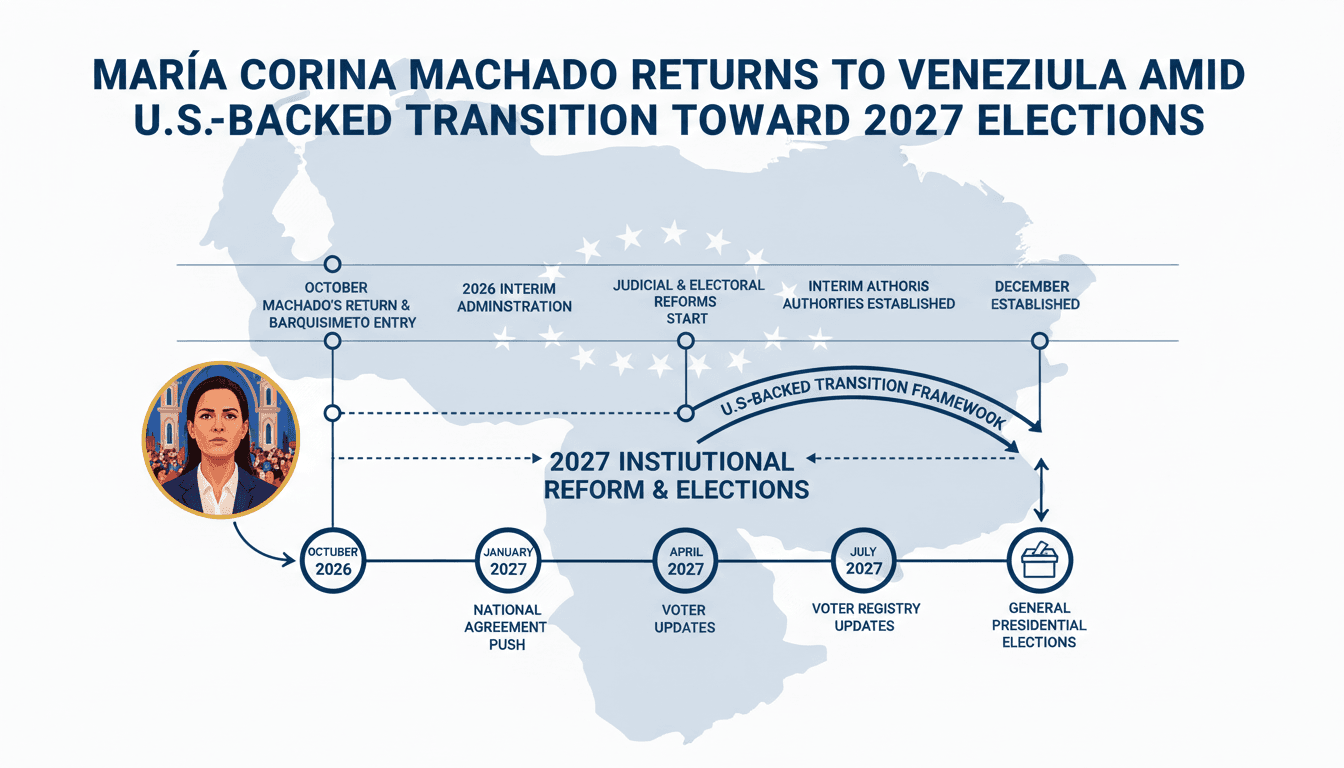
- The return: María Corina Machado, opposition leader and 2025 Nobel Peace Prize laureate, returned to Venezuela on October 25, 2026, ending 10 months of exile following an arrival in Barquisimeto after seven failed prior attempts.
- The institutional roadmap: In public statements delivered in Caracas on October 29, Machado backed a three-phase transition designed to overhaul electoral and judicial bodies ahead of scheduled national voting.
- The external alignment: U.S. officials, led by Secretary of State Marco Rubio, confirmed diplomatic coordination behind her travel, validating an operational plan that targets a formal presidential vacancy declaration and elections in 2027.
The context you actually need
- The power shift: The transition began following the January 2026 removal of Nicolás Maduro by U.S. forces on narcotics trafficking charges, leaving state operations under interim leadership headed by Delcy Rodríguez.
- The interim concession: Rodríguez’s interim administration confirmed its commitment to conduct open elections under a restructured National Electoral Council, though specific operational dates remain unassigned.
- The electoral baseline: Independent data from polling firm Poder y Estrategia released via El Mundo pegged voter support for Machado at 68% as of October 2026, creating structural incentives for opposition-driven ballot reforms.
What's really happening
The physical arrival of María Corina Machado in Barquisimeto and her subsequent briefings in Caracas signal the operational transition from contested authority to an internationally mediated political roadmap. This shift is not governed by spontaneous shifts in political sentiment; it is structured around specific incentives binding the current interim authorities in Caracas, domestic opposition networks, and external policymakers in Washington.
For interim president Delcy Rodríguez and the administrative apparatus remaining after January 2026, agreeing to institutional renegotiations provides immediate administrative survival and an orderly pathway to engage with international bodies. Unilateral governance without clear succession benchmarks carries sustained geopolitical containment risks. Conceding institutional revisions—specifically the reconstitution of the electoral authority—allows the interim executive to de-escalate external friction while managing domestic transition timelines without facing immediate administrative collapse.
For the opposition coalition, Machado’s return solves a severe coordination bottleneck. Leading institutional campaigns from exile created communication frictions and left domestic networks vulnerable to fragmentation. Operating within the country permits the direct verification of voter rolls and anchors the three-phase roadmap involving legal, judicial, and electoral reforms. Machado’s endorsement of a structured, multi-stage timeline demonstrates a trade-off: accepting that national elections will not happen immediately, in exchange for structural changes that make 2027 elections enforceable.
External stakeholders, primarily represented by U.S. Secretary of State Marco Rubio, are prioritizing predictable institutional sequencing over ad-hoc political interventions. Washington’s initial post-January strategy involved postponing rapid electoral contests to prevent governance vacuums. Backing a sequenced framework anchored by judicial reform, voter registry updates, and an eventual formal vacancy declaration aligns external oversight with domestic enforcement.
Financial and commercial markets have displayed constrained immediate pricing shifts, reflecting that raw political announcements do not alter macro metrics until regulatory systems change. The underlying mechanism being constructed is an institutional pathway where foreign capital, multinational entities, and multilateral organizations can price long-term transition risk against specific reform milestones rather than unpredictable administrative changes.
Who feels it first (and how)
- Emerging market sovereign debt analysts: Must recalibrate risk premiums and recovery models around an operational 2027 transition window rather than open-ended political stalemate.
- Regional multinational operations heads: Face operational planning requirements around updating regulatory compliance postures as the national judiciary and commercial codes prepare for revision.
- Electoral administration and legal specialists: Encounter immediate workload increases centered on auditing voter registries, establishing civic consensus protocols, and revising statutory frameworks.
- Cross-border trade operators in Latin America: Gain clearer lead times for regional supply chain reassessments and commercial normalization discussions with Venezuelan entities.
What to watch next
- Electoral authority reconstitution: The names and affiliations appointed to lead the updated electoral body will indicate the technical neutrality of the process.
- Voter registry operational audits: The speed and transparency of updates applied to domestic and diaspora voter rolls will signal whether 2027 deadlines remain achievable.
- Enactment of the three-phase legal package: Legislative and judicial decrees issued by interim bodies will reveal whether the interim executive is honoring the commitments outlined by Machado and U.S. officials.
Machado arrived in Barquisimeto on October 25, 2026, ending 10 months of exile; the interim administration committed to elections under a restructured electoral council; and recent polling by Poder y Estrategia measures support for Machado at 68%.
The formalized three-phase transition framework will guide administrative discussions and bilateral communications through the remainder of 2026.
The exact date for the 2027 presidential election, the specific legal timeline for the formal declaration of presidential vacancy, and the precise timeline for institutional economic recovery.
Frequently Asked Questions
- Why it matters?
- The formal activation of a managed transition framework in Caracas provides global operators with a defined benchmark for emerging market risk reassessment, political continuity, and public-sector reform timelines.
- What happened (in 30 seconds)?
- The return: María Corina Machado, opposition leader and 2025 Nobel Peace Prize laureate, returned to Venezuela on October 25, 2026, ending 10 months of exile following an arrival in Barquisimeto after seven failed prior attempts. The institutional roadmap: In public statements delivered in Caracas on October 29, Machado backed a three-phase transition designed to overhaul electoral and judicial bodies ahead of scheduled national voting. The external alignment: U.S. officials, led by Secretary of
- What's really happening?
- The physical arrival of María Corina Machado in Barquisimeto and her subsequent briefings in Caracas signal the operational transition from contested authority to an internationally mediated political roadmap. This shift is not governed by spontaneous shifts in political sentiment; it is structured around specific incentives binding the current interim authorities in Caracas, domestic opposition networks, and external policymakers in Washington. For interim president Delcy Rodríguez and the adm
- Who feels it first (and how)?
- Emerging market sovereign debt analysts: Must recalibrate risk premiums and recovery models around an operational 2027 transition window rather than open-ended political stalemate. Regional multinational operations heads: Face operational planning requirements around updating regulatory compliance postures as the national judiciary and commercial codes prepare for revision. Electoral administration and legal specialists: Encounter immediate workload increases centered on auditing voter registrie
- What to watch next?
- Electoral authority reconstitution: The names and affiliations appointed to lead the updated electoral body will indicate the technical neutrality of the process. Voter registry operational audits: The speed and transparency of updates applied to domestic and diaspora voter rolls will signal whether 2027 deadlines remain achievable. Enactment of the three-phase legal package: Legislative and judicial decrees issued by interim bodies will reveal whether the interim executive is honoring the commi
Coverage of national news and issues shaping the United States, including politics, economy, and society.
"The Wall Street Journal is one of the most respected financial and news publications in the U.S., known for its rigorous reporting and center-right editorial perspective."
— A47 Editor
Opinion | María Corina Machado Brings New Hope to Venezuela
Venezuelan opposition leader and Nobel laureate María Corina Machado returned to Venezuela on Sunday, October 25, after roughly ten months in exile, posting "I am here. With you." Her return came about a month after the U.S. military deposed former P...
Reporting on North, Central, and South America, plus the Caribbean.
"The Guardian is known for its progressive editorial stance and in-depth analysis."
— A47 Editor
María Corina Machado thanks Donald Trump and Marco Rubio for their actions in Venezuela - video
Venezuelan opposition leader María Corina Machado has thanked US President Donald Trump and Secretary of State Marco Rubio for their role in ousting Nicolás Maduro, who was captured by the Trump administration on 3 January and faces US drug trafficki...
Global news coverage with extensive reporting on Middle Eastern conflicts and geopolitics.
"Al Jazeera is a Qatar-based broadcaster known for wide regional coverage and alternative perspectives."
— A47 Editor
Venezuela’s Machado lauds Trump for ‘freedom’, urges 2027 elections
María Corina Machado, Venezuela's opposition leader and Nobel Peace Prize laureate, returned to Venezuela after roughly ten months in exile, announcing her homecoming on X with the post "I'm here. With you." Her return came as national protests deman...
Comprehensive coverage of Middle Eastern and global issues.
"Al Jazeera is a prominent voice from the Global South, especially the Middle East, with an emphasis on underreported stories."
— A47 Editor
Venezuela’s Machado lauds Trump for ‘freedom’, urges 2027 elections
María Corina Machado, Venezuela's opposition leader and Nobel Peace Prize laureate, returned to Venezuela after roughly ten months in exile, announcing her homecoming on X with the post "I'm here. With you." Her return came as national protests deman...