
Netanyahu Presses Trump for Post-Midterm Strikes on Iran as Qatar-Mediated Talks Continue
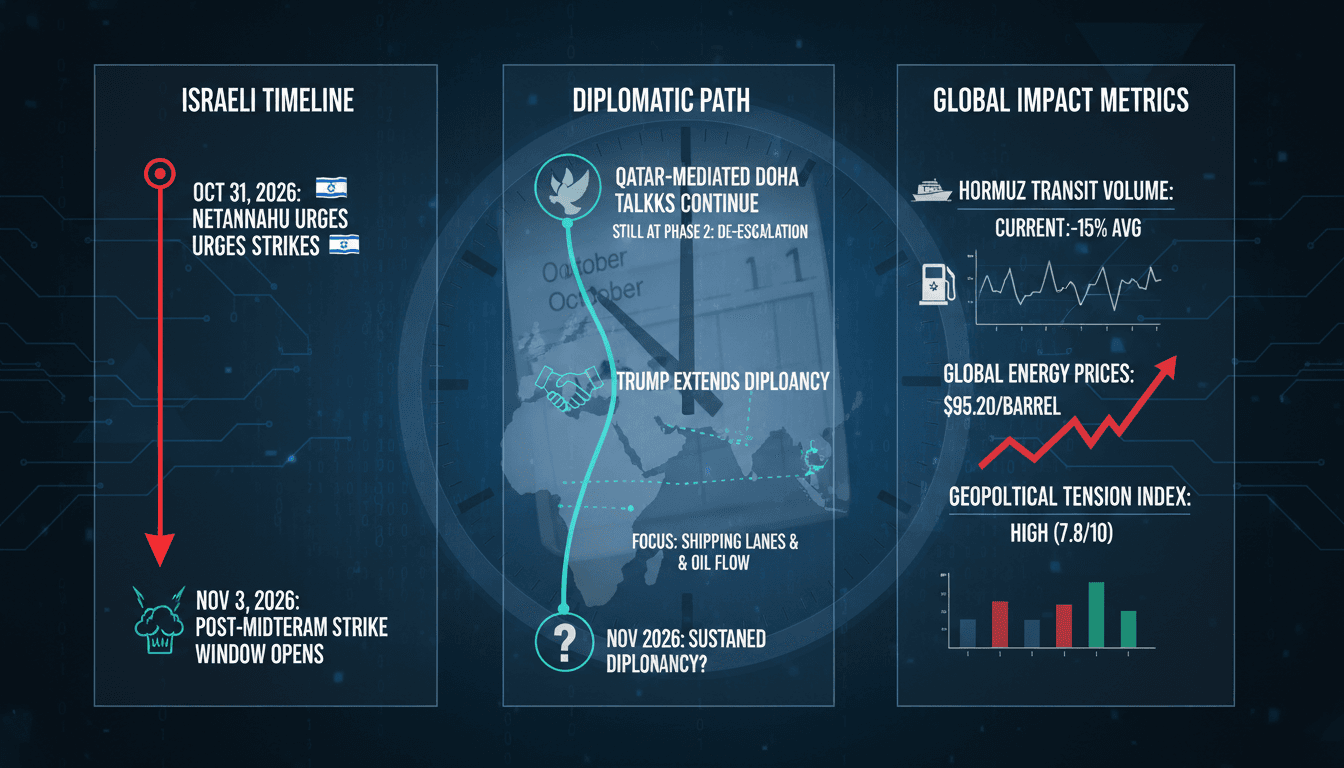
Sustained instability around the Strait of Hormuz directly threatens international shipping lines, driving up regional supply chain expenses and energy import overhead for global business operators.
Why it matters
The debate over whether to resume military operations against Iranian targets or preserve Qatari-brokered talks dictates the flow of Gulf maritime commerce and the baseline volatility of global fuel markets.
What happened (in 30 seconds)
- Direct leader engagement: On October 31, 2026, Israeli Prime Minister Benjamin Netanyahu urged U.S. President Donald Trump during a phone call to resume military strikes on Iran immediately following the November 3 U.S. midterm elections.
- Diverging strategic preferences: While Israeli leadership presented intelligence regarding Iranian nuclear reconstitution to justify prompt action, Trump maintained that current Qatari-mediated negotiations are proceeding satisfactorily and noted no immediate urgency.
- Active operational preparations: U.S. Secretary of State Marco Rubio confirmed that no final determination on strikes has been reached, even as military contingency planning for post-election scenarios remains underway alongside a third day of talks in Doha.
The context you actually need
- An eight-month regional conflict: Joint military operations began on February 28, 2026, leading to Iranian retaliatory strikes and establishing an ongoing cycle of targeted actions and temporary pauses.
- Short-lived diplomatic frameworks: A memorandum of understanding reached on June 17, 2026, established a diplomatic channel that paused hostilities for three weeks before operational friction resumed.
- Maritime corridor disruption: Continuing security risks across the Strait of Hormuz have constrained oil exports from the Gulf, creating persistent cost pressures across international freight and domestic fuel markets.
What's really happening
The strategic divide between Washington and Tel Aviv centers on conflicting timelines and tactical incentives. Israeli defense planning views the post-midterm window as an operational requirement. From this perspective, Iranian efforts to reconstitute nuclear infrastructure present a closing window for deterrence. The assessment shared with U.S. officials highlights active work at specialized facilities, with Israeli leadership arguing that delay allows Tehran to harden critical sites against conventional penetration.
Conversely, the U.S. posture is anchored in the utility of leverage. Trump publicly indicated that diplomatic talks are progressing without immediate pressure to act, pointing to just 1 to 2 remaining nuclear-related sites that require strategic attention. By prioritizing the Doha negotiation track mediated by Qatar, Washington seeks to secure structural concessions without absorbing the immediate economic consequences of renewed military conflict. A central component of these talks is a mechanism to restore unhindered navigation through the Strait of Hormuz, an outcome that directly serves international market stabilization.
Tehran’s strategy mirrors this economic pressure point. Iranian Foreign Minister Abbas Araghchi has conditioned diplomatic movement on reciprocal U.S. commitments. By leveraging access to the Strait of Hormuz—previously offering a seven-day reopening framework in exchange for sanctions relief, which Washington rejected—Iran maintains operational leverage over global energy logistics. The narrowing of proposed maritime corridors keeps regional shipping insurers and energy buyers on high alert.
Regional states, including Bahrain, along with international observers such as Russia, continue to urge adherence to the June 17 framework. For regional hubs like Dubai, the persistence of this conflict translates directly into higher logistics costs, fluctuating commercial marine insurance premiums, and elevated baseline fuel costs. Until Washington chooses between finalizing the Doha framework or authorizing post-election strikes, international operators face an operational environment shaped by continuous supply-chain contingency planning.
Who feels it first (and how)
- Gulf logistics and maritime operators: Shipping fleets navigating the Strait of Hormuz absorb higher security compliance overhead, extended transit times, and persistent war-risk insurance premiums.
- Energy-intensive corporations: Industrial manufacturers and airlines encounter persistent input-cost volatility tied directly to disruptions in Persian Gulf crude and product flows.
- Dubai-based commercial enterprises: Local businesses face elevated transport and utility costs driven by prolonged regional energy distribution bottlenecks.
- Defense and contingency planners: Regional security teams must continuously hedge against rapid escalation cycles scheduled around U.S. electoral and political milestones.
What to watch next
- Doha negotiation milestones: The conclusion of the three-day Qatari-mediated talks will indicate whether Iran and the U.S. can reach an enforceable deal on Strait of Hormuz commercial passage.
- Post-November 3 U.S. deployments: Operational troop movements, carrier strike group positioning, or changes in regional readiness will signal whether Washington is leaning toward deterrence or kinetic strikes.
- Iranian diplomatic feedback: Formal responses from Iranian Foreign Minister Abbas Araghchi regarding sanctions relief terms will clarify whether the June 17 framework remains salvageable.
Netanyahu asked Trump to initiate strikes on Iran after the November 3 midterm elections; Trump favored ongoing negotiations; 1 to 2 nuclear-related sites remain primary targets of concern.
The Strait of Hormuz will remain subject to periodic operational friction and commercial transit restrictions until a verified bilateral agreement is implemented.
Whether the U.S. administration will authorize joint military actions if the current round of Qatari-led mediation fails to produce maritime transit guarantees.
Frequently Asked Questions
- Why it matters?
- The debate over whether to resume military operations against Iranian targets or preserve Qatari-brokered talks dictates the flow of Gulf maritime commerce and the baseline volatility of global fuel markets.
- What happened (in 30 seconds)?
- Direct leader engagement: On October 31, 2026, Israeli Prime Minister Benjamin Netanyahu urged U.S. President Donald Trump during a phone call to resume military strikes on Iran immediately following the November 3 U.S. midterm elections. Diverging strategic preferences: While Israeli leadership presented intelligence regarding Iranian nuclear reconstitution to justify prompt action, Trump maintained that current Qatari-mediated negotiations are proceeding satisfactorily and noted no immediate u
- What's really happening?
- The strategic divide between Washington and Tel Aviv centers on conflicting timelines and tactical incentives. Israeli defense planning views the post-midterm window as an operational requirement. From this perspective, Iranian efforts to reconstitute nuclear infrastructure present a closing window for deterrence. The assessment shared with U.S. officials highlights active work at specialized facilities, with Israeli leadership arguing that delay allows Tehran to harden critical sites against co
- Who feels it first (and how)?
- Gulf logistics and maritime operators: Shipping fleets navigating the Strait of Hormuz absorb higher security compliance overhead, extended transit times, and persistent war-risk insurance premiums. Energy-intensive corporations: Industrial manufacturers and airlines encounter persistent input-cost volatility tied directly to disruptions in Persian Gulf crude and product flows. Dubai-based commercial enterprises: Local businesses face elevated transport and utility costs driven by prolonged regi
- What to watch next?
- Doha negotiation milestones: The conclusion of the three-day Qatari-mediated talks will indicate whether Iran and the U.S. can reach an enforceable deal on Strait of Hormuz commercial passage. Post-November 3 U.S. deployments: Operational troop movements, carrier strike group positioning, or changes in regional readiness will signal whether Washington is leaning toward deterrence or kinetic strikes. Iranian diplomatic feedback: Formal responses from Iranian Foreign Minister Abbas Araghchi regard
Arabic-language coverage of international news and geopolitics.
"RT Arabic is a Russian state-funded outlet often criticized for promoting Kremlin-aligned narratives."
— A47 Editor
أكسيوس: نتنياهو يضغط على ترامب لضرب إيران بعد الانتخابات الأمريكية والأخير يميل للتفاوض
Axios reported that Israeli Prime Minister Benjamin Netanyahu is pressing U.S. President Donald Trump to resume strikes on Iran immediately after the November 3 congressional elections, while Trump reportedly leans toward negotiations with Tehran.
Jordanian news and regional updates.
"Roya News is a Jordanian outlet focused on breaking news and local affairs."
— A47 Editor
أكسيوس يكشف تفاصيل اتصال حاد بين ترمب ونتنياهو حول استئناف العمليات العسكرية ضد طهران
Axios has revealed details of a sharp and escalating divergence in positions between Washington and Tel Aviv, centered on a tense phone call between President Donald Trump and Prime Minister Benjamin Netanyahu over resuming military operations agains...
Jordanian news and regional updates.
"Roya News is a Jordanian outlet focused on breaking news and local affairs."
— A47 Editor
أكسيوس: ترمب قد يأمر بشن ضربات على إيران إذا مُني الجمهوريون بهزيمة في انتخابات التجديد النصفي
Axios, citing a U.S. official, reported that President Donald Trump may order strikes on Iran if Republicans suffer a defeat in the midterm elections, according to the base report published by Royanews.
Pan-Arab political news and analysis.
"Al-Quds Al-Arabi is a London-based Arabic newspaper known for political coverage."
— A47 Editor
بضغوط من نتنياهو… أكسيوس: ترمب قد يأمر بعملية عسكرية ضد إيران إذا خسر الجمهوريون انتخابات التجديد النصفي
Axios, citing American sources, reports growing signs that President Donald Trump may order a new military escalation against Iran, as regional diplomatic efforts accelerate to prevent a renewed war. Israeli pressure reportedly calls for a joint mili...