
Pentagon Mandates 90-Day Operational Self-Sufficiency for Major Continental U.S. Military Bases Under FORTRESS Initiative
Why it matters
The formal transition of sovereign military installations toward 90-day off-grid survivability signals an institutional hedge against domestic cyberattacks, physical sabotage, and systemic grid collapse during multi-front conflict scenarios.
What happened (in 30 seconds)
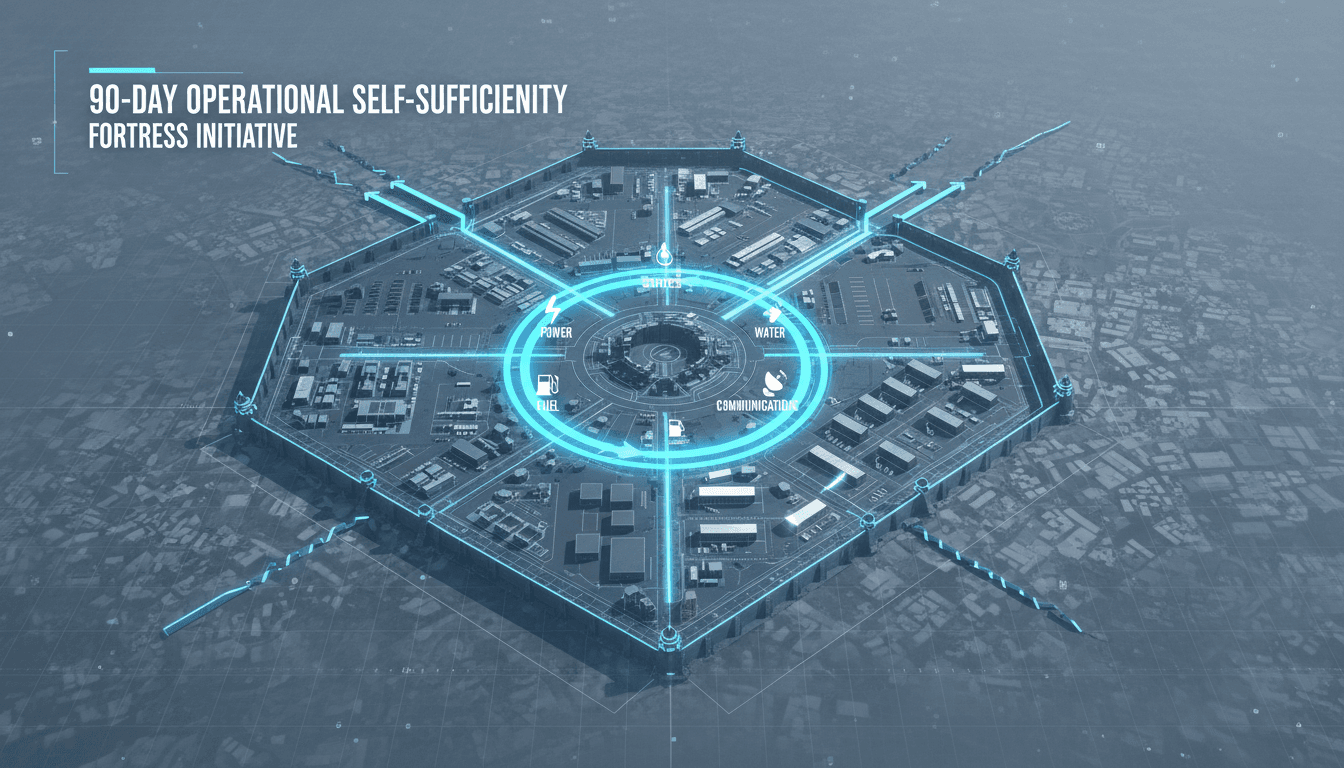
- The FORTRESS directive surfaced: The Department of Defense confirmed a requirement under the FORTRESS (Federal Operations for Resilience, Troop Resources, Energy, Supply, and Survivability) initiative requiring continental U.S. military bases to maintain operational self-sufficiency for at least 90 days.
- The operational scope emerged: Unveiled by Secretary of Defense Pete Hegseth and reported by The Washington Times on October 27, 2026, the mandate focuses on independent power generation—including small nuclear reactors—water reserves, dedicated fuel caches, and isolated communications.
- The oversight engine formed: The Pentagon established that an implementation office reporting to Under Secretary of War for Acquisition and Sustainment Michael Duffey would launch by October 30, 2026, to oversee baseline resilience reviews.
The context you actually need
- The civilian grid dependency: Defense installations across the continental United States historically draw the vast majority of their standard electricity, water, and baseline municipal inputs directly from civilian public utilities, creating exposure to domestic grid shocks.
- The scale of review: Approximately 500 domestic military installations are currently undergoing baseline logistical and energy assessments to determine structural deficits against the new three-month target.
- The strategic reassessment: The initiative marks a formal operational transition away from reliance on commercial supply lines during active multi-theater warfare scenarios involving peer state actors.
What's really happening
The FORTRESS initiative represents a structural re-engineering of domestic military posture. For decades, military logistics models assumed the continental homeland operated as a protected rear area. Supply chains operated on lean principles, drawing power from local regional grids, relying on civilian municipal water authorities, and contracting domestic communications throughput from private telecommunications carriers. The Pentagon’s move to enforce a 90-day operational perimeter indicates that defense leadership no longer assumes domestic sanctuary during peer-level confrontation.
The mechanical friction centers on base islanding. Under the direction announced by Secretary of Defense Pete Hegseth on September 30, 2026, in Quantico, Virginia, domestic installations are tasked with surviving complete severance from public utilities without degrading mission execution. As Pentagon Chief Spokesperson Sean Parnell indicated, uninterrupted reliance on civilian infrastructure introduces an intolerable operational liability when external actors possess cyberwarfare and sabotage capabilities capable of destabilizing domestic systems.
Achieving 90 days of disconnected resilience across roughly 500 bases alters federal procurement incentives. Traditional backup diesel generators generally support critical command facilities for 72 hours to seven days before requiring fuel replenishment. Bridging the gap to 90 days necessitates an entirely different capital architecture: microgrids, long-duration energy storage, on-site water extraction and closed-loop filtration, dedicated communications channels, and distributed generation sources, including small modular nuclear reactors.
Because baseline assessments are managed under Michael Duffey, the Under Secretary for Acquisition and Sustainment, the program shifts resilience from a theoretical planning consideration to a binding procurement metric. The implementation framework will audit current gaps, assign risk profiles to critical nodes, and channel capital toward infrastructure that can run in complete isolation. As independent defense analysts from institutions such as the Center for Strategic and International Studies note, the operational targets are demanding, with full execution costs and multi-year rollout schedules still to be codified as assessments conclude.
Who feels it first (and how)
- Defense Infrastructure Contractors: Engineering and facility maintenance firms will see procurement tenders shift toward microgrid deployment, on-site fuel containment, and water recycling architectures.
- Advanced Energy and Small Nuclear Developers: Providers of small modular reactors and distributed off-grid systems will encounter immediate federal demand as bases look to replace legacy diesel setups with long-duration generation.
- Regional Civilian Utilities: Public power and water authorities adjacent to major continental installations will navigate reduced military reliance, shifting capacity planning as bases establish separate utility perimeters.
- Supply Chain and Defense Logistics Planners: Operators managing military procurement contracts must align shipping schedules, depot storage limits, and localized inventory stockpiles with a strict 90-day isolation buffer.
What to watch next
- The standup of the FORTRESS program office: Look for the formal administrative operationalization under Under Secretary Michael Duffey, which sets the evaluation criteria for base compliance.
- The completion of the 500-base baseline review: Initial assessment data will reveal the capital gap between current 72-hour emergency reserves and the mandated 90-day standard.
- Procurement notices for localized nuclear power: The release of defense solicitations specifying small modular reactor deployments will indicate how aggressively the Pentagon plans to phase out commercial grid dependence.
The Pentagon has issued the FORTRESS directive setting a 90-day self-sufficiency benchmark for major continental U.S. bases covering energy, fuel, water, and communications, led by an office reporting to Under Secretary Michael Duffey.
Meeting the three-month isolation target will accelerate federal capital allocation toward on-site generation technologies, microgrid automation, and specialized energy storage solutions across continental facilities.
The total fiscal budget required to transition approximately 500 installations, the firm compliance deadlines for individual bases, and the exact regulatory approvals needed for wide-scale deployment of on-base nuclear reactors remain unconfirmed.
Frequently Asked Questions
- Why it matters?
- The formal transition of sovereign military installations toward 90-day off-grid survivability signals an institutional hedge against domestic cyberattacks, physical sabotage, and systemic grid collapse during multi-front conflict scenarios.
- What happened (in 30 seconds)?
- The FORTRESS directive surfaced: The Department of Defense confirmed a requirement under the FORTRESS (Federal Operations for Resilience, Troop Resources, Energy, Supply, and Survivability) initiative requiring continental U.S. military bases to maintain operational self-sufficiency for at least 90 days. The operational scope emerged: Unveiled by Secretary of Defense Pete Hegseth and reported by The Washington Times on October 27, 2026, the mandate focuses on independent power generation—includi
- What's really happening?
- The FORTRESS initiative represents a structural re-engineering of domestic military posture. For decades, military logistics models assumed the continental homeland operated as a protected rear area. Supply chains operated on lean principles, drawing power from local regional grids, relying on civilian municipal water authorities, and contracting domestic communications throughput from private telecommunications carriers. The Pentagon’s move to enforce a 90-day operational perimeter indicates th
- Who feels it first (and how)?
- Defense Infrastructure Contractors: Engineering and facility maintenance firms will see procurement tenders shift toward microgrid deployment, on-site fuel containment, and water recycling architectures. Advanced Energy and Small Nuclear Developers: Providers of small modular reactors and distributed off-grid systems will encounter immediate federal demand as bases look to replace legacy diesel setups with long-duration generation. Regional Civilian Utilities: Public power and water authorities
- What to watch next?
- The standup of the FORTRESS program office: Look for the formal administrative operationalization under Under Secretary Michael Duffey, which sets the evaluation criteria for base compliance. The completion of the 500-base baseline review: Initial assessment data will reveal the capital gap between current 72-hour emergency reserves and the mandated 90-day standard. Procurement notices for localized nuclear power: The release of defense solicitations specifying small modular reactor deployments
Conservative-leaning political and national coverage.
"The Washington Times is a conservative-leaning newspaper known for its political coverage and advocacy of right-of-center viewpoints."
— A47 Editor
Pentagon says every base should be fully self-sufficient for at least 90 days
The Pentagon has set a goal that every major U.S. military base should be able to operate for at least 90 days without outside help, such as civilian power or supply chains, in the event a war disrupts those networks. The Washington Times reported th...
Corporate leadership, finance, technology, and market trends.
"Fortune covers financial trends, leadership, and innovation with a pragmatic editorial approach."
— A47 Editor
Pentagon orders bases to plan for 90 days without the grid as Britain urges families to stockpile food and water
The Pentagon has ordered U.S. military bases to plan for 90 days of operation without the electrical grid, while the British government urges families to stockpile food and water, as both allied governments prepare for cyberattacks and sabotage that ...
U.S. political news and right-leaning commentary.
"Fox News is a highly influential conservative news outlet known for right-leaning political commentary and coverage."
— A47 Editor
Inside the Pentagon's doomsday plan to keep America fighting if global war erupts
The Pentagon's FORTRESS initiative, as reported by Fox News, requires every major U.S. military base to sustain operations for 90 days without civilian power or supply chains, a planning posture aimed at keeping American forces fighting if a global w...