
Iran Convenes Saudi, Turkish and Pakistani Security Officials in Tehran Amid Houthi Escalation and Regional War Risks
Why it matters
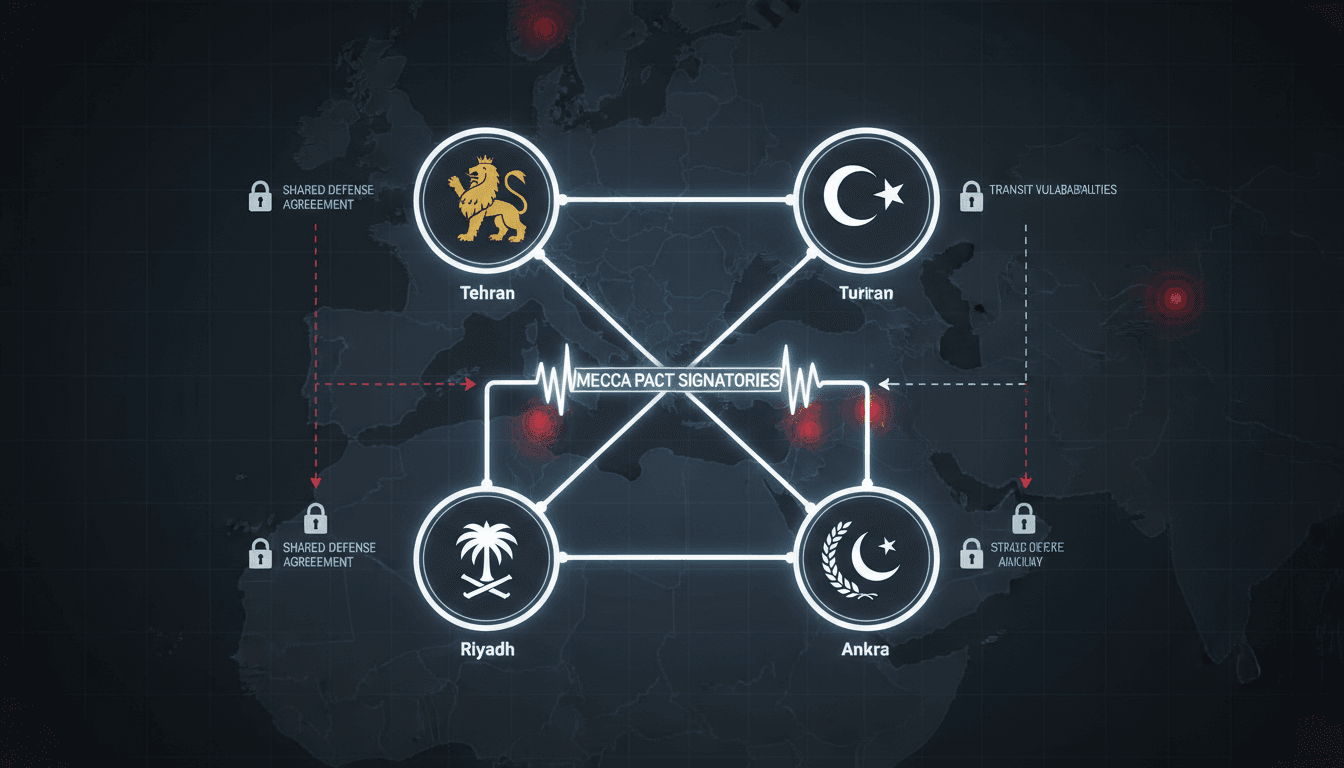
The direct meeting between Iran and the three Mecca Joint Defense Agreement members creates an endogenous diplomatic backchannel designed to contain conflict spillovers without relying on external security guarantees.
What happened (in 30 seconds)
- High-level talks in Tehran: On October 26, 2026, Iranian President Masoud Pezeshkian hosted Saudi Defense Minister Prince Khalid bin Salman, Pakistani army chief Field Marshal Asim Munir, and Turkish intelligence chief Ibrahim Kalin.
- Mecca Pact framework: The talks served as the first high-level engagement between the signatories of the August 7, 2026 Mecca Joint Defense Agreement—Saudi Arabia, Turkey, and Pakistan—and the Iranian leadership.
- Dialogue without formal accord: The delegations focused on de-escalating tensions from recent Houthi strikes on Saudi Arabia and broader regional hostilities, agreeing to sustain dialogue while announcing no concrete operational agreements.
The context you actually need
- A multi-front escalation: The diplomatic engagement unfolded against the backdrop of renewed regional armed conflict that erupted in late February 2026 involving Iran, the United States, and Israel, alongside October 2026 Houthi strikes targeting Saudi territory.
- The August mutual defense pact: Saudi Arabia, Turkey, and Pakistan established mutual defense commitments under the Mecca Joint Defense Agreement on August 7, 2026, altering the collective security architecture across South Asia and the Middle East.
- Parallel mediation tracks: In parallel with the four-way talks, established mediation channels facilitated by Qatar and Pakistan have targeted disputes surrounding nuclear facilities and maritime security across the Strait of Hormuz.
What's really happening
The Tehran summit reveals an incentive-driven pivot toward local containment among regional powers operating under active wartime pressures. Rather than outsourcing conflict resolution to external actors, the four states are using direct, multilateral communication to establish immediate guardrails against unintended escalations.
For Iran, hosting the defense and intelligence leadership of Saudi Arabia, Turkey, and Pakistan serves a distinct operational objective: building an endogenous regional security dialogue that functions outside Western influence. Facing military pressure from the United States and Israel since February 2026, Tehran requires functional diplomatic channels with its immediate neighbors to reduce the risk of multi-front encirclement. By engaging the signatories of the Mecca Joint Defense Agreement collectively, Iranian officials aim to signal that regional stability can be managed internally, even as cross-border tensions persist.
For the Mecca Pact signatories, participation reflects clear institutional self-interest. Saudi Arabia's primary operational vulnerability stems from Houthi strikes on domestic infrastructure, exemplified by the October 2026 escalations. Engaging Tehran directly allows Riyadh to test whether diplomatic engagement can suppress regional proxy actions that threaten economic assets and critical transport corridors. However, Saudi statements carefully emphasized dialogue promotion over formal commitments, avoiding premature policy concessions while Turkey's parliament continues its formal review of the Mecca Pact.
Turkey and Pakistan bring distinct institutional incentives to the table. Ankara seeks to balance its mutual defense commitments with its public stance ruling out direct military exposure in theater zones like Yemen. Managing direct ties with Iranian intelligence chief Mohsen Rezaei and President Pezeshkian provides Turkish intelligence with early visibility into regional operations. Pakistan, maintaining deep security ties with Saudi Arabia alongside an immediate land border with Iran, requires stability on its western flank. Islamabad's dual role—condemning Houthi attacks while facilitating mediation over the Strait of Hormuz—demonstrates how non-Arab pact members are hedging against regional energy shocks.
Ultimately, the meeting does not represent a resolved security compact. Instead, it constitutes an operational buffer. The absence of a formal treaty or joint communiqué confirms that all four states remain constrained by divergent strategic goals. Yet, the reality that defense ministers and intelligence chiefs convened at a single table amid active hostilities confirms that every participant views direct communication as cheaper than uncontrolled escalation.
Who feels it first (and how)
- Gulf logistics and maritime fleet operators: Shipping managers monitoring the Strait of Hormuz gain an operational indicator of whether regional de-escalation channels will protect energy lanes from retaliatory disruptions.
- Corporate risk and compliance officers in regional hubs: Strategy teams across GCC markets like Dubai can baseline scenario plans against non-escalation signals, tracking physical asset safety despite elevated regional background tension.
- Energy sector infrastructure operators in Saudi Arabia: Industrial facilities facing exposure to cross-border strikes gain direct visibility into whether Saudi-Iranian discussions lead to a reduction in Houthi operational activity.
- Cross-border trade and supply chain directors across South Asia and Turkey: Turkish and Pakistani industrial exporters face shifting risk premiums tied to the parliamentary integration and territorial commitments of the Mecca Pact.
What to watch next
- Turkish parliamentary action: Watch for the formal vote on the Mecca Joint Defense Agreement in Ankara, which will establish the legal scope and operational limits of Turkish mutual defense commitments.
- Houthi operational tempo: Track whether cross-border drone and missile launches against Saudi critical infrastructure decelerate following the direct discussions in Tehran.
- Follow-up working groups: Monitor whether the four nations formalize a recurring security contact group or if engagement remains ad hoc without technical implementation mechanisms.
Delegations led by Masoud Pezeshkian, Prince Khalid bin Salman, Asim Munir, and Ibrahim Kalin met in Tehran on October 26, 2026, under the Mecca Pact framework without signing a formal agreement.
The Mecca Pact members will leverage backchannel dialogues to insulate national economic infrastructure while avoiding direct military intervention in active combat theaters.
Whether Tehran holds sufficient direct operational leverage over Houthi decision-making to guarantee the sustained pause in strikes sought by Saudi Arabia.
Frequently Asked Questions
- Why it matters?
- The direct meeting between Iran and the three Mecca Joint Defense Agreement members creates an endogenous diplomatic backchannel designed to contain conflict spillovers without relying on external security guarantees.
- What happened (in 30 seconds)?
- High-level talks in Tehran: On October 26, 2026, Iranian President Masoud Pezeshkian hosted Saudi Defense Minister Prince Khalid bin Salman, Pakistani army chief Field Marshal Asim Munir, and Turkish intelligence chief Ibrahim Kalin. Mecca Pact framework: The talks served as the first high-level engagement between the signatories of the August 7, 2026 Mecca Joint Defense Agreement—Saudi Arabia, Turkey, and Pakistan—and the Iranian leadership. Dialogue without formal accord: The delegations focus
- What's really happening?
- The Tehran summit reveals an incentive-driven pivot toward local containment among regional powers operating under active wartime pressures. Rather than outsourcing conflict resolution to external actors, the four states are using direct, multilateral communication to establish immediate guardrails against unintended escalations. For Iran, hosting the defense and intelligence leadership of Saudi Arabia, Turkey, and Pakistan serves a distinct operational objective: building an endogenous regiona
- Who feels it first (and how)?
- Gulf logistics and maritime fleet operators: Shipping managers monitoring the Strait of Hormuz gain an operational indicator of whether regional de-escalation channels will protect energy lanes from retaliatory disruptions. Corporate risk and compliance officers in regional hubs: Strategy teams across GCC markets like Dubai can baseline scenario plans against non-escalation signals, tracking physical asset safety despite elevated regional background tension. Energy sector infrastructure operator
- What to watch next?
- Turkish parliamentary action: Watch for the formal vote on the Mecca Joint Defense Agreement in Ankara, which will establish the legal scope and operational limits of Turkish mutual defense commitments. Houthi operational tempo: Track whether cross-border drone and missile launches against Saudi critical infrastructure decelerate following the direct discussions in Tehran. Follow-up working groups: Monitor whether the four nations formalize a recurring security contact group or if engagement rem
Regional coverage and analysis focused on politics, diplomacy, and business across the Middle East.
"Al-Monitor is known for analytical reporting on Middle East politics and policy developments."
— A47 Editor
How wartime urgency pushed Iran to court Saudi Arabia, Turkey, Pakistan
Iran is seeking a regional security order independent of Washington, and its outreach to Saudi Arabia, Turkey and Pakistan has gained diplomatic momentum as wartime urgency grows. Officials from the Makkah (Mecca) defence pact, led by Saudi Defence M...
Global business headlines with AI angles.
"General business outlet that frequently covers AI."
— A47 Editor
Middle Eastern Powers Met to De-escalate Tensions. Oil Prices Remain Above $110 a Barrel.
Top officials from Saudi Arabia, Turkey and Pakistan traveled to Tehran as fears of renewed escalation between Iran and the United States and Israel grew, with oil prices remaining above $110 a barrel. The mediation effort aims to de-escalate a regio...
Global news coverage with extensive reporting on Middle Eastern conflicts and geopolitics.
"Al Jazeera is a Qatar-based broadcaster known for wide regional coverage and alternative perspectives."
— A47 Editor
Iran says US ‘not serious’ about talks amid Tehran meeting
Officials from Iran, Pakistan, Turkiye and Saudi Arabia held talks in Tehran aimed at stopping further escalation, while Iran said the United States is "not serious" about negotiations, according to Al Jazeera's report on the base story.
Comprehensive coverage of Middle Eastern and global issues.
"Al Jazeera is a prominent voice from the Global South, especially the Middle East, with an emphasis on underreported stories."
— A47 Editor
Iran says US ‘not serious’ about talks amid Tehran meeting
Officials from Iran, Pakistan, Turkiye and Saudi Arabia held talks in Tehran aimed at stopping further escalation, while Iran said the United States is "not serious" about negotiations, according to Al Jazeera's report on the base story.
Editor-curated FT homepage stories spanning markets, business, world, and opinion.
"The Financial Times is a globally respected business publication with a centrist/center-left tone and strong markets focus."
— A47 Editor
Iran hosts regional powers for talks to prevent renewed escalation
Senior security officials from Saudi Arabia, Pakistan and Turkey are set to meet Iranian counterparts in Tehran on Monday in talks aimed at preventing a renewed escalation of regional conflict, according to the Financial Times.
Breaking news, politics, business, and entertainment from the U.S. and around the world.
"The New York Post is a tabloid-format newspaper known for its sensationalist headlines and conservative-leaning editorial tone."
— A47 Editor
Delegations meet in Iran with Middle East on edge over potential for renewed fighting
Officials from Saudi Arabia, Pakistan and Turkey met in Tehran on Monday in an effort to avert a wider war between Iran, Israel and the United States, as concern grows across the Middle East over the possibility of renewed fighting.
Arabic-language coverage of international news and geopolitics.
"RT Arabic is a Russian state-funded outlet often criticized for promoting Kremlin-aligned narratives."
— A47 Editor
طهران: زيارة ممثلي دول تحالف مكة خطوة للتعاون بشأن آليات الأمن الإقليمي
Iran's Foreign Ministry said Tehran's hosting of a high-level security meeting with Saudi Arabia, Pakistan and Turkey, representing the Mecca coalition, is a practical step toward reflecting on and cooperating over regional security mechanisms based ...
UAE-based English-language newspaper covering regional politics, economics, and global affairs.
"The National reflects Emirati policy perspectives while maintaining international editorial standards."
— A47 Editor
Middle East latest: Saudi Arabia leads Makkah pact countries to Tehran for crucial war talks
Saudi Arabia is leading the Makkah defence pact countries, including Turkey and Pakistan, to Tehran for talks described as crucial amid the wider war-related tensions, following Houthi missile and drone attacks that have targeted Saudi infrastructure...