
French Government Advances Joint Liability Bill for Riot Damage Amid Rights Group Opposition
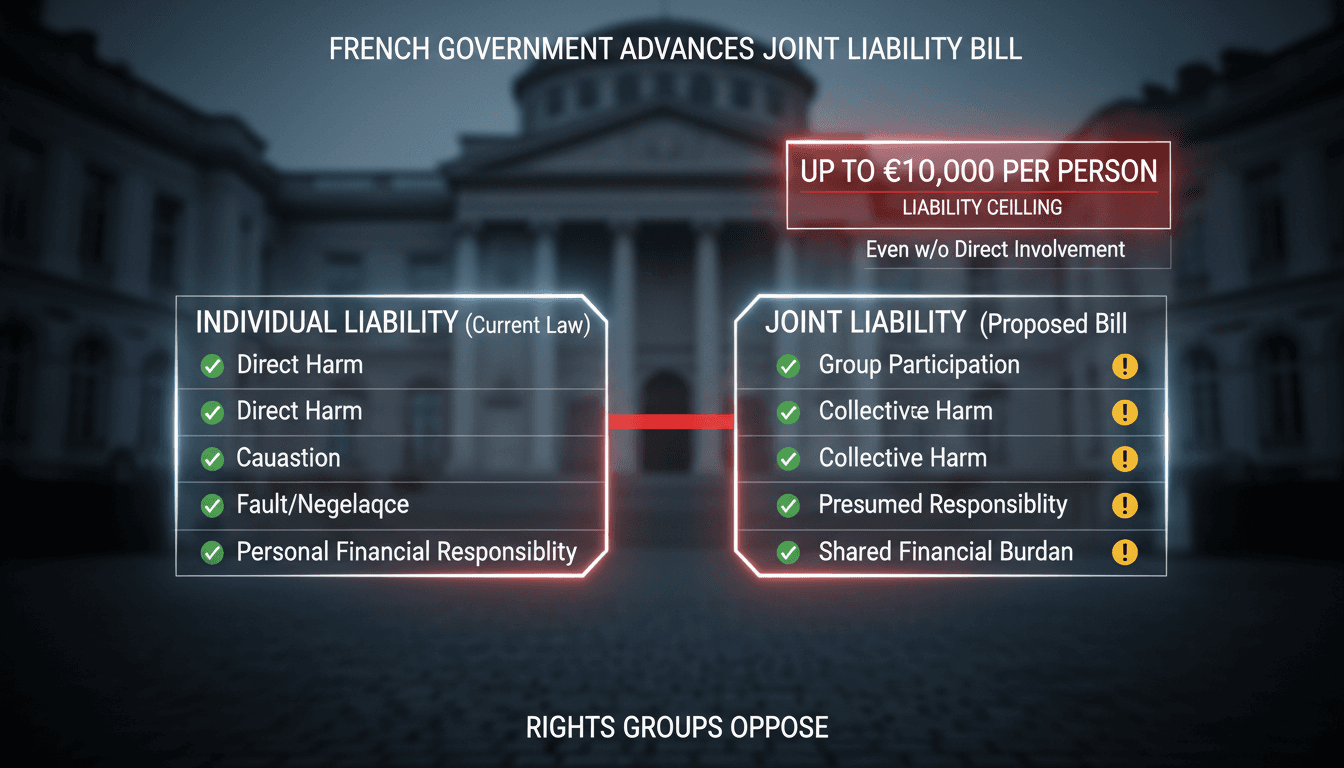
Why it matters
The proposed legal mechanism shifts the financial burden of municipal unrest directly from state budgets to individual demonstration participants via joint civil liability.
What happened (in 30 seconds)
* Legislative push: On October 27, 2026, the French government advanced a draft bill in the Senate establishing joint civil liability for individuals present within groups that cause property damage during public unrest. * Liability threshold: The proposed statute introduces a financial recovery mechanism capped at €10,000 per person, enforceable even without proof of direct individual destruction. * Institutional pushback: Human rights organizations, including Amnesty International and the Human Rights League (LDH), alongside legal associations, warned the measure infringes upon standard assembly rights by instituting collective financial liability.
The context you actually need
* A sequence of costly unrest: The draft measure gained legislative momentum following retail destruction after the May 2026 UEFA Champions League final and subsequent October 17, 2026 protests over living costs and school conditions. * Historical tensions: Preceding domestic demonstrations, including the Yellow Vest movement, repeatedly highlighted the structural conflict between crowd policing practices and commercial business recovery in metropolitan cores. * The fiscal incentive: Facing millions of euros in commercial property losses, policymakers designed the policy framework to reduce state and municipal insurance compensation outlays by extracting civil damages directly from participants.
What's really happening
The mechanics of the "casseurs payeurs" ("rioters pay") draft legislation introduce a structural change in how civil liability functions during public demonstrations. Under standard civil codes, establishing liability requires proving three distinct elements: an individual fault, a quantifiable harm, and a direct causal link connecting the specific person to that specific damage.
The proposed framework alters this threshold by establishing joint liability. Under the text debated on October 27–28, 2026, an individual can be held financially accountable up to €10,000 simply for knowingly participating in an assembly that carries out violence or property damage, or for failing to disperse following official orders. Interior Minister Laurent Nuñez defended the distinction as joint responsibility rather than collective punishment, emphasizing that the mechanism targets groups knowingly engaged in operational disruption.
From an economic perspective, the administration is attempting to alter the incentive structure of street participation. By introducing personal financial exposure—including mechanisms to attach welfare benefits or assign legal liability to parents of participating minors—the policy introduces a quantifiable downside to remaining in proximity to property-destroying factions.
For the state, the primary incentive is cost externalization. Successive waves of civil unrest generated millions of euros in claims for private insurers and municipal funds. When street protests turn destructive, municipal clean-up costs, commercial storefront replacements, and police deployment expenses are traditionally absorbed by public balance sheets and commercial underwriters. Transferring this exposure directly to participants functions as an enforcement tool designed to thin crowd density, making hard-core vandalism groups easier to isolate.
Rights advocates, including the Human Rights League and Amnesty International, point out that this reallocation carries operational friction. Because modern urban protests involve blended crowds of peaceful demonstrators, bystanders, and destructive actors, establishing that someone "knowingly participated" or failed to leave quickly enough creates legal exposure for individuals who committed no physical vandalism. In practice, the burden of financial recovery shifts risk away from institutional underwriters onto everyday civic participants.
Who feels it first (and how)
* Urban commercial operators: Retailers and hospitality chains in major French metropolitan centers observe a potential deterrence mechanism aimed at reducing localized storefront damage. * Protest organizers and labor unions: Civic associations face heightened liability risks, as secondary participation could expose their members to administrative recovery actions. * Working-class households: Families with dependents or individuals dependent on state welfare support face direct liquidity exposure up to the €10,000 cap if named in joint liability orders. * Municipal insurers: Commercial underwriters and municipal funds could see a secondary avenue for subrogation claims, potentially shifting baseline risk pricing.
What to watch next
* Senate amendments on liability caps: Track whether legislative negotiations maintain the €10,000 threshold or adopt higher caps advocated by right-wing lawmakers. * Constitutional review challenges: Watch for formal appeals to the French Constitutional Council, which will evaluate whether the statute satisfies fundamental protections regarding individual fault and freedom of assembly. * Retail insurance adjustments: Observe whether commercial property underwriters modify urban coverage premiums in response to the newly enacted recovery channels.
The French government formally advanced the bill in the Senate on October 27, 2026, setting a €10,000 civil liability ceiling and including provisions targeting welfare allocations and parental accountability.
The bill will encounter protracted legal challenges in constitutional courts due to procedural questions regarding individual attribution in tort law.
Whether joint financial liability will measurably reduce street property damage or simply alter the demographics and tactical posture of urban demonstrations.
Frequently Asked Questions
- Why it matters?
- The proposed legal mechanism shifts the financial burden of municipal unrest directly from state budgets to individual demonstration participants via joint civil liability.
- What happened (in 30 seconds)?
- Legislative push: On October 27, 2026, the French government advanced a draft bill in the Senate establishing joint civil liability for individuals present within groups that cause property damage during public unrest. Liability threshold: The proposed statute introduces a financial recovery mechanism capped at €10,000 per person, enforceable even without proof of direct individual destruction. Institutional pushback: Human rights organizations, including Amnesty International and the Human Righ
- What's really happening?
- The mechanics of the "casseurs payeurs" ("rioters pay") draft legislation introduce a structural change in how civil liability functions during public demonstrations. Under standard civil codes, establishing liability requires proving three distinct elements: an individual fault, a quantifiable harm, and a direct causal link connecting the specific person to that specific damage. The proposed framework alters this threshold by establishing joint liability. Under the text debated on October 27–2
- Who feels it first (and how)?
- Urban commercial operators: Retailers and hospitality chains in major French metropolitan centers observe a potential deterrence mechanism aimed at reducing localized storefront damage. Protest organizers and labor unions: Civic associations face heightened liability risks, as secondary participation could expose their members to administrative recovery actions. Working-class households: Families with dependents or individuals dependent on state welfare support face direct liquidity exposure up
- What to watch next?
- Senate amendments on liability caps: Track whether legislative negotiations maintain the €10,000 threshold or adopt higher caps advocated by right-wing lawmakers. Constitutional review challenges: Watch for formal appeals to the French Constitutional Council, which will evaluate whether the statute satisfies fundamental protections regarding individual fault and freedom of assembly. Retail insurance adjustments: Observe whether commercial property underwriters modify urban coverage premiums in r
24/7 international news from a French perspective in multiple languages.
"France 24 is viewed as a globally focused outlet with balanced coverage and a European perspective."
— A47 Editor
Rights groups say proposed French law to make rioters pay for damage is anti-democratic
French rights groups have criticised a proposed law that would make rioters liable to pay thousands of euros for damage caused during protests, arguing the measure is anti-democratic and could undermine the legitimate right to protest. The government...
Macro commentary, policy analysis, growth/inflation themes, and global outlooks.
"Contextual macro coverage that complements day-to-day market headlines."
— A47 Editor
Critics attack ’anti-democratic’ French bill making rioters pay
Critics have attacked a French bill described as "anti-democratic" that would make rioters pay for damages, according to a report published by Investing.com. The measure has drawn criticism from opponents who argue it undermines democratic principles...
International coverage from The Guardian's global desks.
"The Guardian is known for its progressive editorial stance and in-depth analysis."
— A47 Editor
Macron accused of putting France’s right to protest at risk with ‘vandal’s law’
The Guardian reports that French President Emmanuel Macron faces accusations from trade unions of undermining the fundamental right to protest as the government fast-tracks a bill that would make protesters liable for damage caused by vandalism at st...