
Israel Election Yields No Majority as Netanyahu and Eisenkot Blocs Fall Short of 61 Seats
Why it matters
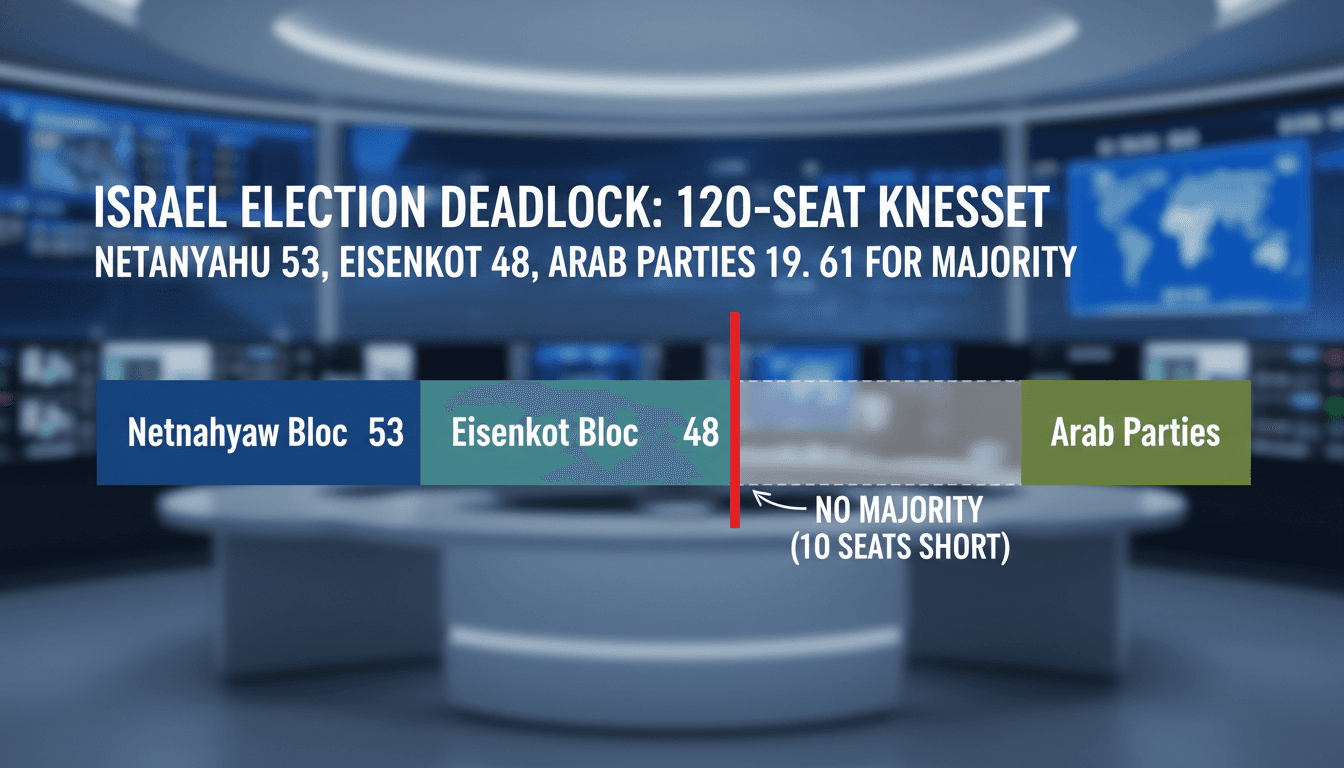
A fractured 120-seat parliament leaves both major coalitions short of a governing majority, risking policy stagnation and repeated snap elections that directly affect regional market sentiment.
What happened (in 30 seconds)
* The ballot failed to produce a viable majority, leaving Prime Minister Benjamin Netanyahu's right-wing bloc at 53 seats and Gadi Eisenkot's opposition bloc at 48 seats. * Arab parties secured a combined 19 seats, creating a structural arithmetic barrier because neither dominant bloc is willing to formalize governing alliances with them. * Turnout reached 77.9 percent, marking the highest participation level in recent electoral cycles despite the resulting mathematical paralysis.
The context you actually need
* A 61-seat threshold is legally required to assemble a cabinet in the 120-member Knesset, a threshold that neither major leader can reach on their own merits. * President Isaac Herzog initiated immediate consultations, launching a constitutionally bounded coalition window that can span up to roughly 100 days before triggering fresh elections. * The contest followed years of chronic instability, compounded by fatigue from multi-front regional conflicts involving Gaza and tensions with Iran, alongside ongoing corruption trials facing the incumbent prime minister.
What's really happening
- A national unity arrangement: A power-sharing compromise between Likud and moderate opposition elements, which would demand substantial platform concessions that neither faction currently signals willingness to yield.
- A minority cabinet: A government constructed by Eisenkot that relies on external votes from Arab parties on confidence measures without offering them cabinet portfolios.
- Targeted factional defections: The peel-off of individual lawmakers or smaller party splinters to lift one of the major blocs past the 61-seat mark.
- Dissolution and repeat elections: An inability to certify a government within the legal timeline, forcing the country back to the polls for another cycle.
Who feels it first (and how)
* Energy and commodities traders: Facing sustained volatility margins as prolonged cabinet formation keeps geopolitical baseline assumptions fluid. * Regional commercial operators in the Gulf: Navigating indirect shifts in market sentiment and hedging currency exposures while regional diplomacy operates in a holding pattern. * Israeli domestic business sectors: Managing domestic capital allocation without confirmed multi-year budget appropriations or legislative clarity on infrastructure priorities. * Public sector administration in Israel: Operating under strict caretaker budget ceilings that restrict statutory funding, appointments, and new discretionary procurement programs.
What to watch next
* The pace of presidential mandates: Isaac Herzog’s official sequence of assigning the initial 28-day formation mandate will determine which leader gets the first mover advantage in luring defectors. * Lieberman and Bennett's coalition maneuvers: Any willingness from right-leaning opposition figures to negotiate with either bloc will signal whether an internal compromise is mathematically viable. * Arab party voting coordination: Decisions by Ra'am and the Joint List to act as a unified external voting bloc could create leverage for an Eisenkot-led minority executive.
Netanyahu secured 53 seats, Eisenkot secured 48 seats, Arab parties hold 19 seats, and voter turnout reached 77.9 percent on October 27, 2026.
The coalition negotiation timeline will extend toward the full 100-day legal envelope as both leaders attempt to force the other into ideological compromises.
Whether either primary faction will ultimately cross its publicly declared red lines to form a minority or unity government, or whether voters will face another election cycle.
Frequently Asked Questions
- Why it matters?
- A fractured 120-seat parliament leaves both major coalitions short of a governing majority, risking policy stagnation and repeated snap elections that directly affect regional market sentiment.
- What happened (in 30 seconds)?
- The ballot failed to produce a viable majority, leaving Prime Minister Benjamin Netanyahu's right-wing bloc at 53 seats and Gadi Eisenkot's opposition bloc at 48 seats. Arab parties secured a combined 19 seats, creating a structural arithmetic barrier because neither dominant bloc is willing to formalize governing alliances with them. Turnout reached 77.9 percent, marking the highest participation level in recent electoral cycles despite the resulting mathematical paralysis.
- What's really happening?
- The impasse in the Knesset is an arithmetic problem created by rigid political red lines. In a 120-seat chamber, forming an executive administration requires a baseline of 61 seats. Benjamin Netanyahu’s right-wing coalition controls 53 seats, while Gadi Eisenkot’s opposition bloc holds 48 seats. Together, the two mainstream Jewish blocs account for 101 seats, but ideological friction and personal rivalries prevent a straightforward partnership. Meanwhile, Arab parties—comprising Ra'am and the Jo
- Who feels it first (and how)?
- Energy and commodities traders: Facing sustained volatility margins as prolonged cabinet formation keeps geopolitical baseline assumptions fluid. Regional commercial operators in the Gulf: Navigating indirect shifts in market sentiment and hedging currency exposures while regional diplomacy operates in a holding pattern. Israeli domestic business sectors: Managing domestic capital allocation without confirmed multi-year budget appropriations or legislative clarity on infrastructure priorities. P
- What to watch next?
- The pace of presidential mandates: Isaac Herzog’s official sequence of assigning the initial 28-day formation mandate will determine which leader gets the first mover advantage in luring defectors. Lieberman and Bennett's coalition maneuvers: Any willingness from right-leaning opposition figures to negotiate with either bloc will signal whether an internal compromise is mathematically viable. Arab party voting coordination: Decisions by Ra'am and the Joint List to act as a unified external votin
Global news coverage with extensive reporting on Middle Eastern conflicts and geopolitics.
"Al Jazeera is a Qatar-based broadcaster known for wide regional coverage and alternative perspectives."
— A47 Editor
How can Israel break its election deadlock?
Israel's national election on October 27, 2026, the first since the October 7, 2023 Hamas attacks, ended without a clear winner, with no party or bloc reaching the 61 seats required in the 120-seat Knesset to form a government. Coverage from multiple...
Comprehensive coverage of Middle Eastern and global issues.
"Al Jazeera is a prominent voice from the Global South, especially the Middle East, with an emphasis on underreported stories."
— A47 Editor
How can Israel break its election deadlock?
Israel's national election on October 27, 2026, the first since the October 7, 2023 Hamas attacks, ended without a clear winner, with no party or bloc reaching the 61 seats required in the 120-seat Knesset to form a government. Coverage from multiple...
International stories from NPR’s global desk.
"NPR is an American public media organization known for thoughtful reporting and a slightly left-leaning editorial tone."
— A47 Editor
Israel is in a political deadlock. What comes next?
Israel's national election on October 27, 2026, the first since the October 7, 2023 Hamas attacks, ended in a deadlock with neither Prime Minister Benjamin Netanyahu's bloc nor the opposition bloc led by Gadi Eisenkot reaching the 61 seats needed for...
International coverage of politics, culture, and current affairs.
"BBC News is widely regarded as a reputable international news organization, known for its impartial tone and public service mandate."
— A47 Editor
How could Israel break election deadlock? Here are four scenarios
Israel's national election on October 27, 2026, the first since the October 7, 2023 Hamas attacks, ended without a clear winner, leaving neither Prime Minister Benjamin Netanyahu's bloc nor the opposition bloc led by former IDF chief of staff Gadi Ei...