
Netanyahu Bloc Falls Short of Knesset Majority With 53 Seats as Coalition Talks Begin
Why it matters
A structural shift in parliamentary arithmetic leaves no faction with a clean governing mandate, creating prolonged policy uncertainty across regional economic and security frameworks.
What happened (in 30 seconds)
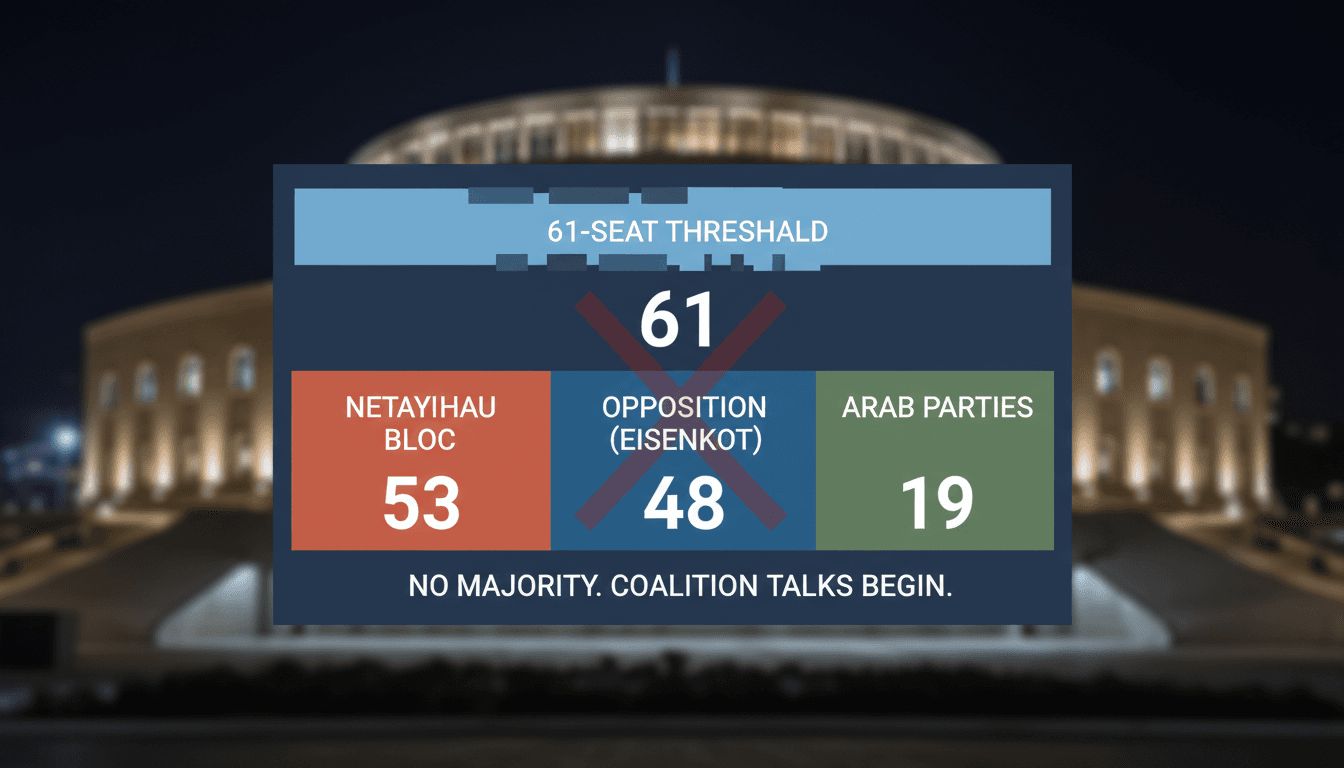
- A 15-seat drop for the incumbent bloc: Benjamin Netanyahu's right-wing alliance secured 53 seats in the October 27, 2026 election, losing 15 seats compared to its previous 68-seat majority and falling well short of the 61-seat threshold.
- An opposition split across two camps: The opposition bloc led by Gadi Eisenkot reached 48 seats, while Arab-led parties took 19 seats, preventing any conventional alliance from assembling an immediate governing coalition.
- A turnout surge drove fragmentation: Official counts confirmed that 77.9% of registered voters cast ballots—totalling 5,716,665 votes—reallocating parliamentary power after final tallies were certified on October 29–30.
The context you actually need
- The prior benchmark was a stable 68-seat majority: Before this election, the governing coalition held 68 seats, giving it sufficient legislative leverage to pass budgets and steer defense policy without balancing fragmented swing factions.
- Arab representation climbed toward two-decade highs: Driven by turnout surges tied to governance and economic concerns, Arab-led parties expanded their footprint to 19 seats, shifting the leverage required to reach the 61-seat governing threshold.
- The institutional calendar imposes strict deadlines: The newly elected Knesset is mandated to convene on November 10, 2026, forcing President Isaac Herzog to begin consultations immediately with faction leaders to designate a negotiating lead.
What's really happening
The election result reflects structural voter reallocation rather than an isolated polling swing. By dropping from 68 seats to 53, the incumbent bloc absorbed a net contraction of 15 seats. In a 120-seat Knesset, crossing the 61-seat threshold requires either ideological homogeneity or transactional alignment. Neither side holds the numbers to execute either strategy smoothly.
The arithmetic breakdown establishes three distinct parliamentary segments: the pro-Netanyahu bloc at 53 seats (with Likud holding 27 seats alongside allied factions), the Gadi Eisenkot-led opposition bloc at 48 seats, and Arab-led parties (Joint List and Ra'am) holding 19 seats. Under standard coalition mechanics, neither major camp can reach 61 seats without negotiating across deep ideological boundaries.
Turnout explains the shift. At 77.9%, voter participation reached its highest level in decades, bringing 5,716,665 citizens to the ballot box. This surge was catalyzed by compounding economic pressures, post-October 2023 security dynamics, and municipal governance grievances within Arab communities. Rather than consolidating support behind the incumbent coalition, high participation translated into a diversified distribution of seats, effectively doubling Arab-led party representation to 19.
Because election officials formally dismissed procedural irregularities during the October 29–30 count, the challenge moves entirely into the negotiation room. Prime Minister Netanyahu has publicly focused on preserving bloc discipline among his 53 allied lawmakers. Concurrently, opposition figures including Yair Lapid have claimed political momentum and initiated preliminary inter-party discussions.
For the regional operator, the mechanism to track is administrative inertia. When parliamentary negotiations stall, interim governments oversee key executive functions. Under an interim structure, major long-term capital projects, bilateral trade pact expansions, and regulatory realignments default to a holding pattern. Until a 61-seat alliance is ratified, sovereign decision-making defaults to continuity management rather than multi-year legislative strategy. If these consultations fail to assemble a majority, Israeli law triggers fresh elections, extending this administrative holding pattern by several months.
Who feels it first (and how)
- Regional corporate strategists: Executives tracking Middle Eastern cross-border initiatives face slower regulatory sign-offs and delayed bilateral commercial agreements until ministerial posts are permanently assigned.
- Gulf-based trade and finance desks: Operators in Dubai and Abu Dhabi managing Abraham Accords-linked business pipelines must navigate temporary market volatility and paused sovereign-level trade missions.
- Israeli tech and industrial firms: Domestic enterprises face delayed state budget allocations and regulatory freezes while caretaker ministries oversee fiscal management.
- Institutional fixed-income investors: Debt markets process heightened sovereign risk premiums as the probability of repeated elections increases borrowing uncertainty.
What to watch next
- President Herzog's mandate assignment: The selection of which party leader receives the initial mandate to form a government dictates whether negotiations favor a narrow coalition or broad power-sharing.
- The November 10 Knesset swearing-in: The opening session will test whether any cross-bloc alliances can unite to appoint a Speaker, revealing hidden legislative majorities.
- Financial market yield spreads: Movement in sovereign debt yields will indicate whether institutional investors expect a breakthrough or price in a secondary election cycle.
Netanyahu's bloc holds 53 seats, the Eisenkot-led opposition holds 48, Arab parties hold 19, and the 61-seat majority requirement remains unfulfilled after final certification on October 30, 2026.
Coalition bargaining will extend past the November 10 convening date as faction leaders use their leverage to secure ministerial portfolios and policy concessions.
Whether the Knesset will establish a viable governing coalition or reach complete legislative deadlock that triggers another round of national elections.
Frequently Asked Questions
- Why it matters?
- A structural shift in parliamentary arithmetic leaves no faction with a clean governing mandate, creating prolonged policy uncertainty across regional economic and security frameworks.
- What happened (in 30 seconds)?
- A 15-seat drop for the incumbent bloc: Benjamin Netanyahu's right-wing alliance secured 53 seats in the October 27, 2026 election, losing 15 seats compared to its previous 68-seat majority and falling well short of the 61-seat threshold. An opposition split across two camps: The opposition bloc led by Gadi Eisenkot reached 48 seats, while Arab-led parties took 19 seats, preventing any conventional alliance from assembling an immediate governing coalition. A turnout surge drove fragmentation: Off
- What's really happening?
- The election result reflects structural voter reallocation rather than an isolated polling swing. By dropping from 68 seats to 53, the incumbent bloc absorbed a net contraction of 15 seats. In a 120-seat Knesset, crossing the 61-seat threshold requires either ideological homogeneity or transactional alignment. Neither side holds the numbers to execute either strategy smoothly. The arithmetic breakdown establishes three distinct parliamentary segments: the pro-Netanyahu bloc at 53 seats (with Li
- Who feels it first (and how)?
- Regional corporate strategists: Executives tracking Middle Eastern cross-border initiatives face slower regulatory sign-offs and delayed bilateral commercial agreements until ministerial posts are permanently assigned. Gulf-based trade and finance desks: Operators in Dubai and Abu Dhabi managing Abraham Accords-linked business pipelines must navigate temporary market volatility and paused sovereign-level trade missions. Israeli tech and industrial firms: Domestic enterprises face delayed state b
- What to watch next?
- President Herzog's mandate assignment: The selection of which party leader receives the initial mandate to form a government dictates whether negotiations favor a narrow coalition or broad power-sharing. The November 10 Knesset swearing-in: The opening session will test whether any cross-bloc alliances can unite to appoint a Speaker, revealing hidden legislative majorities. Financial market yield spreads: Movement in sovereign debt yields will indicate whether institutional investors expect a br
24/7 international news from a French perspective in multiple languages.
"France 24 is viewed as a globally focused outlet with balanced coverage and a European perspective."
— A47 Editor
Israel elections: Difficult negotiations lie ahead after Netanyahu's bloc lost majority
Israel's final official election results confirmed that Prime Minister Benjamin Netanyahu's bloc won 53 seats in the October 27, 2026 vote, leaving it eight short of the 61-seat majority needed to govern. The opposition bloc won 48, and the outcome m...
Global coverage of politics, crises, and international affairs.
"HuffPost provides progressive-oriented reporting on international developments, often focusing on humanitarian and social justice issues."
— A47 Editor
Difficult Negotiations Lie Ahead In Israel After Netanyahu's Bloc Lost Parliamentary Majority
Israel's October 27, 2026 general election, the first national vote since the October 7, 2023 Hamas attacks, left Prime Minister Benjamin Netanyahu's bloc with 53 seats, eight short of the 61-seat majority needed to govern, while the opposition bloc ...
Global political, business, and cultural coverage from WSJ international desks.
"The Wall Street Journal offers extensive international reporting with a reputation for financial insight and a center-right editorial stance."
— A47 Editor
What Comes Next for Benjamin Netanyahu
In the recent Israeli parliamentary elections held on October 27, 2026, Prime Minister Benjamin Netanyahu's Likud party secured the most votes but fell short of a majority, reflecting a significant shift in the political landscape following the Octob...
Editor-curated FT homepage stories spanning markets, business, world, and opinion.
"The Financial Times is a globally respected business publication with a centrist/center-left tone and strong markets focus."
— A47 Editor
Israel’s election: what happens next?
Partial results from Israel's national election show that neither Prime Minister Benjamin Netanyahu's bloc nor its rivals have a clear path to forming a government, with no bloc yet securing a decisive majority as vote counting continues. The contest...
Comprehensive coverage of Middle Eastern and global issues.
"Al Jazeera is a prominent voice from the Global South, especially the Middle East, with an emphasis on underreported stories."
— A47 Editor
Five key takeaways from Israel’s parliamentary elections
Israelis went to the polls on October 27, 2026, in the first national election since the October 7, 2023 Hamas attacks, and with more than half of votes counted Prime Minister Benjamin Netanyahu's bloc held a slight lead over the opposition but fell ...