
Pentagon Privately Urges Baltic NATO Allies to Moderate Anti-Russia Rhetoric Amid Ukraine Peace Push
Why it matters
The tactical coordination between U.S. defense planners and eastern European allies highlights how diplomatic signaling is being recalibrated to establish off-ramps in the fifth year of the conflict.
What happened (in 30 seconds)
- Direct bilateral requests: Pentagon policy chief Elbridge Colby and other defense officials privately asked counterparts in Lithuania, Latvia, and Estonia to temper their public rhetoric characterizing the security threat from Russia.
- Specific rhetorical limits: U.S. representatives cautioned against language describing Moscow as "cornered like a rat" and advised allied delegations, including Estonian officials, to maintain "measured" communications rather than provocative statements.
- Support conditioned on silence: A European official framed the core message from Washington as an assurance of military backing paired with a strict directive: American presence remains, but regional leaders should minimize vocal escalation.
The context you actually need
- A multi-year conflict timeline: The diplomatic engagement arrives as the full-scale conflict in Ukraine enters its fifth year, coinciding with broader efforts by the Trump administration to structure terms for an eventual negotiated conclusion.
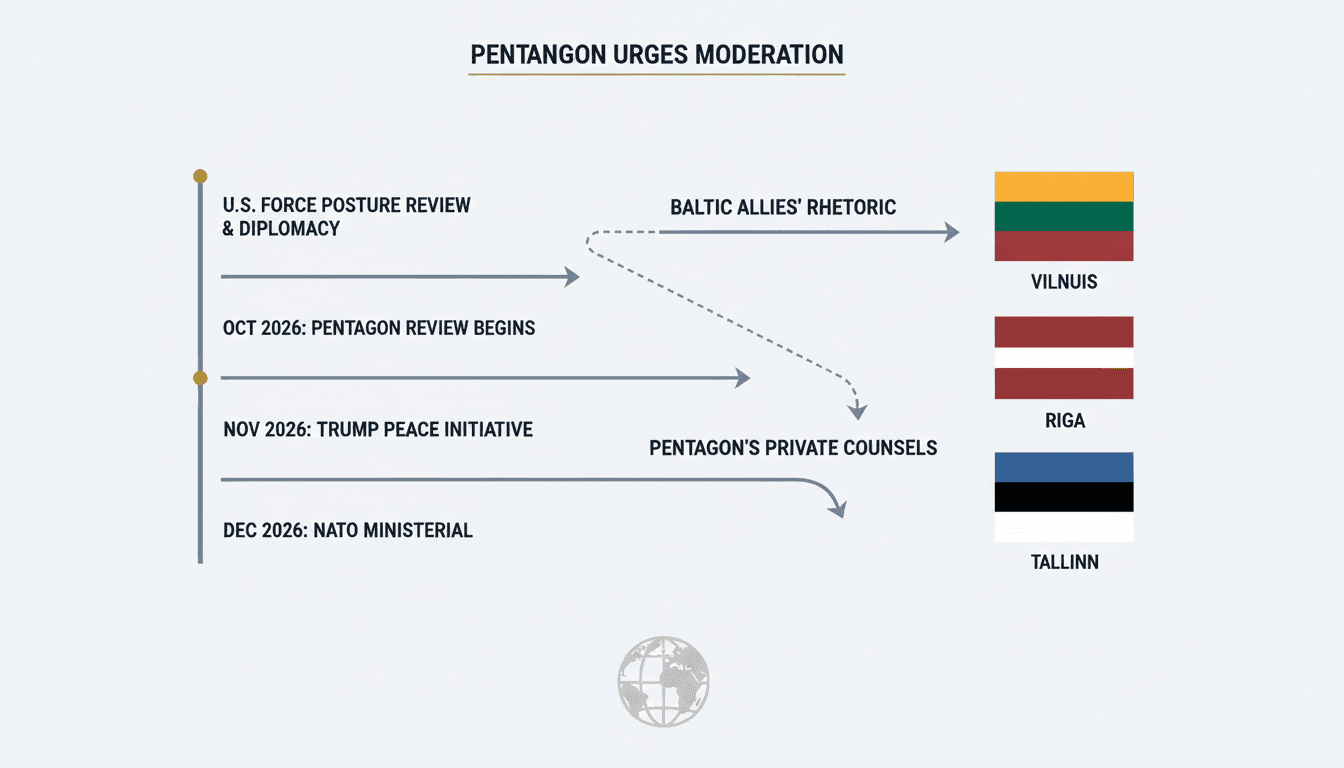
- Troop deployments under assessment: The private requests coincide with an ongoing Pentagon evaluation of American military posture and troop allocation across the European theater, a process partially overseen by Colby.
- Divergent threat assessments: The guidance created private confusion among certain European officials who balance Washington’s diplomatic requests against separate intelligence warnings regarding potential sabotage campaigns.
What's really happening
The core mechanism at play is the management of negotiating space. When international negotiations advance toward structured discussions, public signaling becomes a operational variable. In bilateral settings across recent weeks, defense officials focused on 3 specific frontline nations—Lithuania, Latvia, and Estonia—whose public posture has historically been the most assertive within the alliance.
By advising Baltic leaders to avoid public statements that frame Moscow in extreme terms, Washington is working to control the informational baseline. The incentive structure for U.S. negotiators requires minimizing reputational traps that could derail diplomatic openings. When allied leaders employ sharp rhetoric, it raises domestic political costs for foreign counterparts to engage in talks, creating friction for any framework involving sanctions relief or mutual operational concessions.
Simultaneously, the administration is pairing these diplomatic requests with reviews of security commitments. The parallel timeline between these private talks and the Pentagon's comprehensive review of U.S. troop levels across Europe provides an implicit policy lever. Frontline states rely on forward-deployed American deterrence; Washington relies on those same states not disrupting broader strategic negotiations. The guidance communicated to European officials—summarized as maintaining support while requesting lower volume—reflects an effort to preserve defensive deterrence without inflaming dialogue.
This produces an operational trade-off for Baltic defense establishments. Frontline states use assertive public communication to ensure sustained attention and resource allocation from Western capitals. Asking them to calibrate their language changes their primary mechanism for signaling vulnerability. The friction observed among allied officials stems from this divergence: regional capitals view public warnings as essential deterrence against ongoing hybrid threats, whereas Washington views uncoordinated verbal escalation as an obstacle to brokering an end to cross-border hostilities.
Ultimately, the shift illustrates that diplomatic negotiation requires narrative discipline across an entire coalition. If bilateral communications must be insulated from sudden political shocks, peripheral partners are asked to absorb communicative constraints to facilitate central diplomatic objectives.
Who feels it first (and how)
- Baltic national security planners: Defense and foreign ministry teams in Tallinn, Riga, and Vilnius must rewrite their deterrence communications to balance domestic threat warnings with bilateral requests from Washington.
- European corporate risk managers: Cross-border enterprises operating in northeastern Europe face diverging signals between frontline intelligence alerts and de-escalation messaging from the Pentagon.
- U.S. defense policy teams: Pentagon personnel tasked with the European force posture review must calibrate forward military deployments against the pace of diplomatic negotiations.
What to watch next
- Tone shifts in Baltic diplomatic addresses: Monitor upcoming press conferences and multilateral communiqués from Lithuania, Latvia, and Estonia for an absence of direct characterizations of Russian leadership.
- Milestones in the U.S. European troop review: Watch for public findings or structural announcements from the Pentagon's force posture assessment, which will signal whether force allocations are tied to regional diplomatic alignment.
- Bilateral dialogue terms on Ukraine: Track formal statements regarding sanctions relief frameworks or operational restrictions on energy infrastructure, which represent the stated goals of current diplomatic efforts.
Pentagon officials, including Elbridge Colby, delivered private requests to officials from 3 Baltic nations advising them to tone down public rhetoric concerning Russia.
Washington will continue leveraging bilateral defense reviews to ensure strategic messaging alignment from eastern flank allies as broader negotiations proceed.
Whether Baltic governments will fully suppress their public threat assessments if regional intelligence continues to warn of asymmetric or sabotage risks.
Frequently Asked Questions
- Why it matters?
- The tactical coordination between U.S. defense planners and eastern European allies highlights how diplomatic signaling is being recalibrated to establish off-ramps in the fifth year of the conflict.
- What happened (in 30 seconds)?
- Direct bilateral requests: Pentagon policy chief Elbridge Colby and other defense officials privately asked counterparts in Lithuania, Latvia, and Estonia to temper their public rhetoric characterizing the security threat from Russia. Specific rhetorical limits: U.S. representatives cautioned against language describing Moscow as "cornered like a rat" and advised allied delegations, including Estonian officials, to maintain "measured" communications rather than provocative statements. Support co
- What's really happening?
- The core mechanism at play is the management of negotiating space. When international negotiations advance toward structured discussions, public signaling becomes a operational variable. In bilateral settings across recent weeks, defense officials focused on 3 specific frontline nations—Lithuania, Latvia, and Estonia—whose public posture has historically been the most assertive within the alliance. By advising Baltic leaders to avoid public statements that frame Moscow in extreme terms, Washing
- Who feels it first (and how)?
- Baltic national security planners: Defense and foreign ministry teams in Tallinn, Riga, and Vilnius must rewrite their deterrence communications to balance domestic threat warnings with bilateral requests from Washington. European corporate risk managers: Cross-border enterprises operating in northeastern Europe face diverging signals between frontline intelligence alerts and de-escalation messaging from the Pentagon. U.S. defense policy teams: Pentagon personnel tasked with the European force p
- What to watch next?
- Tone shifts in Baltic diplomatic addresses: Monitor upcoming press conferences and multilateral communiqués from Lithuania, Latvia, and Estonia for an absence of direct characterizations of Russian leadership. Milestones in the U.S. European troop review: Watch for public findings or structural announcements from the Pentagon's force posture assessment, which will signal whether force allocations are tied to regional diplomatic alignment. Bilateral dialogue terms on Ukraine: Track formal stateme
Conservative-leaning political and national coverage.
"The Washington Times is a conservative-leaning newspaper known for its political coverage and advocacy of right-of-center viewpoints."
— A47 Editor
Report: Pentagon asks Europe to tone down the anti-Russia insults
Pentagon officials are reportedly asking European leaders, especially those from front-line countries such as Estonia, Latvia, and Lithuania, to lower the volume of their rhetoric against Russia, according to a report published by The Washington Time...
RT is a Russian state-funded network covering global events from a Russian perspective.
"RT is widely criticized for promoting pro-Kremlin narratives and is considered by many to be a state propaganda outlet."
— A47 Editor
Pentagon tells Baltic hawks to stop ‘poking’ Russia – Reuters
The Pentagon has urged Baltic NATO hawks to curb their anti-Russia rhetoric as U.S. President Donald Trump renews his push for a Ukraine peace settlement, according to a Reuters report carried by RT (Russia Today).
Global business headlines with AI angles.
"General business outlet that frequently covers AI."
— A47 Editor
Rhetoric Between European Countries and Russia is Escalating. Washington Reportedly Asked NATO Allies to Tone it Down.
The U.S. has reportedly urged Lithuania, Latvia and Estonia to moderate their rhetoric toward Russia, even as European allies strengthen deterrence measures and Moscow issues escalating nuclear threats. The report, published by International Business...