
Serbia Student List Victory Sets Stage for Russian Gas Supply Talks
Why it matters
The move signals that structural energy reliance overrides political transitions, binding emerging Balkan manufacturing hubs to long-term bilateral pipeline contracts despite European Union integration pressure.
What happened (in 30 seconds)
- The Student List secured an electoral majority, capturing approximately 52.5% of the vote in Serbia's October 25, 2026, snap parliamentary election following the resignation of Aleksandar Vucic.
- Bilateral gas negotiations were scheduled, with prominent candidate Radomir Saicic confirming talks will take place in Moscow within the incoming administration's first 30 days.
- Neutrality and supply commitments were reaffirmed, establishing that the incoming government will reject Western sanctions against Moscow while pursuing renewal terms before the current arrangement expires on December 31, 2026.
The context you actually need
- A multi-year domestic shift preceded the vote, stemming from public demonstrations following the November 2024 Novi Sad railway station canopy collapse that killed 16 people, which culminated in snap elections and Vucic resigning the presidency in September 2026.
- Physical energy dependence remains exceptionally high, with Russian pipeline shipments via TurkStream accounting for up to 90% of Serbia's natural gas imports in 2025.
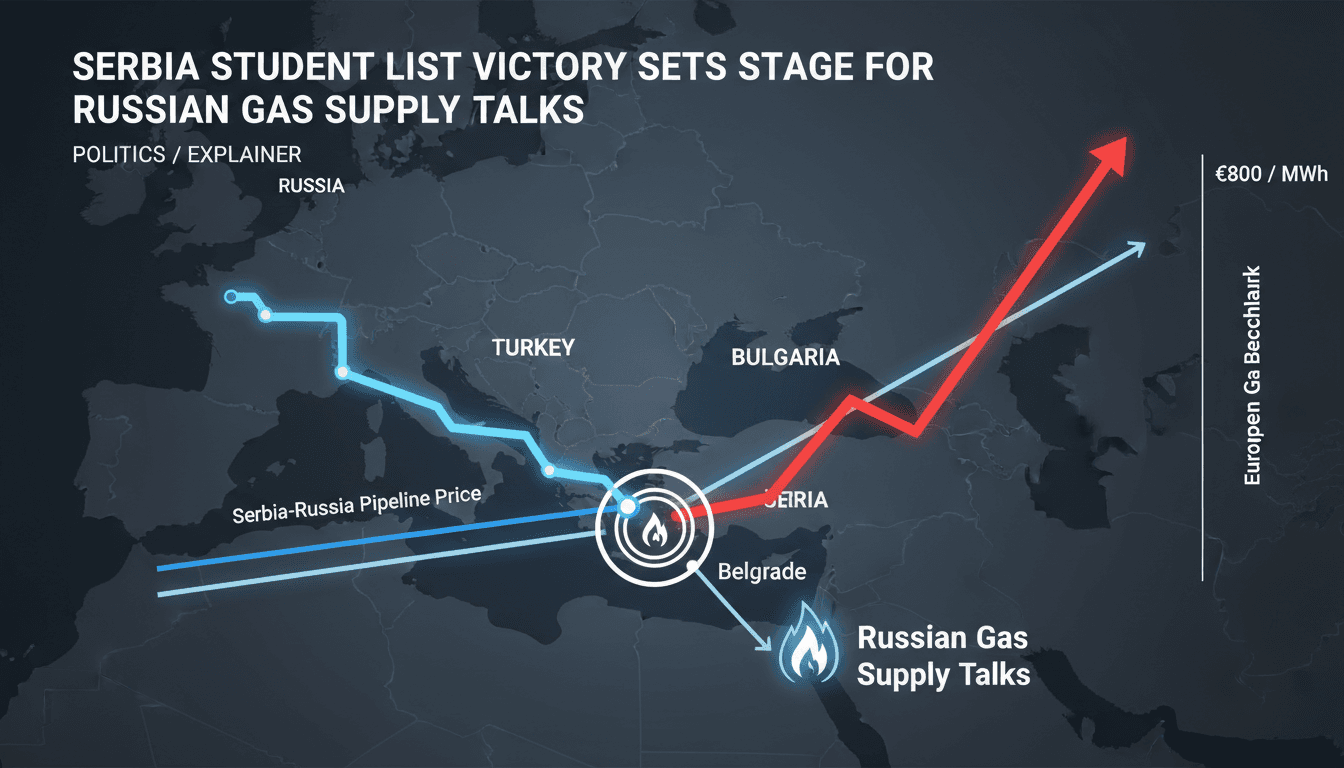
- The expiring pricing window creates fiscal urgency, as the three-year contract negotiated in 2022 expired in May 2025, leaving Belgrade on temporary extensions at roughly €318 per 1,000 cubic meters compared to wider European benchmarks that have exceeded €800.
What's really happening
The immediate decision by the incoming Student List leadership to initiate high-level talks in Moscow outlines the baseline reality of regional industrial economics: political turnover stops at the pipeline valve. While the electoral outcome removed the governing apparatus led by former President Aleksandar Vucic, it did not alter Serbia’s physical balance sheet. The incoming administration inherits an energy balance where up to 90% of national natural gas imports arrive via a single corridor: the Russian-backed TurkStream pipeline network.
The primary variable driving this diplomatic agenda is cost preservation. Serbian industrial operations and municipal district heating networks have functioned under preferential bilateral pricing formulas. Prior arrangements set gas costs around €318 per 1,000 cubic meters. Transferring that import volume onto spot markets or regional liquefied natural gas regasification terminals—where continental European clearing rates have traded above €800 per 1,000 cubic meters—would introduce an immediate deficit for the domestic treasury and compress margins for regional manufacturers.
Consequently, the political calculus for figures like Radomir Saicic and Jovo Bakic centers on baseline economic preservation. The prior contract expired in May 2025, and the stopgap extensions sustaining the country's grid run out strictly on December 31, 2026. Entering bilateral talks within the government’s first 30 days is an operational deadline rather than an ideological preference. Without an executed long-term delivery framework before the winter quarter closes, industrial baseline power costs face immediate escalation.
This balance is further constrained by legacy downstream infrastructure assets. The domestic refining capacity rests with Naftna Industrija Srbije (NIS), an entity carrying Russian ownership structures that face compliance constraints from United States sanctions frameworks. Navigating this operating environment requires the new Belgrade government to maintain strict military neutrality, turn away from European Union punitive sanction packages against Russia, and simultaneously preserve formal talks regarding accession to the European single market.
For the Kremlin, maintaining these supply contracts secures Gazprom’s institutional transit footprint inside non-aligned European corridors. For Belgrade's incoming student-backed administration, securing a stable multi-year tariff ensures that public utility rates remain flat, preventing domestic economic friction during the new government's delicate initial phase of state management.
Who feels it first (and how)
- Serbian heavy manufacturing and district heating operators, who avoid sudden operational budget recalculations tied to continental spot market price spikes.
- European energy infrastructure planners, who must account for sustained Russian transit volumes flowing through the southern TurkStream branch into candidate member states.
- Compliance and legal teams managing Balkan equity assets, specifically those handling supply contracts connected to the Russian-owned NIS oil refinery amidst US sanctions.
What to watch next
- The conclusion of formal Moscow contract negotiations, which will indicate whether Belgrade secures pricing near historical €318 rates or faces tariff revisions.
- Cabinet formation deadlines within the first 30 days, establishing the specific ministerial portfolios handling foreign policy and energy distribution.
- Regulatory determinations regarding the NIS refinery, clarifying how the incoming parliament addresses US secondary sanctions pressure on primary domestic refining facilities.
The Student List won roughly 52.5% of the October 25 vote, the existing interim gas contract expires on December 31, 2026, and up to 90% of Serbian gas imports rely on Russian supply.
The incoming government will prioritize signing an extended multi-year delivery contract to insulate domestic household utility bills from continental market volatility.
Whether internal policy debates among Student List members will lead to friction over future Western integration timelines versus non-alignment commitments.
Frequently Asked Questions
- Why it matters?
- The move signals that structural energy reliance overrides political transitions, binding emerging Balkan manufacturing hubs to long-term bilateral pipeline contracts despite European Union integration pressure.
- What happened (in 30 seconds)?
- The Student List secured an electoral majority, capturing approximately 52.5% of the vote in Serbia's October 25, 2026, snap parliamentary election following the resignation of Aleksandar Vucic. Bilateral gas negotiations were scheduled, with prominent candidate Radomir Saicic confirming talks will take place in Moscow within the incoming administration's first 30 days. Neutrality and supply commitments were reaffirmed, establishing that the incoming government will reject Western sanctions agai
- What's really happening?
- The immediate decision by the incoming Student List leadership to initiate high-level talks in Moscow outlines the baseline reality of regional industrial economics: political turnover stops at the pipeline valve. While the electoral outcome removed the governing apparatus led by former President Aleksandar Vucic, it did not alter Serbia’s physical balance sheet. The incoming administration inherits an energy balance where up to 90% of national natural gas imports arrive via a single corridor: t
- Who feels it first (and how)?
- Serbian heavy manufacturing and district heating operators, who avoid sudden operational budget recalculations tied to continental spot market price spikes. European energy infrastructure planners, who must account for sustained Russian transit volumes flowing through the southern TurkStream branch into candidate member states. Compliance and legal teams managing Balkan equity assets, specifically those handling supply contracts connected to the Russian-owned NIS oil refinery amidst US sanctions
- What to watch next?
- The conclusion of formal Moscow contract negotiations, which will indicate whether Belgrade secures pricing near historical €318 rates or faces tariff revisions. Cabinet formation deadlines within the first 30 days, establishing the specific ministerial portfolios handling foreign policy and energy distribution. Regulatory determinations regarding the NIS refinery, clarifying how the incoming parliament addresses US secondary sanctions pressure on primary domestic refining facilities.
RT is a Russian state-funded network covering global events from a Russian perspective.
"RT is widely criticized for promoting pro-Kremlin narratives and is considered by many to be a state propaganda outlet."
— A47 Editor
Serbian election winners plan gas talks with Russia
Student List, the student-led movement that won Serbia's snap parliamentary election held on October 25, 2026, is planning to negotiate a long-term gas contract with Russia, according to RT. The movement's victory ended roughly 12 to 14 years of rule...
Top international stories selected by The Guardian editors.
"The Guardian is known for its progressive editorial stance and in-depth analysis."
— A47 Editor
‘Swift justice’: Student List supporters focus on cleaning up Serbia’s rotten institutions
Serbia's Student List, a grassroots direct democracy movement born from nearly two years of anti-corruption protests, won a decisive victory in the snap parliamentary election held October 25, 2026, after President Aleksandar Vučić conceded defeat. I...
Corporate leadership, finance, technology, and market trends.
"Fortune covers financial trends, leadership, and innovation with a pragmatic editorial approach."
— A47 Editor
Serbia’s Gen Z takes back their country from strongman Vucic, demanding top police, intelligence, judiciary officials resign immediately
Serbia's Gen Z-led Student List has defeated strongman Aleksandar Vučić's party in a parliamentary election, with former president Vučić conceding defeat amid near-record voter turnout. The base report says the grassroots youth movement demanded that...
International coverage of politics, culture, and current affairs.
"BBC News is widely regarded as a reputable international news organization, known for its impartial tone and public service mandate."
— A47 Editor
Student-backed election winners demand sweeping resignations in Serbia
Following snap parliamentary elections on October 25, 2026, Student List MPs in Serbia have called for top figures linked to President Aleksandar Vučić's Serbian Progressive Party to stand down, days after the party lost power to the student-led move...
News and current affairs from across Europe.
"The Guardian is known for its progressive editorial stance and in-depth analysis."
— A47 Editor
Serbia’s students achieved the impossible. Europe must not fail them now | Srđjan Cvijić
Serbian voters delivered a decisive defeat to President Aleksandar Vučić's Serbian Progressive Party in the October 25, 2026 snap parliamentary election, with the student-led Student List movement emerging as the winner after nearly two years of anti...
International coverage from The Guardian's global desks.
"The Guardian is known for its progressive editorial stance and in-depth analysis."
— A47 Editor
How students toppled Serbia’s strongman – podcast
Serbian voters delivered a decisive defeat to President Aleksandar Vučić's Serbian Progressive Party in the October 25, 2026 snap parliamentary election, with the student-led Student List movement emerging as the winner after nearly two years of anti...
News and current affairs from across Europe.
"The Guardian is known for its progressive editorial stance and in-depth analysis."
— A47 Editor
How students rocked Serbia’s presidential election – video explainer
Serbia's long-serving President Aleksandar Vučić conceded defeat in the October 25, 2026 snap parliamentary election, ending roughly 12 to 14 years of rule by his party after a student-led movement that grew out of outrage over a deadly Novi Sad rail...