
Legal Experts Warn Trump Administration Could Intervene in 2026 Midterm Election Certification
Why it matters
Federal interventions into state certification processes test the constitutional boundaries of election administration, altering the baseline predictability of legislative continuity in the world’s largest economy.
What happened (in 30 seconds)
- Legal warnings emerged on November 1, 2026, as former federal prosecutors flagged potential Department of Justice actions, emergency declarations, or certification challenges surrounding the November 3, 2026, U.S. midterm elections.
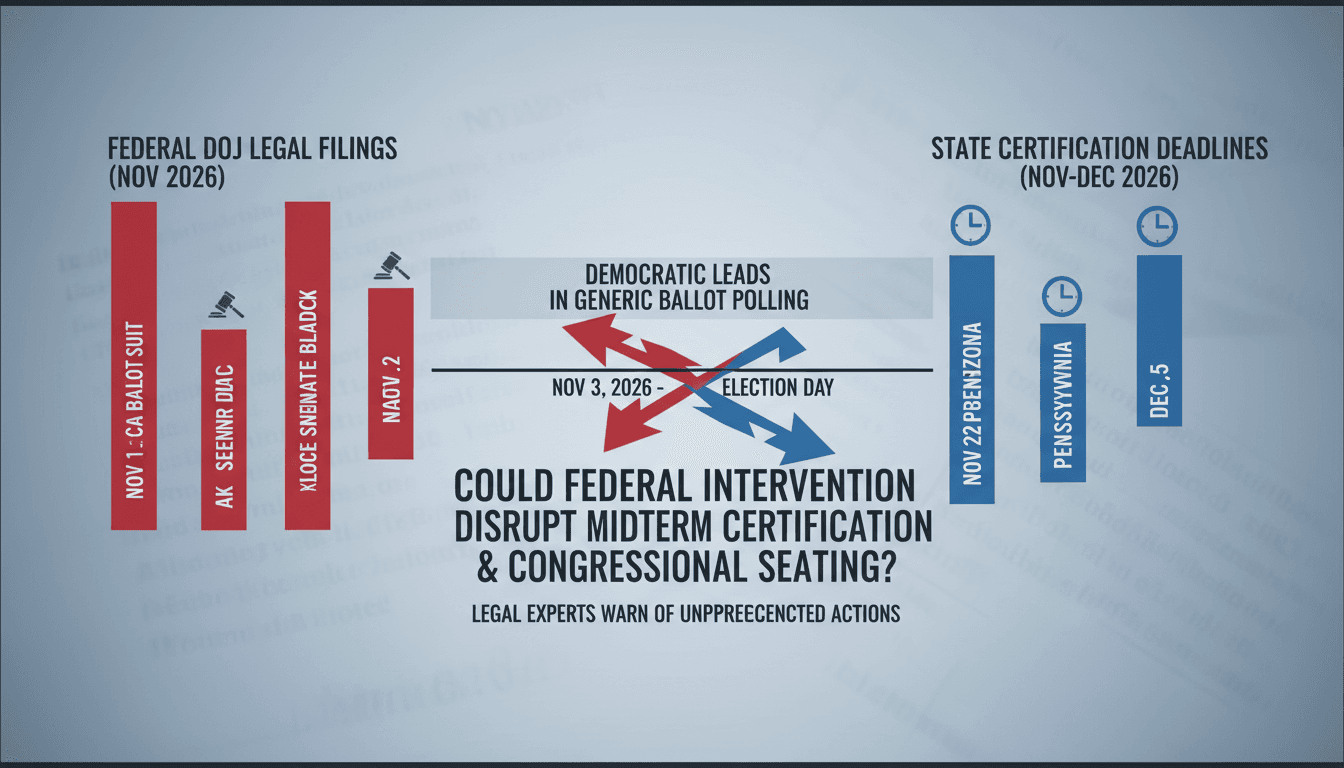
- Federal litigation was initiated prior to voting, including a Department of Justice filing in California concerning roughly 20,000 ballots and an action in Alaska aimed at conditioning Senate race certification.
- The administration outlined conditions for acceptance, with statements indicating outcomes would be recognized if determined to be honest, while state election authorities established contingency operations against federal procedural disputes.
The context you actually need
- Precedent stems from the 2020 election cycle, where multi-jurisdiction lawsuits and administrative disputes contested certified outcomes before post-election audits and recounts validated state results.
- Midterm congressional control creates specific incentives, characterized by an 8-point Democratic advantage on the generic congressional ballot among likely voters in an October 19–20, 2026, Marist University survey of 1,289 registered voters.
- Federal oversight interfaces with decentralized state authority, as the U.S. Constitution vests operational control of elections primarily in individual states, creating legal boundaries that constrain unilateral executive intervention.
What's really happening
The procedural friction surfacing ahead of the November 3, 2026, midterm elections reflects a structural competition between centralized executive authority and decentralized state administration. In the American constitutional system, the mechanics of conducting elections, validating voter rolls, counting ballots, and certifying winners reside with state and local jurisdictions. When the federal executive branch deploys the Department of Justice to contest local rolls or delay certification timelines, it operates at the perimeter of established statutory authority.
The underlying mechanism involves utilizing early legal actions to establish standing and shape the administrative record before votes are fully tallied. For instance, the Department of Justice's suit in California targets an estimated 20,000 ballots on noncitizen voting grounds, while filings in Alaska attempt to structure how state officials approach Senate certifications in close outcomes. Rather than waiting for post-election canvassing deadlines, these preemptive filings create formal administrative hooks. Former federal prosecutors such as Gene Rossi, Neama Rahmani, and Michael McAuliffe have pointed out that while courts routinely enforce strict constitutional limits against federal preemption of state-run tallies, the deployment of federal resources creates operational pauses.
From an institutional incentives standpoint, contesting certification benchmarks serves to preserve political leverage during narrow shifts in congressional majorities. The administration faces an electoral environment where generic ballot polling shows an 8-point deficit among likely voters. In response, administrative tools—ranging from formal data demands for state voter files to considerations of federal emergency frameworks or disputes over seating members of Congress—function as instruments to test procedural resilience.
State administrators, such as the Maine Secretary of State, have treated these federal inquiries not as routine coordination, but as adversarial procedural interventions requiring independent legal defense and contingency staffing. Because state certifications directly dictate who receives credentials to sit in the incoming Congress, any administrative delay has downstream effects on legislative organization, leadership votes, and statutory planning. Although legal scholars maintain that the constitutional mechanics strongly favor state primacy, resolving these jurisdictional disputes requires federal court rulings, creating a period of structural uncertainty that persists until judicial benches define the limits of executive intervention.
Who feels it first (and how)
- State election administrators and Secretaries of State: Absorb direct operational strain from federal data demands, pre-election audits, and emergency litigation challenging their statutory certification timelines.
- Federal and state court dockets: Manage rapid injunction requests and emergency motions regarding ballot validity, such as the active California litigation involving approximately 20,000 ballots.
- Congressional legal counsels and legislative staffs: Face planning contingencies around credentialing and seating timelines if individual state certifications remain unresolved past statutory reporting deadlines.
- Corporate regulatory affairs directors: Experience delayed visibility on committee assignments, policy priorities, and congressional leadership structures dependent on finalized election results.
What to watch next
- Post-election federal court rulings on state certifications: Judicial decisions on whether the Department of Justice has legal standing to alter or pause state canvassing periods will define the reach of federal executive powers.
- State certification deadlines between November and December: Compliance with statutory timelines in contested jurisdictions like Alaska and California will signal whether local processes withstand administrative challenges.
- Congressional seating protocols in January 2027: Any formal objections raised during the convening of the new Congress will reveal how certification disputes translate into legislative operational delays.
The Department of Justice engaged in targeted pre-election actions, including a lawsuit involving approximately 20,000 ballots in California and a pre-certification suit in Alaska.
Federal courts will reference constitutional protections for state-administered elections to limit unilateral federal efforts to halt statutory certification procedures.
Whether administrative interventions will materially delay the final certification of tight congressional races beyond standard statutory reporting dates.
Frequently Asked Questions
- Why it matters?
- Federal interventions into state certification processes test the constitutional boundaries of election administration, altering the baseline predictability of legislative continuity in the world’s largest economy.
- What happened (in 30 seconds)?
- Legal warnings emerged on November 1, 2026, as former federal prosecutors flagged potential Department of Justice actions, emergency declarations, or certification challenges surrounding the November 3, 2026, U.S. midterm elections. Federal litigation was initiated prior to voting, including a Department of Justice filing in California concerning roughly 20,000 ballots and an action in Alaska aimed at conditioning Senate race certification. The administration outlined conditions for acceptance,
- What's really happening?
- The procedural friction surfacing ahead of the November 3, 2026, midterm elections reflects a structural competition between centralized executive authority and decentralized state administration. In the American constitutional system, the mechanics of conducting elections, validating voter rolls, counting ballots, and certifying winners reside with state and local jurisdictions. When the federal executive branch deploys the Department of Justice to contest local rolls or delay certification tim
- Who feels it first (and how)?
- State election administrators and Secretaries of State: Absorb direct operational strain from federal data demands, pre-election audits, and emergency litigation challenging their statutory certification timelines. Federal and state court dockets: Manage rapid injunction requests and emergency motions regarding ballot validity, such as the active California litigation involving approximately 20,000 ballots. Congressional legal counsels and legislative staffs: Face planning contingencies around c
- What to watch next?
- Post-election federal court rulings on state certifications: Judicial decisions on whether the Department of Justice has legal standing to alter or pause state canvassing periods will define the reach of federal executive powers. State certification deadlines between November and December: Compliance with statutory timelines in contested jurisdictions like Alaska and California will signal whether local processes withstand administrative challenges. Congressional seating protocols in January 202
Celebrity news, photo galleries, and Hollywood updates.
"Wonderwall covers celebrity gossip, Hollywood rumors, and pop culture photo galleries."
— A47 Editor
Legal experts warn Trump admin appears primed to intervene in midterm election results: ‘They will use their fertile imagination to take whatever action they think appropriate,’ former federal prosecutor says
Legal experts warn that the Trump administration appears positioned to intervene in the results of the November 3 midterm elections, according to reporting that cites former federal prosecutor Gene Rossi, who told Newsweek that "the sky is the limit"...
News from the United States including domestic politics, society, and culture.
"The Guardian is known for its progressive editorial stance and in-depth analysis, often advocating for social justice, environmental issues, and liberal values."
— A47 Editor
How Trump and his allies seek to interfere in the US midterm elections
The Guardian reports that Donald Trump is waging an effort to interfere with voting in this year's US midterm elections, raising concerns that the federal government could try to slow certification of results, a move that could create chaos when the ...
Top international stories selected by The Guardian editors.
"The Guardian is known for its progressive editorial stance and in-depth analysis."
— A47 Editor
How Trump and his allies seek to interfere in the US midterm elections
The Guardian reports that Donald Trump is waging an effort to interfere with voting in this year's US midterm elections, raising concerns that the federal government could try to slow certification of results, a move that could create chaos when the ...
24/7 international news from a French perspective in multiple languages.
"France 24 is viewed as a globally focused outlet with balanced coverage and a European perspective."
— A47 Editor
'Atmosphere of fear': Trump moves to curtail voting rights ahead of the midterms
France 24 reports that US President Donald Trump has moved to curtail voting rights ahead of the November 3 midterm elections, a contest in which Republicans could lose control of Congress and endanger Trump's legislative agenda. Although the US Cons...