
US Envoy Casts Doubt on Ending $3.8 Billion Annual Military Aid to Israel by Year-End
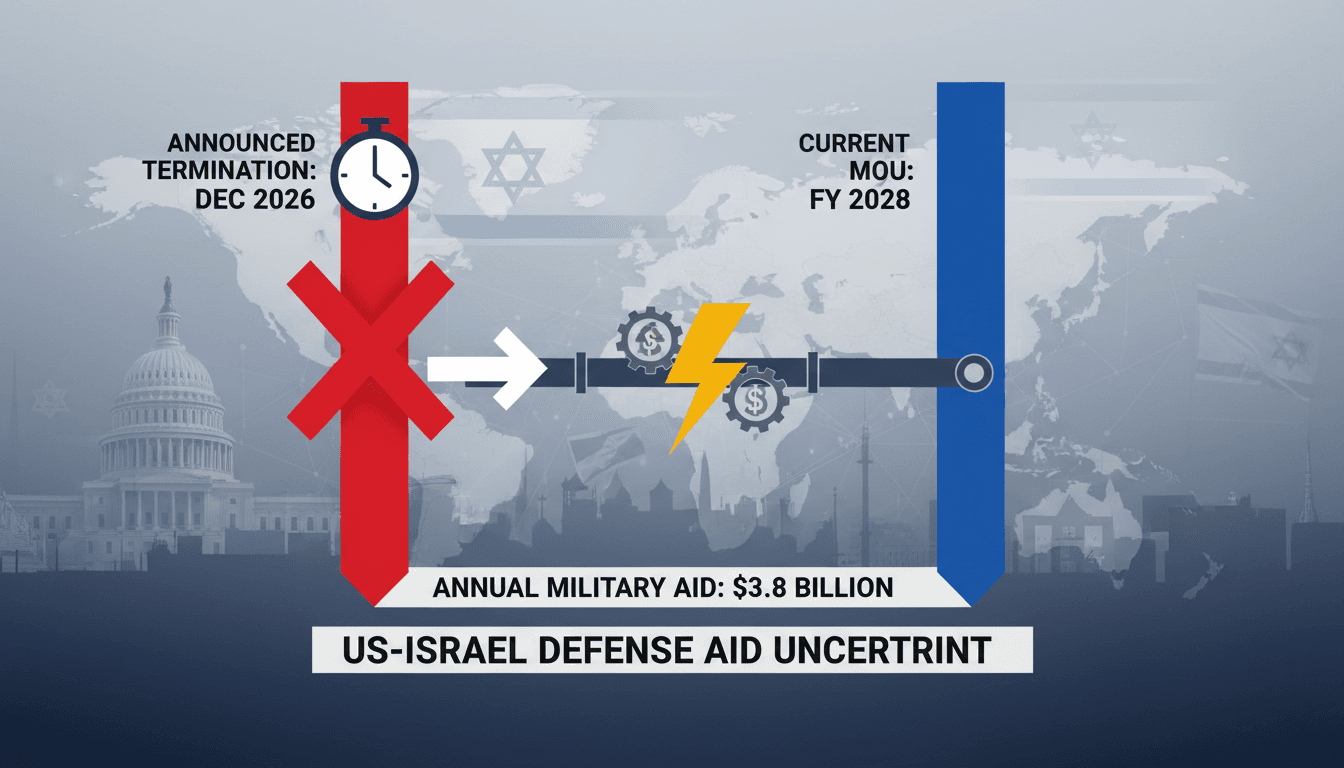
Institutional planning across Middle Eastern supply chains, defense procurement, and sovereign risk models must account for statutory timelines over political announcements.
Why it matters
The gap between executive declarations and binding bilateral appropriations reveals the rigid institutional mechanics that govern global defense spending and Middle Eastern diplomatic architecture.
What happened (in 30 seconds)
- The diplomatic friction point: On November 24, 2026, US Ambassador to Israel Mike Huckabee stated he is "not certain" that annual military aid to Israel will conclude by the end of 2026.
- The conflicting announcement: Huckabee's remarks, delivered at a Tel Aviv conference hosted by the Institute for National Security Studies, follow President Donald Trump's November 3 assertion of an agreement with Prime Minister Benjamin Netanyahu to terminate the funding by year-end.
- The statutory baseline: Huckabee highlighted that an active Memorandum of Understanding (MoU) legally designates $3.8 billion annually for US-manufactured defense equipment through fiscal year 2028.
The context you actually need
- The institutional framework: The current 10-year US-Israel MoU allocates $3.8 billion per year specifically for procurement of American defense equipment, locking in multi-year production schedules and congressional appropriations.
- The legislative shift: The announcement of the purported deal occurred on the day of the US midterm elections, which resulted in Democrats gaining control of Congress amid documented declines in domestic public support for Israel tied to operations in Gaza and Iran.
- The bilateral renegotiation: Israeli and US officials, including Israeli Ambassador to the US Yechiel Leiter, have conducted months-long talks evaluating a restructured, phased framework rather than an immediate cutoff.
What's really happening
The friction between high-profile political statements and the reality of the $3.8 billion annual allocation highlights a fundamental operational divide: headline policy declarations routinely collide with statutory budgeting cycles and industrial commitments.
At the center of this debate is the Memorandum of Understanding running through fiscal year 2028. An MoU backed by congressional appropriations functions as a long-range procurement pipeline rather than a discretionary monthly grant. The $3.8 billion allocated annually does not flow as liquid capital; it is largely restricted to purchases of defense equipment manufactured directly by American contractors. Because these contracts involve long manufacturing lead times, supply chain commitments, and multi-year production queues, an abrupt cancellation by executive fiat encounters immediate administrative, commercial, and procedural hurdles.
The incentives driving both sides clarify why Ambassador Huckabee signaled operational caution. For the executive branch, signaling an end to the package aligns with a broader policy narrative that questions foreign expenditures and responds to shifting political sentiment. Following the 2026 midterm elections, which saw Democrats secure majorities in Congress, political debate surrounding the fiscal package has sharpened. Declining domestic public support—linked to military campaigns in Gaza and against Iran—has placed bilateral funding under greater scrutiny.
However, terminating the program prematurely creates concrete trade-offs for both Washington and Tel Aviv. Prime Minister Benjamin Netanyahu has explored a phased transition away from the current aid structure to neutralize foreign political pressure and assert strategic self-reliance. Yet, an immediate cessation before the 2028 expiration risks destabilizing existing industrial integration. Huckabee's remarks emphasized that the partnership directly yields reciprocal returns in advanced technology, joint research, domestic defense employment, and shared intelligence.
Furthermore, Ambassador Leiter and Israeli defense planners require predictability. Shifting from a subsidized procurement model to open-market commercial defense acquisitions demands structural adjustments to sovereign defense outlays. Because Congress retains constitutional authority over the federal purse, any legal revocation or structural overhaul of already appropriated funding requires legislative alignment. As long as statutory appropriations remain codified through 2028, the executive branch operates within defined legal constraints, making an immediate termination by December 31, 2026, operationally unviable without formal legislative intervention.
Who feels it first (and how)
- US Defense Contractors: Prime aerospace and defense manufacturers face contract duration uncertainty if the $3.8 billion annual stream is restructured ahead of the 2028 statutory deadline.
- Israeli Fiscal Planners: Ministry of Finance and defense procurement teams must model capital expenditure alternatives should subsidies transition toward direct sovereign purchases.
- Regional Security Strategists: Middle Eastern defense ministries and intelligence analysts evaluate the pace of bilateral structural realignments for shifts in regional deterrence balances.
- Expatriate and Energy Markets: Global operators managing regional capital flows and energy logistics track the broader implications of geopolitical stability across Middle Eastern transit corridors.
What to watch next
- Congressional Committee Agendas: Track whether newly elected Democratic leaders introduce binding legislation to modify or condition existing FY2027 and FY2028 appropriations under the MoU.
- Formal Bilateral Framework Drafts: Monitor official diplomatic releases from Ambassador Leiter and State Department teams regarding a phased transition agreement to replace the existing MoU.
- Israeli Ministry of Defense Budget Adjustments: Watch for internal reallocation requests within Israel's domestic budget to gauge preparation for independent procurement cycles.
The existing bilateral MoU mandates $3.8 billion in annual military assistance through fiscal year 2028, primarily allocated for US-produced hardware.
Aid will not terminate abruptly by December 31, 2026, but will instead undergo a negotiated, multi-year phase-down managed between executive teams and Congress.
Whether the newly seated US congressional majority will move to unilaterally alter existing appropriations before a formal successor framework is agreed upon.
Frequently Asked Questions
- Why it matters?
- The gap between executive declarations and binding bilateral appropriations reveals the rigid institutional mechanics that govern global defense spending and Middle Eastern diplomatic architecture.
- What happened (in 30 seconds)?
- The diplomatic friction point: On November 24, 2026, US Ambassador to Israel Mike Huckabee stated he is "not certain" that annual military aid to Israel will conclude by the end of 2026. The conflicting announcement: Huckabee's remarks, delivered at a Tel Aviv conference hosted by the Institute for National Security Studies, follow President Donald Trump's November 3 assertion of an agreement with Prime Minister Benjamin Netanyahu to terminate the funding by year-end. The statutory baseline: Huc
- What's really happening?
- The friction between high-profile political statements and the reality of the $3.8 billion annual allocation highlights a fundamental operational divide: headline policy declarations routinely collide with statutory budgeting cycles and industrial commitments. At the center of this debate is the Memorandum of Understanding running through fiscal year 2028. An MoU backed by congressional appropriations functions as a long-range procurement pipeline rather than a discretionary monthly grant. The
- Who feels it first (and how)?
- US Defense Contractors: Prime aerospace and defense manufacturers face contract duration uncertainty if the $3.8 billion annual stream is restructured ahead of the 2028 statutory deadline. Israeli Fiscal Planners: Ministry of Finance and defense procurement teams must model capital expenditure alternatives should subsidies transition toward direct sovereign purchases. Regional Security Strategists: Middle Eastern defense ministries and intelligence analysts evaluate the pace of bilateral structu
- What to watch next?
- Congressional Committee Agendas: Track whether newly elected Democratic leaders introduce binding legislation to modify or condition existing FY2027 and FY2028 appropriations under the MoU. Formal Bilateral Framework Drafts: Monitor official diplomatic releases from Ambassador Leiter and State Department teams regarding a phased transition agreement to replace the existing MoU. Israeli Ministry of Defense Budget Adjustments: Watch for internal reallocation requests within Israel's domestic budge
Breaking news, politics, business, and entertainment from the U.S. and around the world.
"The New York Post is a tabloid-format newspaper known for its sensationalist headlines and conservative-leaning editorial tone."
— A47 Editor
US envoy ‘not certain’ military aid to Israel will end this year
US Ambassador to Israel Mike Huckabee has expressed uncertainty over whether Washington will end its $3.8 billion in annual military aid to Israel by the end of this year, as President Donald Trump had promised on the day of this month's midterm elec...
Arabic-language coverage of international news and geopolitics.
"RT Arabic is a Russian state-funded outlet often criticized for promoting Kremlin-aligned narratives."
— A47 Editor
هاكابي يشكك في إنهاء المساعدات العسكرية لإسرائيل بنهاية العام
US Ambassador to Israel Mike Huckabee has cautioned that Washington may not end its annual military aid package to Israel, worth $3.8 billion, by the end of the year, according to the base report published by RT Arabic.
Regional coverage and analysis focused on politics, diplomacy, and business across the Middle East.
"Al-Monitor is known for analytical reporting on Middle East politics and policy developments."
— A47 Editor
US envoy 'not certain' military aid to Israel will end this year as Trump promised
US Ambassador to Israel Mike Huckabee said he is "not certain" Washington will end its roughly $3.8 billion in annual military aid to Israel by the end of this year, as President Donald Trump promised on election day, November 3. Trump had said he st...
Macro commentary, policy analysis, growth/inflation themes, and global outlooks.
"Contextual macro coverage that complements day-to-day market headlines."
— A47 Editor
US envoy ’not certain’ military aid to Israel will end this year as Trump promised
A US envoy said he is "not certain" that US military aid to Israel will end this year as President Trump has promised, Investing.com reported. The article centers on US, Israeli and Trump-related policy and the uncertainty surrounding the timeline fo...