
Supreme Court of Canada Largely Upholds Quebec Bill 21 Religious Symbols Ban With One Exception for National Assembly Members
Why it matters
The legal confirmation of a provincial override reshapes institutional authority across Canada, establishing how sub-national governments can insulate employment mandates from federal constitutional oversight.
What happened (in 30 seconds)
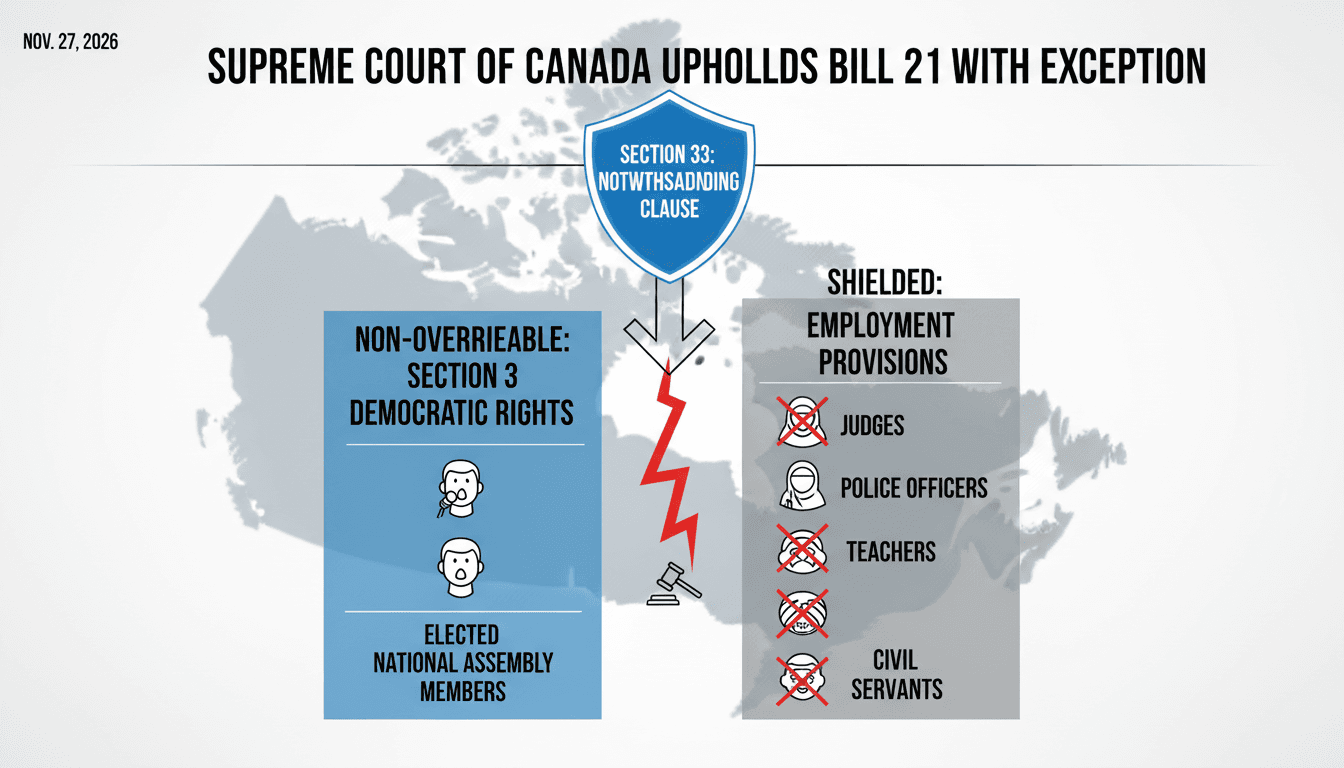
- Top court decision: On November 27, 2026, the Supreme Court of Canada issued a 520-page decision largely upholding Quebec's Bill 21, affirming that provincial authorities can restrict public sector workers from wearing religious symbols on the job.
- Narrow exception applied: The court struck down only section 8 of the statute as applied to elected members of the National Assembly, citing democratic rights protections under section 3 of the Charter of Rights and Freedoms.
- Override validated: The ruling formally accepted Quebec's preemptive invocation of section 33, known as the notwithstanding clause, effectively shielding the core employment restrictions from judicial invalidation.
The context you actually need
- Origins in 2019: Quebec enacted Bill 21 under the Coalition Avenir Québec administration to institute state laicity, barring public employees in positions of authority—such as judges, police officers, prosecutors, and teachers—from displaying religious attire or symbols.
- Preemptive mechanism: To prevent judicial suspension based on religious freedom arguments, the province invoked the notwithstanding clause at the time of passage, creating a five-year shielding structure that required ultimate constitutional adjudication.
- Broad legal front: The case consolidated disputes involving school boards, such as the English Montreal School Board, alongside civil rights advocates, community organizations, and 51 formal interveners participating in the Supreme Court proceedings.
What's really happening
The Supreme Court’s 520-page decision solidifies the constitutional mechanics of sub-national policy autonomy in Canada. At the core of the ruling is section 33 of the Charter of Rights and Freedoms—the notwithstanding clause. This provision grants provincial legislatures the legal capacity to pass legislation that operates notwithstanding specific Charter guarantees, notably section 2 (fundamental freedoms) and sections 7 through 15 (legal and equality rights). By validating Quebec’s preemptive use of this clause, the court confirmed that a legislature does not need prior judicial findings of an infringement before applying the override mechanism.
This establishes a clear institutional incentive structure. When sub-national policymakers encounter tension between standardized federal rights protections and local regulatory preferences, the procedural pathway to bypass judicial review is now legally secured. The court maintained that while judicial bodies preserve the formal authority to declare inconsistencies between provincial statutes and the Charter, they declined to issue declarations against Bill 21's primary operational clauses because the notwithstanding clause legally blocks substantive judicial remedies.
The singular structural limitation imposed by the bench centers on section 3 of the Charter, which protects democratic participation rights—including the right to run for office and participate in legislative assemblies. Because section 33 cannot override section 3, the court determined that barring elected members of the National Assembly from wearing face coverings exceeded provincial override powers.
This carve-out creates a strict dividing line in labor governance. Appointed, contracted, and institutional state workers—such as classroom teachers, prosecutors, and sworn officers—remain bound by administrative secularism rules, while directly elected officials operate under constitutional democratic guarantees. Consequently, institutional risk falls squarely on public administration systems, educational boards, and municipal agencies, which must enforce compliance guidelines without recourse to federal equality challenges. The verdict shifts the balance of governance away from centralized constitutional harmonisation, reinforcing regional authority over workforce conditions within provincial jurisdiction.
Who feels it first (and how)
- Public sector educators and applicants: Current and prospective teachers in Quebec must comply with strict visual appearance guidelines or face employment restrictions, directly altering professional hiring tracks in public school boards.
- Law enforcement and judicial personnel: Police forces, state prosecutors, and court officials operate under settled compliance protocols regarding visible symbols, with no further judicial appeals available to alter statutory conditions.
- School board administrators: Regional employers, including the English Montreal School Board, must reconcile internal diversity policies with non-negotiable statutory mandates verified by the highest court.
- Provincial policy planners outside Quebec: Legislative bodies across Canada gain verified precedent on the precise functional reach and legal insulation provided by the notwithstanding clause.
What to watch next
- Provincial policy replication: Track whether other Canadian provinces utilize preemptive notwithstanding declarations for contentious regional statutes, now that the operational boundaries are legally clear.
- Five-year renewal filings: Bill 21’s invocation of the notwithstanding clause requires legislative re-enactment every five years, making upcoming parliamentary renewal votes critical operational markers for long-term policy permanence.
- Workforce mobility shifts: Monitor whether specialized talent categories, particularly in education and administrative law, show documented movement toward non-restricted provincial jurisdictions.
Bill 21's bans on religious symbols remain in full legal effect for public sector roles in positions of authority, including teachers, police officers, and judges, following the Supreme Court's ruling.
Future constitutional disputes regarding provincial policy will center on non-overrideable provisions, such as section 3 democratic rights, rather than equality or religious freedom provisions.
The long-term impact on overall public sector recruitment and retention rates within Quebec's school districts and municipal services remains unquantified over extended multi-year hiring cycles.
Frequently Asked Questions
- Why it matters?
- The legal confirmation of a provincial override reshapes institutional authority across Canada, establishing how sub-national governments can insulate employment mandates from federal constitutional oversight.
- What happened (in 30 seconds)?
- Top court decision: On November 27, 2026, the Supreme Court of Canada issued a 520-page decision largely upholding Quebec's Bill 21, affirming that provincial authorities can restrict public sector workers from wearing religious symbols on the job. Narrow exception applied: The court struck down only section 8 of the statute as applied to elected members of the National Assembly, citing democratic rights protections under section 3 of the Charter of Rights and Freedoms. Override validated: The r
- What's really happening?
- The Supreme Court’s 520-page decision solidifies the constitutional mechanics of sub-national policy autonomy in Canada. At the core of the ruling is section 33 of the Charter of Rights and Freedoms—the notwithstanding clause. This provision grants provincial legislatures the legal capacity to pass legislation that operates notwithstanding specific Charter guarantees, notably section 2 (fundamental freedoms) and sections 7 through 15 (legal and equality rights). By validating Quebec’s preemptive
- Who feels it first (and how)?
- Public sector educators and applicants: Current and prospective teachers in Quebec must comply with strict visual appearance guidelines or face employment restrictions, directly altering professional hiring tracks in public school boards. Law enforcement and judicial personnel: Police forces, state prosecutors, and court officials operate under settled compliance protocols regarding visible symbols, with no further judicial appeals available to alter statutory conditions. School board administra
- What to watch next?
- Provincial policy replication: Track whether other Canadian provinces utilize preemptive notwithstanding declarations for contentious regional statutes, now that the operational boundaries are legally clear. Five-year renewal filings: Bill 21’s invocation of the notwithstanding clause requires legislative re-enactment every five years, making upcoming parliamentary renewal votes critical operational markers for long-term policy permanence. Workforce mobility shifts: Monitor whether specialized t
International coverage of politics, culture, and current affairs.
"BBC News is widely regarded as a reputable international news organization, known for its impartial tone and public service mandate."
— A47 Editor
Canada's top court largely upholds Quebec ban on religious symbols for public servants
Canada's top court has largely upheld Quebec's ban on religious symbols for public servants, a law challenged by female Muslim, Sikh and Catholic teachers who argued it violated their fundamental rights. The ruling, neutral in tone, centres on the co...
Global news coverage with extensive reporting on Middle Eastern conflicts and geopolitics.
"Al Jazeera is a Qatar-based broadcaster known for wide regional coverage and alternative perspectives."
— A47 Editor
Canada’s top court largely upholds Quebec’s religious symbols ban
Canada's top court has largely upheld Quebec's ban on religious symbols worn by teachers and police on the job, including hijabs and turbans, meaning the law remains in place. The ruling centres on the constitutional questions surrounding the provinc...
Comprehensive coverage of Middle Eastern and global issues.
"Al Jazeera is a prominent voice from the Global South, especially the Middle East, with an emphasis on underreported stories."
— A47 Editor
Canada’s top court largely upholds Quebec’s religious symbols ban
Canada's top court has largely upheld Quebec's ban on religious symbols worn by teachers and police on the job, including hijabs and turbans, meaning the law remains in place. The ruling centres on the constitutional questions surrounding the provinc...
National coverage of politics and current events across Canada.
"Global News is a mainstream Canadian outlet with a centrist editorial stance, focusing on factual reporting."
— A47 Editor
Supreme Court largely upholds Quebec’s secularism law
Canada's Supreme Court has largely upheld Quebec's secularism law, a ruling that premiers across the country were closely watching as it was released. The base article is neutral in sentiment and focuses on the constitutional question of the province...