
Ebola outbreak in Democratic Republic of Congo exceeds 900 suspected cases amid healthcare challenges
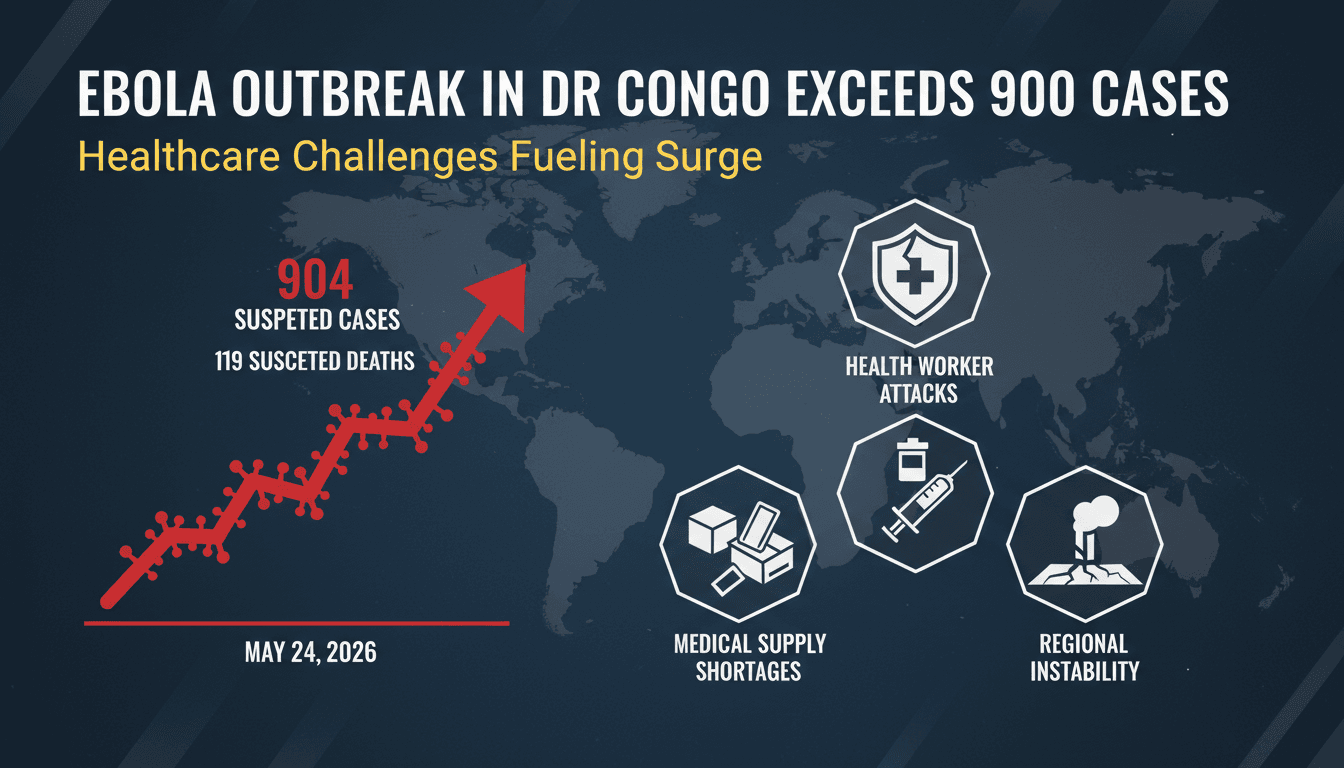
Here's what it means for you.
The ongoing Ebola outbreak in the Democratic Republic of Congo could disrupt regional stability, impacting trade and investment opportunities.
Why it matters
The outbreak poses a significant risk to public health and economic stability in Central Africa, which could have ripple effects on global markets.
What happened (in 30 seconds)
- 904 suspected cases of Ebola have been reported in the DRC as of May 24, 2026, with 119 suspected deaths.
- Health worker attacks and shortages of medical supplies are complicating response efforts, leading to community backlash.
- The World Health Organization has classified the outbreak as posing a "very high" risk within the DRC, although the global risk remains low.
The context you actually need
- Ebola outbreaks are not new to the DRC, but this one is exacerbated by a fragile healthcare system and ongoing violence from armed groups.
- Community mistrust of health authorities has led to violent reactions, including attacks on treatment centers, which further complicates the response.
- Cultural practices surrounding burials conflict with health protocols, increasing the risk of virus transmission.
What's really happening
The current Ebola outbreak in the Democratic Republic of Congo (DRC) began with the first known victim in Bunia on April 24, 2026. Since then, the number of suspected cases has surged to 904, with 119 suspected deaths reported. This alarming rise is not just a public health crisis; it reflects deeper systemic issues within the DRC's healthcare infrastructure and societal dynamics.
The DRC has a long history of Ebola outbreaks, but this situation is particularly dire due to a combination of factors. The healthcare system is already fragile, suffering from years of underfunding and neglect, which has been exacerbated by recent cuts to international aid. As local health facilities become overwhelmed, they report full capacities and inadequate resources to manage the influx of patients. This has led to a critical shortage of medical supplies, further hampering response efforts.
Compounding these challenges is a troubling trend of violence against health workers. Community mistrust has escalated into violent reactions, including arson attacks on treatment centers. This backlash is fueled by a combination of fear, misinformation, and a lack of trust in health authorities. The World Health Organization (WHO) has classified the outbreak as posing a "very high" risk within the DRC, indicating the potential for rapid spread if containment measures are not effectively implemented.
Cultural practices surrounding burials also play a significant role in the outbreak's dynamics. Traditional burial customs often involve close contact with the deceased, which conflicts with health protocols designed to prevent the spread of the virus. This cultural clash complicates efforts to educate communities about safe practices and increases the risk of transmission.
The international community, including organizations like the WHO and the International Federation of Red Cross and Red Crescent Societies, is calling for increased support and resources to combat the outbreak. However, the Congolese government faces criticism for its handling of the crisis, and community leaders express frustration over the lack of trust in health authorities. As the situation unfolds, the potential impacts on regional trade routes and logistics are becoming a concern, particularly for sectors reliant on stability in Central Africa.
Who feels it first (and how)
- Local health workers: Facing violence and shortages, they are unable to provide adequate care.
- Community members: Experiencing fear and mistrust, leading to violent reactions against health initiatives.
- International businesses: Companies reliant on trade with the DRC may face disruptions and increased risk.
- Public health organizations: Struggling to gain community trust and effectively implement health protocols.
What to watch next
- Increased international aid: Watch for announcements regarding support from global health organizations, which could stabilize the situation.
- Community engagement efforts: Monitor initiatives aimed at rebuilding trust between health authorities and local populations, crucial for effective containment.
- Market reactions: Keep an eye on trade and investment patterns in the region, as instability could lead to cautious approaches from businesses.
The DRC has reported 904 suspected cases of Ebola as of May 24, 2026.
Community mistrust will continue to hinder response efforts, potentially leading to more violence against health workers.
The long-term economic impacts on regional trade and investment remain uncertain as the situation evolves.
Frequently Asked Questions
- Why it matters?
- The outbreak poses a significant risk to public health and economic stability in Central Africa, which could have ripple effects on global markets.
- What happened (in 30 seconds)?
- 904 suspected cases of Ebola have been reported in the DRC as of May 24, 2026, with 119 suspected deaths. Health worker attacks and shortages of medical supplies are complicating response efforts, leading to community backlash. The World Health Organization has classified the outbreak as posing a "very high" risk within the DRC, although the global risk remains low.
- What's really happening?
- The current Ebola outbreak in the Democratic Republic of Congo (DRC) began with the first known victim in Bunia on April 24, 2026. Since then, the number of suspected cases has surged to 904, with 119 suspected deaths reported. This alarming rise is not just a public health crisis; it reflects deeper systemic issues within the DRC's healthcare infrastructure and societal dynamics. The DRC has a long history of Ebola outbreaks, but this situation is particularly dire due to a combination of fact
- Who feels it first (and how)?
- Local health workers: Facing violence and shortages, they are unable to provide adequate care. Community members: Experiencing fear and mistrust, leading to violent reactions against health initiatives. International businesses: Companies reliant on trade with the DRC may face disruptions and increased risk. Public health organizations: Struggling to gain community trust and effectively implement health protocols.
- What to watch next?
- Increased international aid: Watch for announcements regarding support from global health organizations, which could stabilize the situation. Community engagement efforts: Monitor initiatives aimed at rebuilding trust between health authorities and local populations, crucial for effective containment. Market reactions: Keep an eye on trade and investment patterns in the region, as instability could lead to cautious approaches from businesses.
International coverage from The Guardian's global desks.
"The Guardian is known for its progressive editorial stance and in-depth analysis."
— A47 Editor
Suspected Ebola cases in DRC pass 900 as health workers face attacks and shortages
The Democratic Republic of the Congo (DRC) has reported over 900 suspected cases of Ebola, with 119 suspected deaths, as health authorities grapple with an escalating outbreak. The World Health Organization (WHO) has classified the outbreak as posing...
Arabic-language political and world news coverage for UAE readers.
"Emarat Al Youm world coverage usually presents international developments through a UAE and Arab audience lens."
— A47 Editor
"إيبولا" يحصد حياة أكثر من 200 شخص في الكونغو وتحذيرات من انتشاره بإفريقيا "إيبولا" يحصد حياة أكثر من 200 شخص في الكونغو وتحذيرات من انتشاره بإفريقيا
The Ministry of Health in the Democratic Republic of the Congo has reported over 200 deaths from the Ebola virus, with 867 suspected cases identified. This alarming outbreak raises concerns about the potential spread of the virus across Africa, promp...
International coverage of politics, culture, and current affairs.
"BBC News is widely regarded as a reputable international news organization, known for its impartial tone and public service mandate."
— A47 Editor
Red Cross volunteers die from suspected Ebola in DR Congo
Two Red Cross volunteers have reportedly died from suspected Ebola in the Democratic Republic of Congo, believed to have contracted the virus prior to the outbreak being officially recognized. This tragic incident highlights the ongoing health crisis...
International coverage of politics, culture, and current affairs.
"BBC News is widely regarded as a reputable international news organization, known for its impartial tone and public service mandate."
— A47 Editor
'Speed, money and compassion' - lessons from an Ebola survivor and other experts
The recent resurgence of Ebola in the Democratic Republic of Congo (DRC) has prompted urgent discussions among experts, including survivors of past outbreaks, on effective strategies to combat the virus. With reports indicating at least 80 confirmed ...
Global political, business, and cultural coverage from WSJ international desks.
"The Wall Street Journal offers extensive international reporting with a reputation for financial insight and a center-right editorial stance."
— A47 Editor
Ebola Outbreak Is Now Third Largest in History. Here’s What to Know.
The Ebola outbreak in the Democratic Republic of Congo (DRC) has escalated, now being classified as the third largest in history, with reports indicating approximately 80 confirmed deaths and over 300 suspected cases. This outbreak is particularly se...
Public health, medical research, healthcare policy, and pharmaceutical developments.
"Dow Jones is a major financial news provider with a professional tone and broad coverage, including specialized health-sector reporting."
— A47 Editor
The Ebola outbreak has quickly become the third largest in history. Here’s what to know.
The Ebola outbreak in the Democratic Republic of Congo (DRC) has escalated, now being classified as the third largest in history, with reports indicating approximately 80 confirmed deaths and over 300 suspected cases. This outbreak is particularly se...
International news, politics, and culture.
"Sky News is a UK-based 24-hour channel known for fast-breaking news and political coverage."
— A47 Editor
Ebola outbreak 'spreading rapidly' - as vaccine from UK scientists 'months away'
The Ebola outbreak in the Democratic Republic of Congo (DRC) is escalating rapidly, with the World Health Organization (WHO) expressing grave concerns over the situation, which has already led to numerous fatalities. UK scientists are developing a ne...
Global coverage of politics, crises, and international affairs.
"HuffPost provides progressive-oriented reporting on international developments, often focusing on humanitarian and social justice issues."
— A47 Editor
Congo Curtails Funeral Wakes In Ebola Outbreak As WHO Upgrades Risk Assessment
The Democratic Republic of Congo has implemented restrictions on funeral wakes amid an escalating Ebola outbreak, prompting the World Health Organization (WHO) to raise the public health risk assessment to 'very high.' The outbreak has resulted in si...
International coverage of politics, culture, and current affairs.
"BBC News is widely regarded as a reputable international news organization, known for its impartial tone and public service mandate."
— A47 Editor
Angry crowd sets Ebola hospital tents on fire in DR Congo
An angry crowd in the Democratic Republic of Congo (DRC) set fire to hospital tents designated for Ebola treatment after grieving relatives were prevented from taking the body of a suspected Ebola victim for burial. This incident highlights the risin...