
James Webb Space Telescope uncovers hidden giant planet and insights into cosmic phenomena
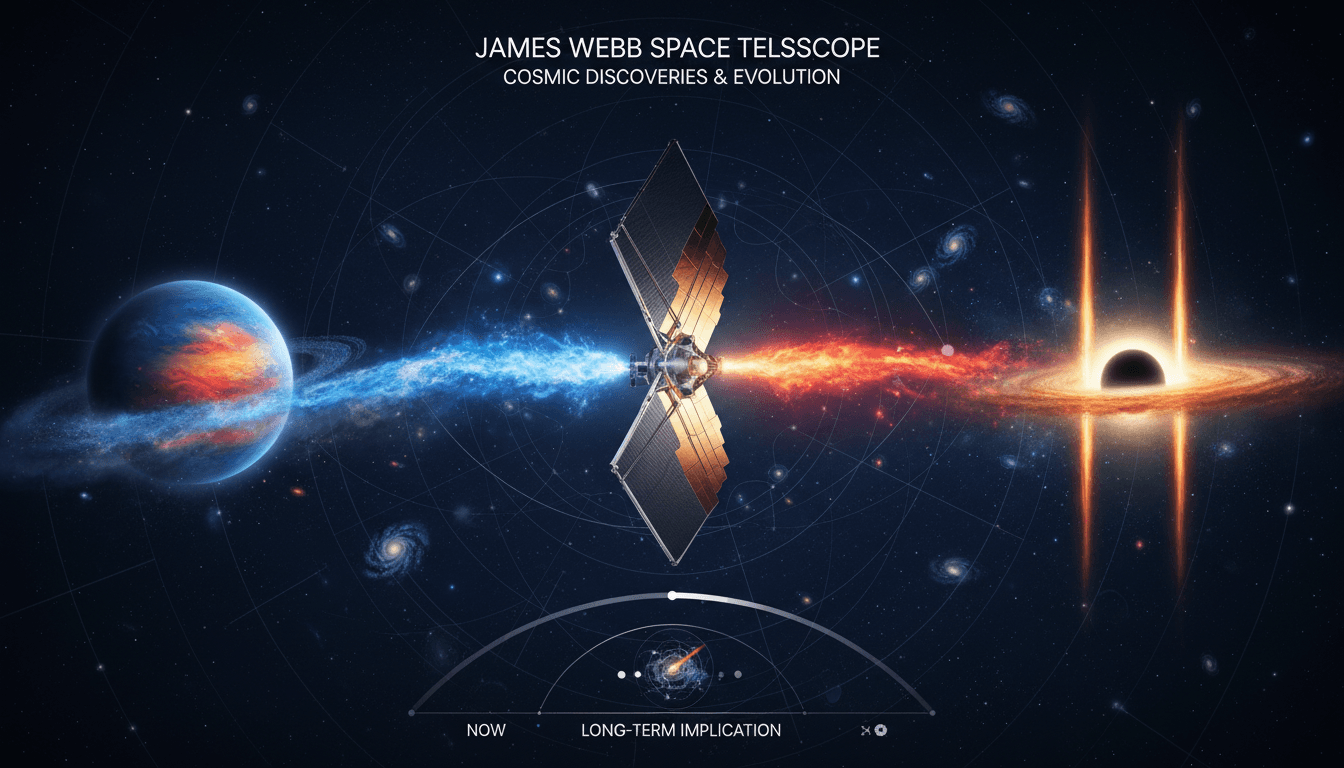
Here's what it means for you.
The discoveries made by the James Webb Space Telescope (JWST) have profound implications for our understanding of the universe. By identifying a giant planet just outside our solar system and revealing insights into supermassive black holes, astronomers are reshaping the narrative of cosmic evolution. This advancement not only enhances scientific knowledge but also has the potential to influence future space exploration and research funding. As JWST continues to unveil hidden cosmic structures, it opens new avenues for understanding the formation of galaxies and the distribution of stardust. The implications of these findings could lead to significant shifts in both academic and public perceptions of our place in the universe.
What happened
The James Webb Space Telescope has made groundbreaking discoveries, including the identification of a giant planet hidden just outside our solar system. Additionally, it has provided new insights into the mechanisms of supermassive black holes, enhancing our understanding of these enigmatic cosmic entities. The telescope has also revealed secrets about early galaxies that contributed to the formation of stardust in the universe.
These findings are part of a broader effort to explore previously hidden cosmic structures, leveraging JWST's advanced capabilities. The discoveries highlight the telescope's role in revolutionizing our understanding of the universe and its complex phenomena.
The Context
The JWST is a collaborative project involving NASA, the European Space Agency (ESA), and the Canadian Space Agency (CSA). Its mission is to explore the cosmos in unprecedented detail, focusing on both nearby and distant cosmic structures. Recent discoveries, such as the feeding mechanisms of supermassive black holes and the role of early galaxies in stardust production, underscore the telescope's significance in modern astronomy.
As astronomers continue to analyze data from JWST, the implications of these findings are expected to deepen our understanding of the universe's formation and evolution. This ongoing research is crucial for both scientific advancement and public interest in space exploration.
Takeaway
The ongoing research with JWST promises to deepen our understanding of the universe's formation and evolution. Future studies will likely focus on the implications of the discovered giant planet and upcoming findings related to black holes and galaxy formation. As the telescope continues its mission, it is expected to unveil more groundbreaking discoveries that will reshape our understanding of cosmic history.
The excitement surrounding these findings indicates a vibrant future for astronomical research, with potential impacts on various fields, including astrophysics and cosmology.
Space science news, astronomy updates, and spaceflight developments.
"Space.com delivers space science news, astronomy updates, and spaceflight developments with engaging coverage."
— A47 Editor
James Webb Space Telescope discovers the secrets of cosmic 'factories' that filled the early universe with stardust
Astronomers utilizing the James Webb Space Telescope (JWST) have uncovered secrets of early galaxies that contributed to the formation of stardust in the infant universe. This discovery was made by examining a modern galaxy, providing insights into t...
Photography news including AI tools and ethics.
"Covers AI’s impact on imaging and creative workflows."
— A47 Editor
Researchers Used Two Telescopes to Discover a Planet Hidden In Plain Sight
Astronomers utilizing the James Webb Space Telescope (JWST) have made a significant discovery of a giant planet located just outside the solar system, which had previously remained undetected despite being in plain sight. This finding highlights the ...
Space science news, astronomy updates, and spaceflight developments.
"Space.com delivers space science news, astronomy updates, and spaceflight developments with engaging coverage."
— A47 Editor
James Webb Space Telescope discovers how black holes feed themselves
Astronomers using the James Webb Space Telescope (JWST) have gained insights into the mechanisms by which supermassive black holes feed themselves, shedding light on their growth and behavior in the universe. This discovery marks a significant advanc...