
James Webb Space Telescope discovers supermassive black hole predating its host galaxy
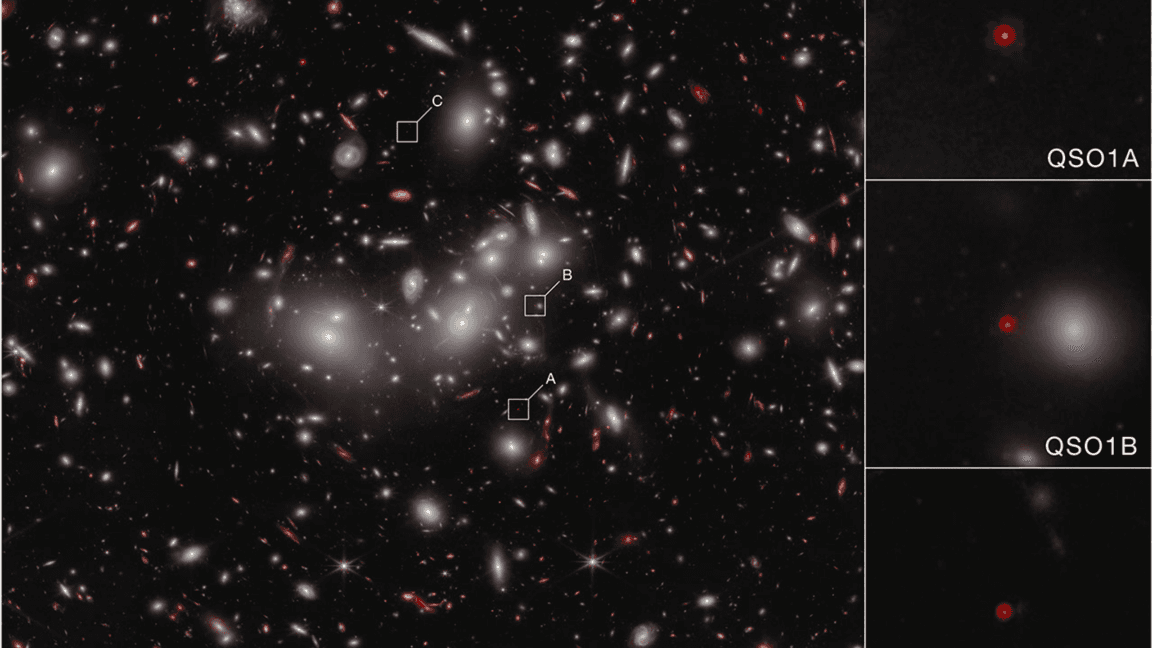
Here's what it means for you.
The discovery of the 'Little Red Dot' by the James Webb Space Telescope has significant implications for our understanding of cosmic evolution. It challenges existing theories about the formation of black holes and galaxies, suggesting that these entities may not develop in tandem as previously thought. This revelation could reshape astrophysical models and influence future research directions in the field. As astronomers delve deeper into the early universe, findings like this will be crucial for refining our comprehension of cosmic structures. The implications extend beyond theoretical astrophysics, potentially impacting how we view the universe's history and development.
What happened
Astronomers have identified a supermassive black hole, known as the 'Little Red Dot', that appears to have formed before its associated galaxy. This groundbreaking discovery was made possible through advanced observations from the James Webb Space Telescope. The black hole is notably overmassive, accounting for over two-thirds of the mass of the galaxy it inhabits.
This significant mass raises questions about the sequence of cosmic evolution, particularly regarding whether black holes can form independently of their host galaxies. The findings challenge long-held beliefs in astrophysics and open new avenues for exploration.
The Context
The discovery of the 'Little Red Dot' is a pivotal moment in our understanding of the universe. Traditionally, it has been assumed that black holes and galaxies develop in a synchronized manner. However, this finding suggests a more complex relationship, indicating that black holes may emerge independently.
The implications of this research could lead to a paradigm shift in how scientists approach the study of cosmic evolution. As astronomers continue to analyze data from the James Webb Space Telescope, the potential for new insights into the formation of early galaxies and black holes is immense.
Takeaway
Future research will likely focus on the formation processes of early galaxies and black holes, driven by the revelations from the 'Little Red Dot'. Upcoming observations from the James Webb Space Telescope will be critical in furthering our understanding of these cosmic phenomena.
As the scientific community grapples with the implications of this discovery, it may redefine our understanding of the interplay between black holes and galaxies, ultimately reshaping theories of cosmic evolution.
Space science news, astronomy updates, and spaceflight developments.
"Space.com delivers space science news, astronomy updates, and spaceflight developments with engaging coverage."
— A47 Editor
James Webb Space Telescope discovers a black hole that formed before its host galaxy. Scientists aren't sure how
The James Webb Space Telescope (JWST) has made a groundbreaking discovery of a black hole that formed prior to its host galaxy, raising fundamental questions about the relationship between black holes and galaxy formation. This finding, linked to the...
In-depth reporting on tech, policy, and science including AI.
"Respected analysis for technically savvy readers, including AI topics."
— A47 Editor
"Little red dot" in early Universe is a naked supermassive black hole
A newly identified supermassive black hole, referred to as the "little red dot," has been discovered in the early Universe, accounting for over two-thirds of the mass of its host object. This finding sheds light on the formation and evolution of blac...
In-depth coverage of hardware, software, science, and policy.
"Ars Technica provides expert technology news, hardware reviews, and analysis for a technically savvy audience."
— A47 Editor
"Little red dot" in early Universe is a naked supermassive black hole
A newly identified supermassive black hole, referred to as the "little red dot," has been discovered in the early Universe, accounting for over two-thirds of the mass of its host object. This finding sheds light on the formation and evolution of blac...
Scientific discoveries, health, technology, and natural phenomena.
"Live Science reports on scientific discoveries, health, technology, and natural phenomena with a popular science tone."
— A47 Editor
James Webb telescope discovers 'naked' black hole that somehow formed before its own galaxy
The James Webb telescope has identified an overmassive black hole located in a small galaxy, suggesting that it may have formed prior to the development of its host galaxy. This discovery raises intriguing questions about the formation and evolution ...