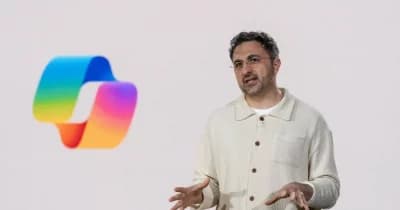
Microsoft Launches Seven New AI Models at Build 2026 Conference

Here's what it means for you.
The introduction of Microsoft’s new AI models could reshape how your business leverages technology for efficiency and innovation.
Why it matters
Microsoft's strategic shift to in-house AI models signals a competitive move against established players, potentially lowering costs and enhancing enterprise capabilities.
What happened (in 30 seconds)
- Microsoft unveiled seven new AI models during the Build 2026 conference, led by CEO Mustafa Suleyman.
- MAI-Thinking-1, a 35-billion-parameter reasoning model, is designed to handle complex tasks in mathematics and coding.
- Models are currently in private preview, allowing enterprises to customize them with their own data for enhanced utility.
The context you actually need
- Microsoft aims to reduce reliance on third-party AI solutions, positioning itself as a key player in the AI landscape.
- The MAI-Thinking-1 model represents a significant advancement in reasoning capabilities, which are crucial for enterprise applications.
- The models are designed to integrate seamlessly with Azure, enhancing Microsoft's cloud offerings and attracting more enterprise clients.
What's really happening
On June 2, 2026, Microsoft made a bold statement at its Build 2026 developer conference by unveiling a suite of seven new AI models, with MAI-Thinking-1 taking center stage. This model, boasting 35 billion parameters, is engineered to excel in reasoning tasks, a domain previously dominated by external providers like OpenAI and Anthropic. By developing these models in-house, Microsoft is not just enhancing its product offerings; it is also strategically positioning itself to disrupt the current AI market.
The introduction of MAI-Thinking-1 is particularly noteworthy as it marks Microsoft's first significant foray into reasoning models. These models are designed to tackle complex tasks that require advanced mathematical and coding skills, making them invaluable for enterprises looking to streamline operations and improve decision-making processes. Alongside MAI-Thinking-1, Microsoft also launched models for image generation (MAI-Image-2.5 and MAI-Image-2.5 Flash), transcription (MAI-Transcribe-1.5), speech generation (MAI-Voice-2 and MAI-Voice-2 Flash), and coding (MAI-Code-1-Flash).
The strategic shift to in-house AI development is driven by a desire to reduce dependency on third-party solutions, which can be costly and less customizable. By allowing enterprises to tailor these models with their own data, Microsoft is enhancing the practical utility of its offerings, making them more attractive to businesses seeking to leverage AI for competitive advantage.
The positive reception from industry analysts and corporate clients indicates a strong interest in these models, with many eager to explore their potential applications. This enthusiasm is reflected in a slight uptick in Microsoft's stock price following the announcement, signaling investor confidence in the company's direction in AI. As enterprises increasingly seek cost-effective alternatives to existing AI solutions, Microsoft's new models could become a cornerstone of their digital transformation strategies.
Who feels it first (and how)
- Enterprise IT departments: They will need to adapt to new AI tools and integrate them into existing workflows.
- Data scientists and engineers: These professionals will be tasked with customizing and optimizing the new models for specific business needs.
- C-suite executives: They will be evaluating the cost-benefit of adopting these new technologies to enhance operational efficiencies.
- Sectors like finance and logistics: Industries that rely heavily on data analysis and operational efficiency will see immediate impacts.
What to watch next
- Adoption rates of MAI models: Monitoring how quickly enterprises integrate these models will indicate their market impact.
- Feedback from early adopters: Insights from businesses using the models in private preview will reveal strengths and weaknesses.
- Market response from competitors: How other AI providers react to Microsoft's new offerings could shape the competitive landscape.
Microsoft has launched seven new AI models, including MAI-Thinking-1.
Enterprises will begin adopting these models to enhance operational efficiencies.
The long-term impact on the competitive landscape of AI providers remains to be seen.
Frequently Asked Questions
- Why it matters?
- Microsoft's strategic shift to in-house AI models signals a competitive move against established players, potentially lowering costs and enhancing enterprise capabilities.
- What happened (in 30 seconds)?
- Microsoft unveiled seven new AI models during the Build 2026 conference, led by CEO Mustafa Suleyman. MAI-Thinking-1, a 35-billion-parameter reasoning model, is designed to handle complex tasks in mathematics and coding. Models are currently in private preview, allowing enterprises to customize them with their own data for enhanced utility.
- What's really happening?
- On June 2, 2026, Microsoft made a bold statement at its Build 2026 developer conference by unveiling a suite of seven new AI models, with MAI-Thinking-1 taking center stage. This model, boasting 35 billion parameters, is engineered to excel in reasoning tasks, a domain previously dominated by external providers like OpenAI and Anthropic. By developing these models in-house, Microsoft is not just enhancing its product offerings; it is also strategically positioning itself to disrupt the current A
- Who feels it first (and how)?
- Enterprise IT departments: They will need to adapt to new AI tools and integrate them into existing workflows. Data scientists and engineers: These professionals will be tasked with customizing and optimizing the new models for specific business needs. C-suite executives: They will be evaluating the cost-benefit of adopting these new technologies to enhance operational efficiencies. Sectors like finance and logistics: Industries that rely heavily on data analysis and operational efficiency will
- What to watch next?
- Adoption rates of MAI models: Monitoring how quickly enterprises integrate these models will indicate their market impact. Feedback from early adopters: Insights from businesses using the models in private preview will reveal strengths and weaknesses. Market response from competitors: How other AI providers react to Microsoft's new offerings could shape the competitive landscape.
Opinionated AI coverage for general audiences.
"TNW’s AI vertical covering tools, ethics, and trends."
— A47 Editor
Microsoft’s AI chief says the company wants to “eliminate” what it pays Anthropic
Mustafa Suleyman, Microsoft's AI chief, has indicated that the company aims to reduce its financial commitments to Anthropic, citing the high costs associated with its AI models. He expressed concerns about Anthropic's pricing during a recent intervi...
Technology business news, market impacts, and innovation trends.
"Bloomberg is a premier financial and tech news provider, respected for its in-depth reporting and analytical rigor."
— A47 Editor
Microsoft’s AI Chief Says Anthropic Models Are Too Expensive
Microsoft’s AI chief has expressed concerns regarding the high costs associated with Anthropic's AI models, indicating a strategic shift towards developing more affordable in-house alternatives. This move reflects the company's intent to enhance its ...
Technology business and AI-related headlines.
"Data-driven tech newsroom with global scope."
— A47 Editor
Microsoft’s AI Chief Says Anthropic Models Are Too Expensive
Microsoft’s AI chief has expressed concerns regarding the high costs associated with Anthropic's AI models, indicating a strategic shift towards developing more affordable in-house alternatives. This move reflects the company's intent to enhance its ...
Consumer tech news, reviews, and buying guides for gadgets and electronics.
"TechRadar is known for comprehensive buying advice, hardware reviews, and consumer tech news targeted at mainstream audiences."
— A47 Editor
OpenAI and Anthropic are battling to conquer the AI market in Finance and Legal
OpenAI and Anthropic are currently engaged in a competitive struggle to capture market share in the finance and legal sectors, with both companies vying for new and existing customers. This rivalry is intensified by Anthropic's recent confidential fi...
Consumer tech news, reviews, and buying guides for gadgets and electronics.
"TechRadar is known for comprehensive buying advice, hardware reviews, and consumer tech news targeted at mainstream audiences."
— A47 Editor
‘We need an AI that places humanity first’: Microsoft AI CEO outlines hopes to build “humanist superintelligence” - and has seven new models to help him do it
Microsoft AI CEO Mustafa Suleyman announced the introduction of seven new AI models aimed at developing a “humanist superintelligence,” emphasizing the need for AI that prioritizes humanity. This initiative reflects the company's vision for an AI-ena...
Research, news, and analysis on blockchain startups, DeFi, and regulations.
"Crypto Briefing provides research, news, and analysis on blockchain startups, DeFi, and crypto regulations with investor-focused coverage."
— A47 Editor
Microsoft unveils seven new MAI models, led by CEO Mustafa Suleyman
Microsoft has unveiled seven new proprietary AI models under the leadership of CEO Mustafa Suleyman, marking a significant expansion in its artificial intelligence capabilities aimed at enhancing enterprise solutions. This initiative is expected to r...
Editor-curated FT homepage stories spanning markets, business, world, and opinion.
"The Financial Times is a globally respected business publication with a centrist/center-left tone and strong markets focus."
— A47 Editor
Microsoft targets Anthropic with new model releases
Microsoft has announced its intention to compete with Anthropic by releasing new AI models aimed at business users, as stated by Mustafa Suleyman, the company's AI chief. This strategic move highlights Microsoft's focus on enhancing its AI offerings ...
Tech business coverage, major deals, product launches, and Silicon Valley trends.
"WSJ’s tech section offers authoritative reporting on the intersection of technology and business, including exclusive industry analysis."
— A47 Editor
Google Is Daring Rivals To Keep Up in AI Spending Race
Google is intensifying its competition in the artificial intelligence (AI) sector, challenging rivals to match its significant investments in AI technology. This move comes as Anthropic has confidentially filed for an initial public offering (IPO), i...