
Iran escalates military actions against US following Khamenei's funeral
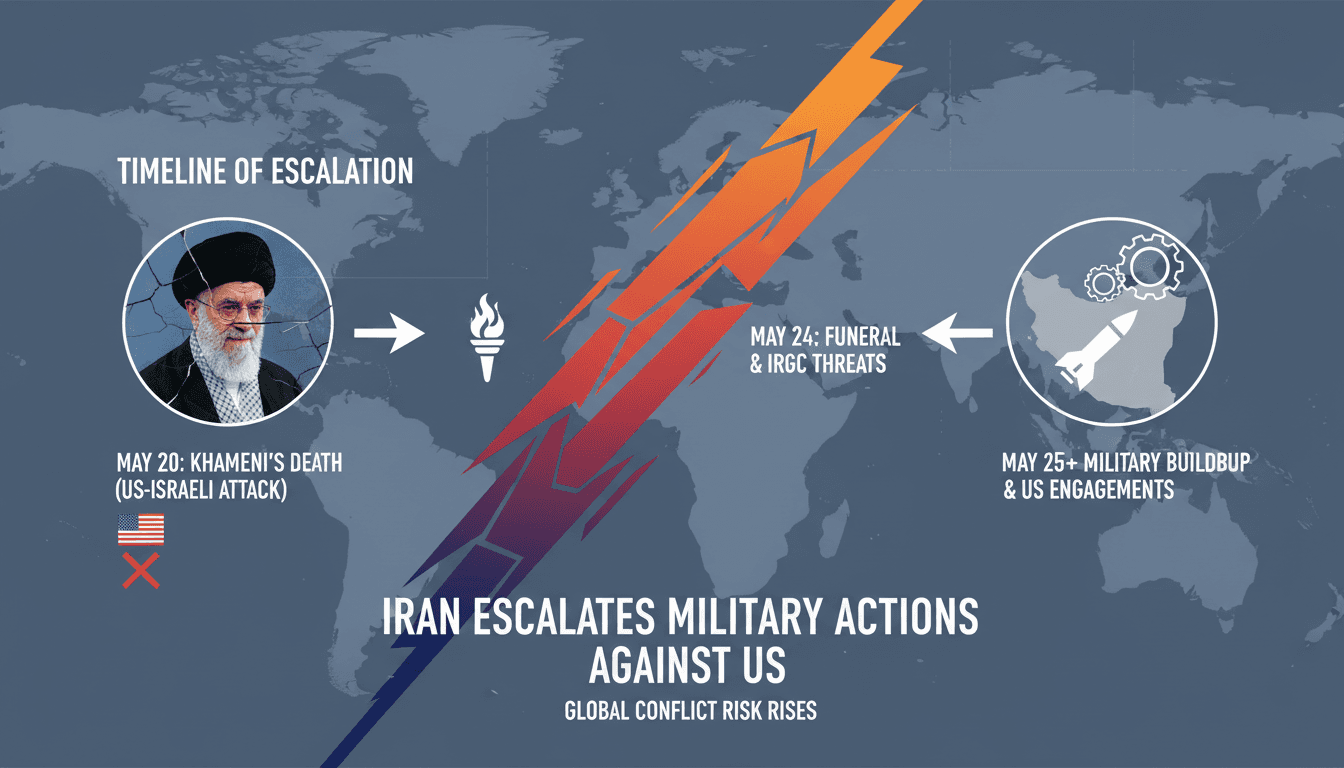
Here's what it means for you.
The recent escalation in military actions between Iran and the United States following the funeral of Ayatollah Ali Khamenei signals a significant shift in the geopolitical landscape. As Iran adopts a more nationalistic military leadership, the potential for broader conflict in the region increases, impacting global markets and security policies. Stakeholders should closely monitor developments, as the situation may influence energy prices and diplomatic relations.
What happened
Iran has buried Supreme Leader Ayatollah Ali Khamenei while simultaneously escalating military confrontations with US forces in the region. Khamenei was killed in a US-Israeli attack on February 28, which has prompted Iranian Revolutionary Guards to threaten further retaliation against US military presence. The funeral processions were marked by slogans calling for revenge against former President Trump, reflecting the heightened tensions.
In the wake of Khamenei's death, Iranian forces have launched attacks on American military infrastructure in Gulf states and Jordan. Reports indicate that 14 fatalities resulted from US strikes on Iranian territory, underscoring the escalating violence. This situation illustrates a critical turning point for Iran as it navigates its response to external threats.
The Context
The death of Ayatollah Khamenei marks a significant transition for Iran, moving from a theocratic regime to a more militarized governance structure. The funeral, held in Mashhad, served as a platform for Iran to assert its regional influence while engaging in military confrontations with the US. The ongoing conflict has implications for the Strait of Hormuz, a vital shipping route currently under Iranian control.
As tensions rise, the Iranian Revolutionary Guards have taken a more prominent role in shaping military policy, indicating a shift in governance. The timing of these events is crucial, as they coincide with a period of heightened US-Iran military engagements. The international community is watching closely, as the potential for broader conflict looms.
Takeaway
The ongoing military confrontations suggest a potential for further escalation in US-Iran relations. Stakeholders should monitor developments in military engagements and shifts in regional alliances, as neighboring countries may respond to the evolving situation. Diplomatic efforts may be necessary to prevent further escalation, but the current trajectory indicates a continued aggressive posture from both sides.
As military actions intensify, the risk of broader conflict remains high. The situation is fluid, and the international community must remain vigilant in addressing the implications of these developments.
English-language reporting on Saudi politics, policy, and society.
"Saudi Gazette reflects mainstream Saudi institutional perspectives."
— A47 Editor
Iran hits American military sites in Gulf states, Jordan after deadly US strikes
Iranian forces launched attacks on American military infrastructure in Gulf states and Jordan following deadly US strikes on Iran's southern coastal and eastern provinces, further straining a three-week-old ceasefire agreement. The attacks coincided ...
European coverage of Middle East politics and security issues.
"France 24 offers international reporting with a European editorial perspective."
— A47 Editor
As Iran buries Khamenei, it shifts from 'a theocracy to a nationalistic military leadership'
The funeral of Iran's late Supreme Leader, Ayatollah Ali Khamenei, concluded with a massive procession in Mashhad, following a week of mourning that began on July 3, 2026. The event drew millions of mourners and was marked by displays of national pri...
Coverage of current events and conflicts in the Middle East.
"France 24 is viewed as a globally focused outlet with balanced coverage and a European perspective."
— A47 Editor
As Iran buries Khamenei, it shifts from 'a theocracy to a nationalistic military leadership'
The funeral of Iran's late Supreme Leader, Ayatollah Ali Khamenei, concluded with a massive procession in Mashhad, following a week of mourning that began on July 3, 2026. The event drew millions of mourners and was marked by displays of national pri...
Regional and international reporting focused on Middle Eastern politics, diplomacy, and economics.
"Asharq Al-Awsat is a Saudi-owned international newspaper reflecting mainstream Gulf political perspectives."
— A47 Editor
Iran to Bury Slain Supreme Leader in Culmination of Mass Funeral
Iran is set to bury its late Supreme Leader, Ayatollah Ali Khamenei, in Mashhad on July 9, 2026, following a week of mass funeral processions that began on July 3. The ceremonies have attracted millions of mourners, reflecting Khamenei's significant ...
Editor-curated FT homepage stories spanning markets, business, world, and opinion.
"The Financial Times is a globally respected business publication with a centrist/center-left tone and strong markets focus."
— A47 Editor
Iran projects regional power as Khamenei funeral heads to Iraq
Iran is preparing for a significant display of power as the body of the late Supreme Leader Ayatollah Ali Khamenei is set to be exhibited in Shia holy cities, coinciding with a period of mourning across the nation. The funeral processions are expecte...