
Google Enters Classified AI Contract with Pentagon Amid Employee Dissent
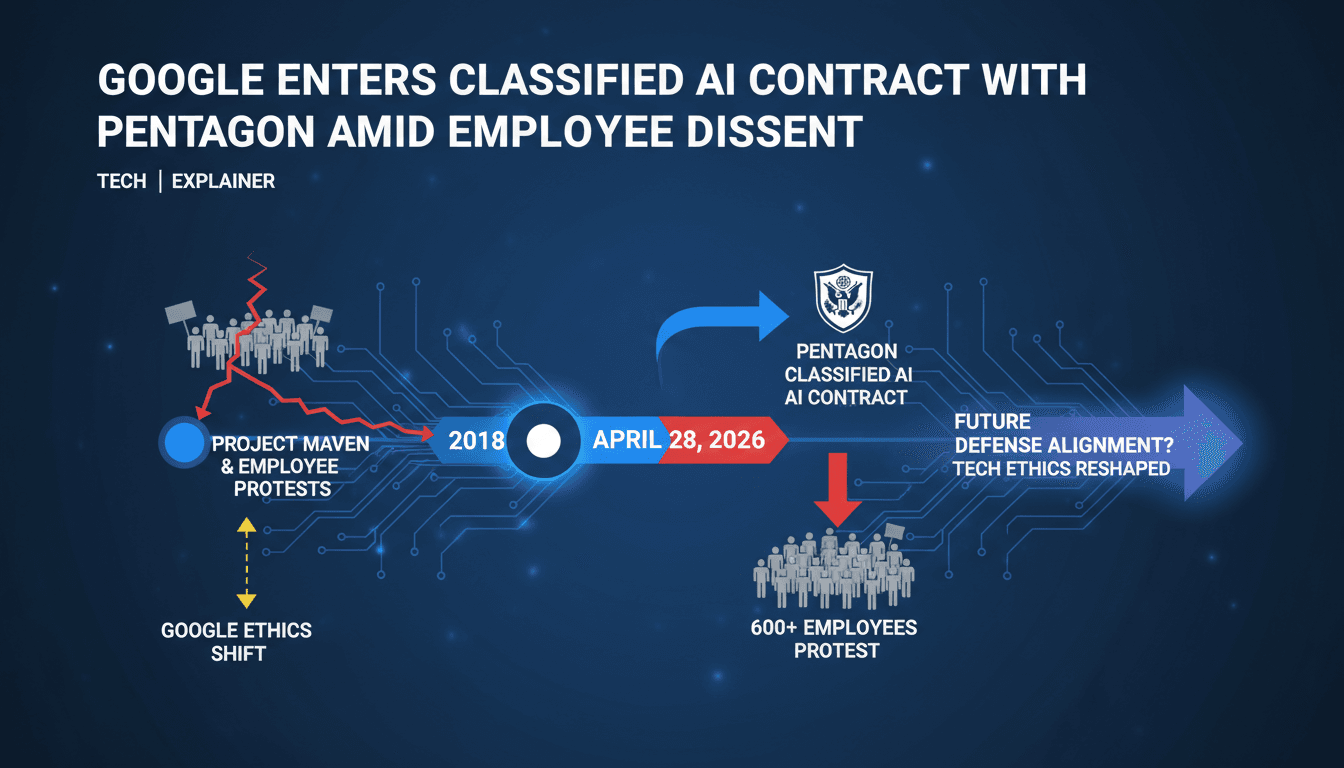
Here's what it means for you.
As AI technology increasingly intersects with national security, understanding these developments is crucial for professionals in tech and defense sectors.
Why it matters
This agreement signals a significant shift in how major tech companies engage with government defense contracts, potentially reshaping the landscape of AI applications in military contexts.
What happened (in 30 seconds)
- Google signed a classified AI agreement with the U.S. Department of Defense on April 28, 2026, allowing the Pentagon to use its AI models for military purposes.
- Over 600 Google employees protested the deal, citing concerns over lethal autonomous weapons and surveillance implications.
- The agreement includes safeguards against mass surveillance and autonomous weapons but grants the Pentagon broad access to Google's AI capabilities.
The context you actually need
- Previous protests influenced policy: In 2018, Google faced backlash over Project Maven, leading to a commitment to avoid military contracts involving AI.
- Evolving corporate stance: Google has gradually shifted its position, advocating for democratic leadership in AI development for national security since 2025.
- Internal dissent remains strong: Despite the deal, employee opposition persists, highlighting ongoing tensions between corporate interests and ethical concerns.
What's really happening
On April 28, 2026, Google finalized a classified agreement with the U.S. Department of Defense, allowing the Pentagon to utilize its AI models for sensitive military applications. This move comes after a history of employee protests, notably the 2018 Project Maven controversy, where thousands of Google employees voiced their opposition to the company's involvement in military AI projects. The backlash from that incident led Google to adopt AI principles that prohibited certain military applications, reflecting a commitment to ethical standards in technology.
However, the landscape has shifted. In early 2026, Google removed restrictive language from its policies, signaling a willingness to engage with government contracts once again. The recent agreement permits API access for "any lawful government purpose," which raises questions about the potential for misuse in surveillance or autonomous weaponry. While Google has incorporated safety filters into the agreement, it does not grant the company veto rights over how the Pentagon chooses to deploy its technology.
This development positions Google alongside other AI firms like OpenAI and xAI, which have also engaged with national security efforts. The implications of this agreement extend beyond Google itself, as it reflects a broader trend of tech companies increasingly collaborating with government entities. The potential for AI to enhance military capabilities is significant, but it also raises ethical concerns about accountability and the risks of autonomous systems.
The internal dissent from Google employees, including a public letter signed by over 600 individuals, underscores the tension between corporate objectives and ethical considerations. Researchers and employees have expressed shame and concern over the implications of this deal, indicating that the conversation around AI ethics is far from settled. Google has defended its decision as a "responsible approach" to national security, but the backlash suggests that many within the company disagree.
As the landscape of AI and military applications evolves, the balance between innovation and ethical responsibility will be a critical area to monitor. The agreement with the Pentagon may set a precedent for future collaborations between tech giants and government agencies, influencing how AI technologies are developed and deployed in sensitive contexts.
Who feels it first (and how)
- Tech employees: Those working in AI and machine learning sectors may face ethical dilemmas and workplace tensions.
- Defense contractors: Companies in the defense sector may see increased competition and collaboration opportunities with tech firms.
- Policymakers: Government officials will need to navigate the implications of AI in military applications, balancing innovation with ethical considerations.
What to watch next
- Employee activism: Monitor ongoing employee reactions at Google and other tech firms regarding military contracts, as this could influence corporate policies and public perception.
- Regulatory developments: Watch for potential government regulations on AI applications in military contexts, which could reshape the landscape for tech companies.
- Market responses: Keep an eye on stock market reactions to similar agreements, as investor sentiment may shift based on public and employee backlash.
Google has signed a classified AI agreement with the Pentagon.
Employee protests will continue to influence corporate policies on military contracts.
The long-term impact of this agreement on Google's reputation and employee retention remains uncertain.
Frequently Asked Questions
- Why it matters?
- This agreement signals a significant shift in how major tech companies engage with government defense contracts, potentially reshaping the landscape of AI applications in military contexts.
- What happened (in 30 seconds)?
- Google signed a classified AI agreement with the U.S. Department of Defense on April 28, 2026, allowing the Pentagon to use its AI models for military purposes. Over 600 Google employees protested the deal, citing concerns over lethal autonomous weapons and surveillance implications. The agreement includes safeguards against mass surveillance and autonomous weapons but grants the Pentagon broad access to Google's AI capabilities.
- What's really happening?
- On April 28, 2026, Google finalized a classified agreement with the U.S. Department of Defense, allowing the Pentagon to utilize its AI models for sensitive military applications. This move comes after a history of employee protests, notably the 2018 Project Maven controversy, where thousands of Google employees voiced their opposition to the company's involvement in military AI projects. The backlash from that incident led Google to adopt AI principles that prohibited certain military applicati
- Who feels it first (and how)?
- Tech employees: Those working in AI and machine learning sectors may face ethical dilemmas and workplace tensions. Defense contractors: Companies in the defense sector may see increased competition and collaboration opportunities with tech firms. Policymakers: Government officials will need to navigate the implications of AI in military applications, balancing innovation with ethical considerations.
- What to watch next?
- Employee activism: Monitor ongoing employee reactions at Google and other tech firms regarding military contracts, as this could influence corporate policies and public perception. Regulatory developments: Watch for potential government regulations on AI applications in military contexts, which could reshape the landscape for tech companies. Market responses: Keep an eye on stock market reactions to similar agreements, as investor sentiment may shift based on public and employee backlash.
Latest tech news, product reviews, and analysis for consumers and professionals.
"CNET delivers accessible and detailed technology reporting, including trusted product reviews and how-to guides."
— A47 Editor
Google Moves Forward With Pentagon AI Deal Despite Employee Pushback
Google has moved forward with a classified agreement with the Pentagon, allowing the U.S. Department of Defense to utilize its artificial intelligence models for any lawful government purpose. This decision comes despite significant pushback from ove...
Consumer tech news, reviews, and buying guides for gadgets and electronics.
"TechRadar is known for comprehensive buying advice, hardware reviews, and consumer tech news targeted at mainstream audiences."
— A47 Editor
‘Human lives are already being lost’: Open letter signed by hundreds of Google employees requests CEO reject ‘unethical and dangerous’ US military AI use
An open letter signed by over 600 Google employees has urged CEO Sundar Pichai to reject the company's involvement in providing artificial intelligence technology for military use by the U.S. Department of Defense, citing ethical concerns and potenti...
Pan-Arab news coverage spanning politics, business, sports, and regional affairs.
"Asharq Al-Awsat reflects a broad Arab editorial perspective with strong attention to regional geopolitics."
— A47 Editor
600 موظف في «غوغل» يطالبون برفض عقد عسكري سرّي مع «البنتاغون»
Six hundred employees at Google have called for the rejection of a secret military contract with the Pentagon, which involves the use of the company's artificial intelligence models for undisclosed activities. This agreement has raised concerns among...
Capitol Hill news, legislation, and policy insight.
"The Hill specializes in U.S. politics and policy, with a focus on Capitol Hill developments and a reputation for insider reporting."
— A47 Editor
Google workers urge CEO to reject classified AI work with Pentagon
Hundreds of Google employees have urged the company's CEO to reject any potential collaboration with the Pentagon involving classified artificial intelligence projects, citing risks similar to those faced by Anthropic, which was recently banned from ...
Business and tech news excluding paywalled content.
"High-volume business/tech outlet with frequent AI coverage."
— A47 Editor
Hundreds of Googlers ask their CEO to block classified AI work with the Pentagon
About 600 Google employees urge CEO Sundar Pichai to block classified Pentagon AI deals, citing ethical concerns over military use of AI for weapons.
Curated tech headlines including AI stories.
"Influential aggregator surfacing the day’s top tech/AI links."
— A47 Editor
More than 600 Google employees, including many from DeepMind, sign a letter to Sundar Pichai demanding he bar the DOD from using Google's AI for classified work (Gerrit De Vynck/Washington Post)
Over 600 Google employees, including many from DeepMind, have signed a letter addressed to CEO Sundar Pichai, urging him to prevent the U.S. Department of Defense (DOD) from utilizing Google's AI technologies for classified military purposes. The let...
Technology business and AI-related headlines.
"Data-driven tech newsroom with global scope."
— A47 Editor
Google Staff Urge Pichai to Refuse Classified Military AI Work
Over 600 AI researchers at Google have signed a letter urging CEO Sundar Pichai to refuse to allow the company's artificial intelligence systems to be used for classified military purposes by the U.S. Department of Defense. This move reflects signifi...
Technology business news, market impacts, and innovation trends.
"Bloomberg is a premier financial and tech news provider, respected for its in-depth reporting and analytical rigor."
— A47 Editor
Google Staff Urge Pichai to Refuse Classified Military AI Work
Hundreds of AI researchers at Google have signed a letter urging CEO Sundar Pichai to reject the use of the company's artificial intelligence systems for classified military applications, reflecting growing concerns over ethical implications in defen...
Editor-curated FT homepage stories spanning markets, business, world, and opinion.
"The Financial Times is a globally respected business publication with a centrist/center-left tone and strong markets focus."
— A47 Editor
Google staff urge chief executive to block US military AI use
Over 560 Google employees have signed an open letter urging CEO Sundar Pichai to prevent the company from collaborating with the US military on artificial intelligence projects, following a contentious situation involving the Pentagon and AI startup ...