
James Webb Space Telescope discovers supermassive black hole predating its galaxy
Here's what it means for you.
The discovery of a supermassive black hole that formed before its host galaxy has significant implications for our understanding of cosmic evolution. This finding challenges long-held theories about the sequence of black hole and galaxy formation, suggesting a more complex relationship than previously thought. As astronomers delve deeper into this revelation, it may reshape our understanding of the early universe and the fundamental processes that govern cosmic structures. This advancement in observational technology underscores the importance of continued investment in space exploration and astrophysics research. The implications of this discovery could influence future studies and theories in the field, potentially leading to groundbreaking insights.
What happened
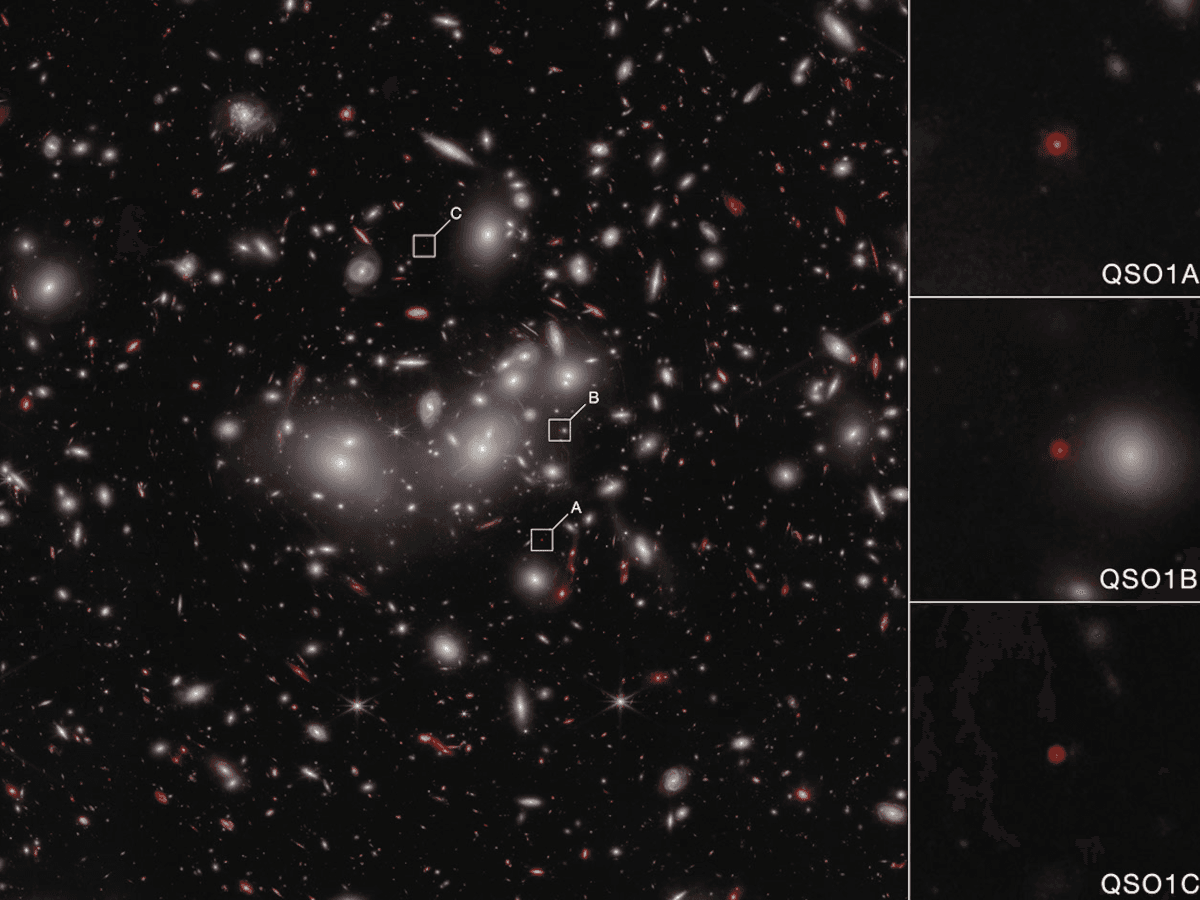
Astronomers have identified a supermassive black hole that predates its host galaxy, as revealed by the James Webb Space Telescope. This black hole is estimated to weigh approximately 50 million solar masses, marking it as a significant entity in cosmic formation studies. The discovery was made in a region referred to as a "little red dot," highlighting the telescope's advanced observational capabilities.
This finding raises critical questions about the timeline of black hole and galaxy formation in the early universe. The implications of this discovery challenge existing models and assumptions, prompting a reevaluation of how we understand cosmic history.
The Context
The discovery of this supermassive black hole is a pivotal moment in astrophysics, as it suggests that black holes can exist independently of their host galaxies. This challenges the traditional view of cosmic evolution, which posits a more linear relationship between the formation of galaxies and their central black holes. The findings were reported by multiple sources, indicating a broad interest and validation within the scientific community.
As astronomers continue to analyze data from the James Webb Space Telescope, the implications of this discovery could lead to new theories in astrophysics. The timing of this revelation coincides with advancements in observational technology and analysis techniques, allowing for deeper exploration of the cosmos.
Takeaway
Future research may uncover more about the early universe and the intricate relationship between black holes and galaxies. Investigations into the formation of black holes in the early universe will likely be a focal point for astronomers moving forward. This discovery not only reshapes our understanding of cosmic history but also opens new avenues for exploration and inquiry.
As the scientific community processes these findings, we can expect further studies that will delve into the implications of this discovery on existing cosmic evolution theories. The ongoing analysis of data from the James Webb Space Telescope promises to yield more revelations about the universe's formative years.
Tech, science, and startup news including AI.
"Irish tech outlet covering innovation and AI."
— A47 Editor
NASA’s Webb telescope reveals black hole formed before galaxy
NASA's Webb telescope has provided evidence of a 50 million solar mass black hole that formed before its host galaxy, suggesting a significant shift in understanding the timeline of cosmic structures.
Consumer technology news with AI coverage.
"Gadget and tech site reporting on AI in products."
— A47 Editor
James Webb telescope spots supermassive black hole that formed before its galaxy
The James Webb Space Telescope has made a groundbreaking discovery by identifying a supermassive black hole that formed prior to its host galaxy, challenging existing theories about cosmic evolution. This finding suggests that black holes can emerge ...
Covers consumer technology, electronics, gadgets, and product reviews.
"Engadget is a trusted source for gadget reviews and consumer tech news, known for its hands-on analysis and industry coverage."
— A47 Editor
James Webb telescope spots supermassive black hole that formed before its galaxy
The James Webb Space Telescope has made a groundbreaking discovery by identifying a supermassive black hole that formed prior to its host galaxy, challenging existing theories about cosmic evolution. This finding suggests that black holes can emerge ...
Scientific discoveries, health, technology, and natural phenomena.
"Live Science reports on scientific discoveries, health, technology, and natural phenomena with a popular science tone."
— A47 Editor
James Webb telescope discovers 'naked' black hole that somehow formed before its own galaxy
The James Webb telescope has identified an overmassive black hole located in a small galaxy, suggesting that it may have formed prior to the development of its host galaxy. This discovery raises intriguing questions about the formation and evolution ...
Science and technology stories including AI.
"Longstanding science magazine with thoughtful AI coverage."
— A47 Editor
Gigantic ‘little red dot’ threatens to upend cosmic history
The James Webb Space Telescope (JWST) has sparked debate regarding the nature of 'little red dots,' which are black holes observed in the early universe. A new analysis may provide clarity on these cosmic phenomena, potentially reshaping our understa...
Scientific research, technology, environment, and society.
"Scientific American is one of the oldest and most authoritative science magazines, known for deep dives into science, technology, and society."
— A47 Editor
Gigantic ‘little red dot’ threatens to upend cosmic history
The James Webb Space Telescope (JWST) has sparked debate regarding the nature of 'little red dots,' which are black holes observed in the early universe. A new analysis may provide clarity on these cosmic phenomena, potentially reshaping our understa...