
Bank of Korea raises interest rates for first time in over three years
Here's what it means for you.
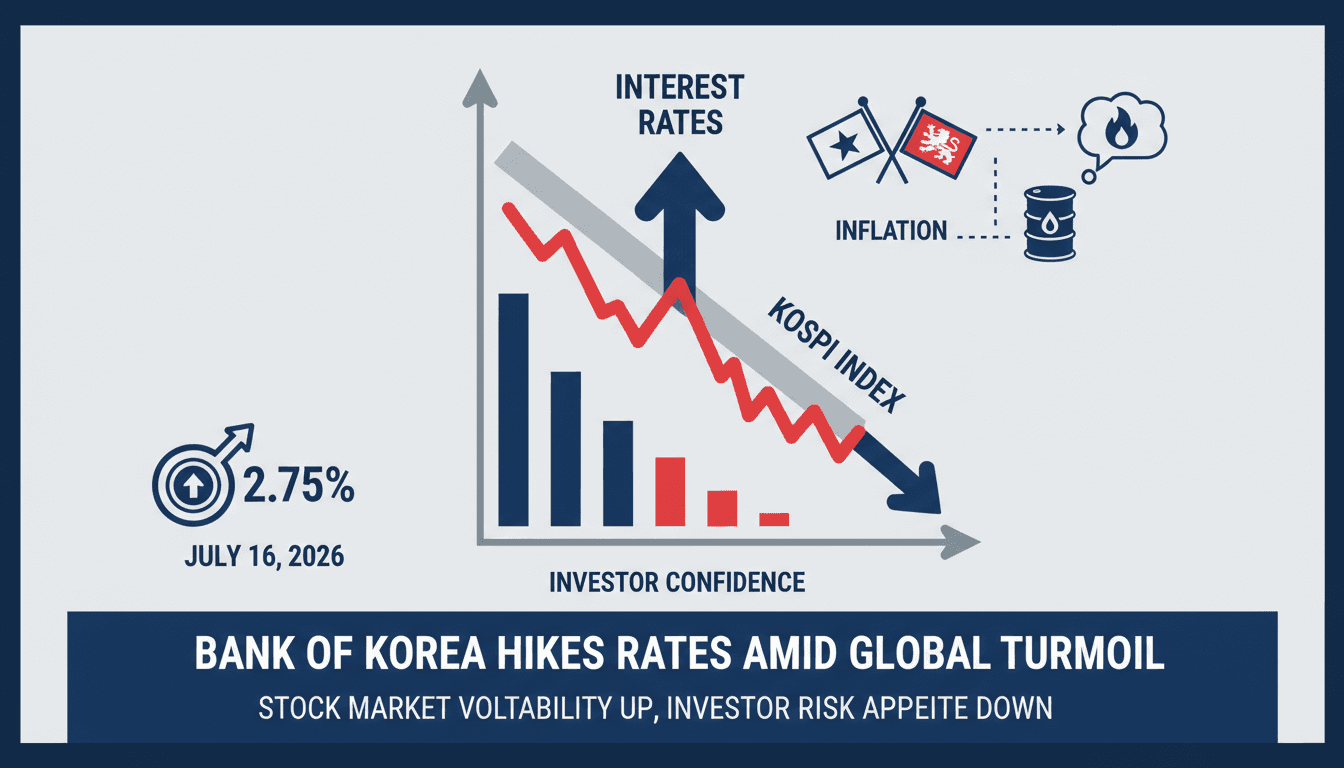
The Bank of Korea's decision to raise interest rates to 2.75% marks a significant shift in monetary policy, aimed at combating rising inflation driven by geopolitical tensions. This move is likely to dampen investor risk appetite, particularly in volatile sectors such as technology and cryptocurrency. As South Korea's stock market reacts, stakeholders should prepare for increased volatility and potential shifts in investment strategies. The implications extend beyond local markets, as this rate hike may influence global market trends amid ongoing economic uncertainties. Investors and analysts will need to closely monitor the effects on South Korea's economy and the broader implications for international markets.
What happened
On July 16, 2026, the Bank of Korea raised its base interest rate to 2.75%, marking the first increase in over three years. This decision was made in response to inflationary pressures exacerbated by the ongoing U.S.-Iran conflict. Following the announcement, South Korea's Kospi index experienced a significant decline, falling by 6.6%.
The rate hike reflects the central bank's commitment to curbing inflation and stabilizing the economy amid rising geopolitical tensions. The move has particularly impacted technology stocks, which are sensitive to interest rate changes.
The Context
This rate hike is the first since 2023 and comes at a time when inflationary concerns are heightened due to geopolitical instability. The ongoing U.S.-Iran conflict has created an environment of uncertainty, prompting the Bank of Korea to take decisive action to protect economic stability.
The decision is significant for various stakeholders, including investors, policymakers, and consumers, as it signals a shift in the central bank's approach to managing inflation. The immediate aftermath saw a notable decline in the Kospi index, indicating the market's reaction to the new monetary policy.
Takeaway
Looking ahead, the Bank of Korea's decision to raise interest rates could lead to further volatility in the stock market, particularly affecting sectors sensitive to interest rate fluctuations. Investors should monitor the impact of this rate hike on South Korea's economy and stock market closely.
Additionally, the central bank may consider further rate adjustments in response to ongoing inflationary pressures. The evolving economic landscape will require stakeholders to remain vigilant as they navigate potential changes in market dynamics.
Real-time updates, analysis, and reports on the blockchain and cryptocurrency sectors.
"Crypto News delivers real-time updates, analysis, and reports on the blockchain and cryptocurrency sectors."
— A47 Editor
South Korea rate hike puts fresh pressure on crypto risk appetite
South Korea has raised its base interest rate to 2.75%, marking the end of a three-year pause in monetary policy. This decision is expected to exert additional pressure on the country's active cryptocurrency market, which has been characterized by si...
Business, markets, economy, and corporate news with strong UAE and regional relevance.
"Emirates 24|7 business coverage tends to center UAE markets, property, regulation, and regional economic developments."
— A47 Editor
Asian stocks slide as South Korea's Kospi tumbles 6.6%; oil eases despite US-Iran tensions
Asian stock markets experienced a downturn on Thursday, primarily driven by a significant 6.6% drop in South Korea's Kospi index, following the Bank of Korea's first interest rate hike since 2023 amid inflationary concerns linked to the ongoing confl...
Social/economic commentary and analysis relevant to business and markets.
"WSJ blends data-driven economic insight with commentary on policy and society."
— A47 Editor
Bank of Korea Raises Rate for First Time Since 2023
The Bank of Korea has raised its interest rates for the first time since 2023, responding to persistent inflation driven by geopolitical tensions, particularly the U.S.-Iran conflict. This decision marks a significant shift in the central bank's mone...
Pan-Arab news coverage spanning politics, business, sports, and regional affairs.
"Asharq Al-Awsat reflects a broad Arab editorial perspective with strong attention to regional geopolitics."
— A47 Editor
البنك المركزي الكوري الجنوبي يرفع الفائدة لأول مرة منذ 2023 لكبح التضخم والديون
The Bank of Korea raised its key interest rate for the first time since 2023 on Thursday, marking a significant shift in monetary policy aimed at curbing inflation and managing debt levels. This decision comes after more than three years of maintaini...
Macro commentary, policy analysis, growth/inflation themes, and global outlooks.
"Contextual macro coverage that complements day-to-day market headlines."
— A47 Editor
Bank of Korea hikes interest rates for first time in 3-½ years
The Bank of Korea has raised interest rates for the first time in three and a half years, responding to persistent inflationary pressures and economic conditions. This decision marks a significant shift in the central bank's monetary policy as it aim...