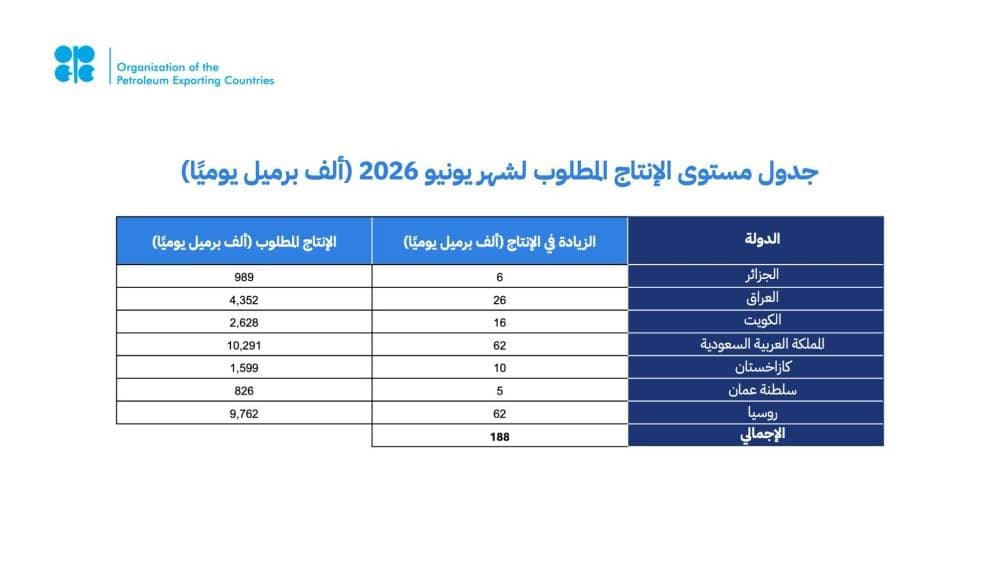
OPEC+ Increases Oil Production Quota by 188,000 Barrels per Day Following UAE Exit

Here's what it means for you.
If you’re in the energy sector or rely on oil prices, this production increase could signal both opportunities and risks in a volatile market.
Why it matters
This decision reflects OPEC+'s attempt to maintain stability in oil markets while grappling with geopolitical tensions that threaten supply.
What happened (in 30 seconds)
- OPEC+ approved an increase of 188,000 barrels per day in oil production quotas effective June 2026.
- The UAE withdrew from OPEC+ on May 1, 2026, citing unfair production limits, reducing the group to 21 members.
- Brent crude prices surged above $120 per barrel due to the ongoing Iran war and the closure of the Strait of Hormuz.
The context you actually need
- The UAE's exit from OPEC+ is significant as it produced approximately 3.6 million barrels per day, accounting for 3% of global supply before the Iran war.
- The Strait of Hormuz, a critical chokepoint for oil exports, has been closed since February 28, 2026, exacerbating supply constraints and driving prices higher.
- OPEC+ has historically relied on collective decision-making, and the UAE's departure raises questions about the group's future coordination and influence in the global oil market.
What's really happening
On May 1, 2026, the United Arab Emirates formally exited OPEC+ after decades of membership, a move that has significant implications for the oil market. The UAE's withdrawal was driven by frustrations over production quotas that it deemed unfair, limiting its ability to export oil. This departure reduced OPEC+ to 21 members, with only seven key producers—Saudi Arabia, Russia, Iraq, Kuwait, Kazakhstan, Algeria, and Oman—now responsible for setting monthly quotas.
Just days after the UAE's exit, OPEC+ announced a production increase of 188,000 barrels per day, effective June 2026. This decision, while seemingly proactive, is largely symbolic given the ongoing geopolitical crisis in the region. The closure of the Strait of Hormuz has severely constrained oil supplies, pushing Brent crude prices to a four-year high of over $120 per barrel, compared to pre-war levels around $72 per barrel.
The increase in production quotas is intended to project a sense of stability and continuity within OPEC+, especially as the group faces external pressures from the market. However, analysts suggest that this move may not significantly alleviate the supply issues caused by the Strait's closure. The lack of mention of the UAE's departure in OPEC+'s announcement indicates a desire to maintain unity among the remaining members, even as the group's influence appears to be waning.
The UAE is not sitting idle; it is advancing its independent strategies, with the Abu Dhabi National Oil Company (Adnoc) committing $55 billion to expansion projects. This investment aims to diversify the UAE's economy away from oil dependency and buffer against the disruptions caused by the ongoing conflict in Iran. As the UAE seeks to enhance its production capabilities independently, it could potentially increase local revenues, which would support infrastructure and public services.
In summary, while the production increase may seem like a positive step, the underlying geopolitical tensions and the UAE's exit from OPEC+ complicate the narrative. The oil market is likely to experience continued volatility as these dynamics unfold.
Who feels it first (and how)
- Energy companies: Increased production quotas may lead to short-term gains but also expose them to market volatility.
- Consumers: Higher oil prices could translate to increased costs for fuel and goods, impacting household budgets.
- Investors: Those in oil and energy sectors may see fluctuating stock prices as market reactions to geopolitical developments unfold.
- Governments: Countries reliant on oil exports may face budgetary pressures due to fluctuating prices and supply constraints.
What to watch next
- Brent crude price trends: Monitoring price movements will indicate market reactions to geopolitical developments and OPEC+ decisions.
- UAE's independent production strategies: The success of Adnoc's expansion projects could reshape the UAE's role in the global oil market.
- Geopolitical developments in Iran: Any changes in the conflict or the status of the Strait of Hormuz will have immediate implications for global oil supply.
OPEC+ has approved a production increase of 188,000 barrels per day.
Oil prices will remain volatile due to geopolitical tensions and supply constraints.
The long-term impact of the UAE's exit on OPEC+ coordination and influence is still uncertain.
This article was generated by AI from 9 verified sources and reviewed by A47 editorial systems.
Frequently Asked Questions
- Why it matters?
- This decision reflects OPEC+'s attempt to maintain stability in oil markets while grappling with geopolitical tensions that threaten supply.
- What happened (in 30 seconds)?
- OPEC+ approved an increase of 188,000 barrels per day in oil production quotas effective June 2026. The UAE withdrew from OPEC+ on May 1, 2026, citing unfair production limits, reducing the group to 21 members. Brent crude prices surged above $120 per barrel due to the ongoing Iran war and the closure of the Strait of Hormuz.
- What's really happening?
- On May 1, 2026, the United Arab Emirates formally exited OPEC+ after decades of membership, a move that has significant implications for the oil market. The UAE's withdrawal was driven by frustrations over production quotas that it deemed unfair, limiting its ability to export oil. This departure reduced OPEC+ to 21 members, with only seven key producers—Saudi Arabia, Russia, Iraq, Kuwait, Kazakhstan, Algeria, and Oman—now responsible for setting monthly quotas. Just days after the UAE's exit,
- Who feels it first (and how)?
- Energy companies: Increased production quotas may lead to short-term gains but also expose them to market volatility. Consumers: Higher oil prices could translate to increased costs for fuel and goods, impacting household budgets. Investors: Those in oil and energy sectors may see fluctuating stock prices as market reactions to geopolitical developments unfold. Governments: Countries reliant on oil exports may face budgetary pressures due to fluctuating prices and supply constraints.
- What to watch next?
- Brent crude price trends: Monitoring price movements will indicate market reactions to geopolitical developments and OPEC+ decisions. UAE's independent production strategies: The success of Adnoc's expansion projects could reshape the UAE's role in the global oil market. Geopolitical developments in Iran: Any changes in the conflict or the status of the Strait of Hormuz will have immediate implications for global oil supply.
Conservative-leaning political and national coverage.
"The Washington Times is a conservative-leaning newspaper known for its political coverage and advocacy of right-of-center viewpoints."
— A47 Editor
OPEC+ countries agree modest rise in production as Iran retains chokehold on key Strait of Hormuz
OPEC+ countries, including Saudi Arabia and Russia, have agreed to a modest increase in oil production starting in June, aiming to ensure market stability amid ongoing geopolitical tensions. This decision comes as Iran maintains a significant influen...
Markets, economy, and company analysis from NYT’s business desk.
"The New York Times is a globally recognized newspaper offering authoritative reporting with a center-left editorial stance."
— A47 Editor
OPEC Plus, in Symbolic Gesture, to Increase Oil Production
OPEC Plus has announced a symbolic increase in oil production, following the recent decision by the United Arab Emirates (UAE) to exit the organization effective May 1, 2026. This move comes as seven members of the consortium emphasized the need for ...
Global news coverage with extensive reporting on Middle Eastern conflicts and geopolitics.
"Al Jazeera is a Qatar-based broadcaster known for wide regional coverage and alternative perspectives."
— A47 Editor
OPEC+ announces symbolic oil output rise during Strait of Hormuz closure
OPEC+ has announced a symbolic increase in oil production quotas by 188,000 barrels per day for June, despite the ongoing closure of the Strait of Hormuz, a critical maritime route for oil shipping. This decision comes amid heightened geopolitical te...
Comprehensive coverage of Middle Eastern and global issues.
"Al Jazeera is a prominent voice from the Global South, especially the Middle East, with an emphasis on underreported stories."
— A47 Editor
OPEC+ announces symbolic oil output rise during Strait of Hormuz closure
OPEC+ has announced a symbolic increase in oil production quotas by 188,000 barrels per day for June, despite the ongoing closure of the Strait of Hormuz, a critical maritime route for oil shipping. This decision comes amid heightened geopolitical te...
Regional coverage and analysis focused on politics, diplomacy, and business across the Middle East.
"Al-Monitor is known for analytical reporting on Middle East politics and policy developments."
— A47 Editor
OPEC+ hikes oil production quotas but stays mum on UAE pull-out
OPEC+ has announced an increase in oil production quotas by 188,000 barrels per day for June, following the unexpected withdrawal of the United Arab Emirates (UAE) from the organization, effective May 1, 2026. This decision reflects the group's commi...
European coverage of Middle East politics and security issues.
"France 24 offers international reporting with a European editorial perspective."
— A47 Editor
OPEC+ raises oil output quotas for 'stability' after shock UAE pull-out
OPEC+ has announced an increase in oil production quotas for seven member countries, including Russia and Saudi Arabia, following the unexpected withdrawal of the United Arab Emirates (UAE) from the organization, effective May 1, 2026. This decision ...
24/7 international news from a French perspective in multiple languages.
"France 24 is viewed as a globally focused outlet with balanced coverage and a European perspective."
— A47 Editor
OPEC+ raises oil output quotas for 'stability' after shock UAE pull-out
OPEC+ has announced an increase in oil production quotas for seven member countries, including Russia and Saudi Arabia, following the unexpected withdrawal of the United Arab Emirates (UAE) from the organization, effective May 1, 2026. This decision ...
English-language reporting focused on Saudi Arabia and regional affairs.
"Saudi Gazette provides English-language coverage that often aligns with mainstream Saudi news priorities."
— A47 Editor
OPEC+ seven agree 188,000 bpd output adjustment for June to support market stability
Seven OPEC+ countries, including Saudi Arabia and Russia, have agreed to adjust oil production by 188,000 barrels per day for June 2026 to bolster market stability amid fluctuating global oil prices. This decision was made during a virtual meeting wh...
English-language reporting on Saudi politics, policy, and society.
"Saudi Gazette reflects mainstream Saudi institutional perspectives."
— A47 Editor
OPEC+ seven agree 188,000 bpd output adjustment for June to support market stability
Seven OPEC+ countries, including Saudi Arabia and Russia, have agreed to adjust oil production by 188,000 barrels per day for June 2026 to bolster market stability amid fluctuating global oil prices. This decision was made during a virtual meeting wh...
Sports reporting with a focus on Saudi and regional competitions.
"Okaz sports coverage is broad and audience-friendly, with strong attention to Saudi teams and leagues."
— A47 Editor
السعودية و6 دول تعدّل الإنتاج وتؤكد مجدداً التزامها باستقرار السوق البترولية
The seven member countries of the OPEC Plus group, including Saudi Arabia, Russia, Iraq, Kuwait, Kazakhstan, Algeria, and Oman, held a virtual meeting on May 3, 2026, to review the oil market developments and future prospects. They decided to impleme...
Culture, society, and public-interest stories for Arabic-speaking readers.
"This Al Watan feed appears section-specific, and the label is kept broad enough to avoid overclaiming the exact mapping."
— A47 Editor
السعودية و6 دول تتفق على رفع الإنتاج 188 ألف برميل يوميا اعتبارا من يونيو
On May 3, 2026, the seven member countries of the OPEC+ group, including Saudi Arabia, Russia, Iraq, Kuwait, Kazakhstan, Algeria, and Oman, held a virtual meeting to review the oil market's developments and future prospects. They decided to implement...
Global markets, investing, and macroeconomics from a premier financial newsroom.
"Bloomberg is respected for in-depth financial reporting and data-driven analysis."
— A47 Editor
OPEC+ Agrees Symbolic Quota Hike as UAE Touts Oil Investment
OPEC+ has agreed to a modest increase in oil production quotas for June, marking a symbolic gesture following the recent exit of the United Arab Emirates (UAE) from the organization. This decision reflects the group's intent to maintain stability in ...