
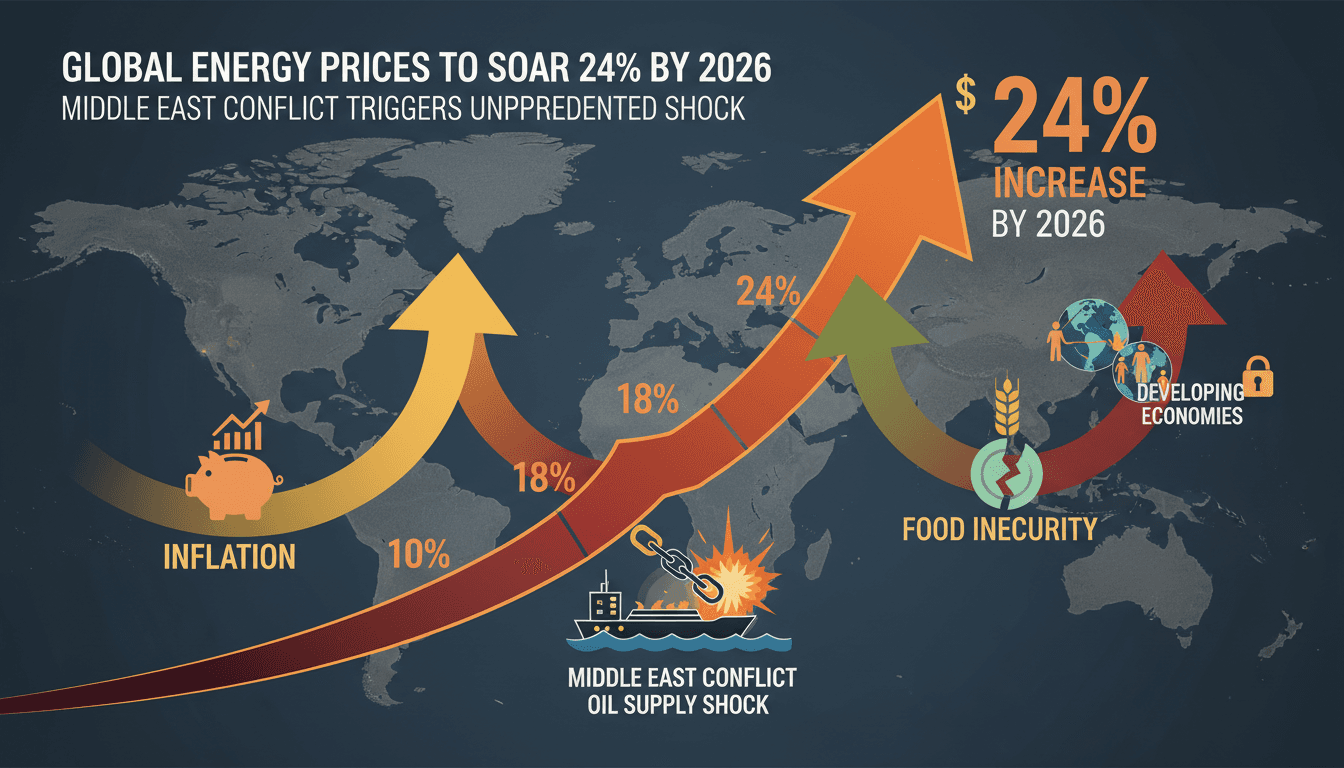
World Bank Projects 24% Increase in Global Energy Prices by 2026 Due to Middle East Conflict
Here's what it means for you.
Rising energy prices could significantly impact your cost of living and investment strategies.
Why it matters
The forecast signals a potential economic downturn, particularly affecting inflation and food security globally.
What happened (in 30 seconds)
- The World Bank projected a 24% surge in global energy prices for 2026 due to disruptions from the ongoing Middle East war.
- Brent crude oil prices are expected to average $86 per barrel, with risks pushing them as high as $115.
- Commodity prices overall are anticipated to rise by 16%, exacerbating inflation and food insecurity for millions.
The context you actually need
- The Strait of Hormuz is critical, handling 35% of global seaborne crude oil trade, making it vulnerable to geopolitical tensions.
- The war has already caused a record oil supply shock, reducing global oil supply by 10 million barrels per day.
- Developing economies are projected to face inflation rates of 5.1%, pushing an additional 45 million people into food insecurity.
What's really happening
The World Bank's forecast, released on April 28, 2026, highlights a significant economic ripple effect stemming from the ongoing conflict in the Middle East. The war, particularly involving Iran, has led to targeted attacks on energy infrastructure and shipping routes, notably through the Strait of Hormuz. This strategic chokepoint is vital for global oil transport, and disruptions here have resulted in the largest oil supply shock on record, with a staggering reduction of 10 million barrels per day.
As a result, Brent crude oil prices have surged, with projections indicating an average of $86 per barrel in 2026, up from $69 in 2025. The World Bank's Chief Economist, Indermit Gill, emphasized that the ramifications of this energy price surge extend beyond just fuel costs. Higher energy prices typically lead to increased costs for food and other essential commodities, as transportation and production expenses rise. The forecast anticipates a 31% increase in fertilizer prices, which will further inflate food costs and exacerbate food insecurity, particularly in developing nations.
The broader economic implications are significant. The World Bank has revised its growth forecasts for the Gulf Cooperation Council (GCC) down to 1.3% for 2026, reflecting the adverse effects of energy turmoil. While residents in Dubai and other GCC nations may be shielded from direct energy price hikes due to government subsidies, they are not insulated from the indirect consequences, such as rising food prices and inflationary pressures.
The forecast also comes at a time when the U.S. Federal Reserve is grappling with inflation risks, leading to a decision to hold interest rates steady. This indicates a cautious approach to monetary policy amid rising commodity prices, which could further complicate economic recovery efforts.
In summary, the World Bank's projection is not just a statistic; it represents a complex interplay of geopolitical tensions, economic vulnerabilities, and the potential for widespread hardship, particularly for the most vulnerable populations.
Who feels it first (and how)
- Consumers in developing economies: Facing higher food and energy costs, leading to increased financial strain.
- Agricultural sectors: Experiencing rising fertilizer prices, which could reduce crop yields and increase food prices.
- Investors in energy markets: Likely to see volatility in oil prices, impacting investment strategies and returns.
- Governments in the GCC: May need to adjust fiscal policies to manage inflation and support vulnerable populations.
What to watch next
- Oil price fluctuations: Monitoring Brent crude prices will be crucial as they directly impact global economic stability.
- Inflation rates in developing economies: Rising inflation could lead to social unrest and increased demand for government intervention.
- Food security indicators: Tracking food prices and availability will be essential to gauge the humanitarian impact of rising energy costs.
Energy prices are projected to rise significantly due to geopolitical tensions.
Inflation will increase, particularly in developing economies, leading to greater food insecurity.
The long-term effects on global economic growth and stability remain uncertain.
This article was generated by AI from 6 verified sources and reviewed by A47 editorial systems.
Markets, economy, and company analysis from NYT’s business desk.
"The New York Times is a globally recognized newspaper offering authoritative reporting with a center-left editorial stance."
— A47 Editor
World Bank estimates energy prices will surge 24 percent in 2026.
The World Bank has projected a 24% surge in energy prices by 2026, attributing this increase to the ongoing conflict in Iran, which is contributing to global inflation and economic instability.
Sports reporting with a focus on Saudi and regional competitions.
"Okaz sports coverage is broad and audience-friendly, with strong attention to Saudi teams and leagues."
— A47 Editor
«البنك الدولي»: توقعات بارتفاع أسعار الطاقة 24%
The World Bank has projected a 24% increase in energy prices by 2026, marking the highest levels since the extensive Russian invasion of Ukraine four years ago, contingent on the resolution of severe disruptions from the ongoing Middle Eastern confli...
Arabic-language economic and business reporting with strong UAE market relevance.
"Emarat Al Youm business coverage often centers UAE property, banking, consumer issues, and economic policy."
— A47 Editor
البنك الدولي: 24٪ ارتفاعاً متوقعاً في أسعار الطاقة خلال 2026 البنك الدولي: 24٪ ارتفاعاً متوقعاً في أسعار الطاقة خلال 2026
The World Bank has projected a 24% increase in energy prices by 2026, marking the highest levels since the Russian war. This forecast indicates significant shifts in the global energy market, likely influenced by ongoing geopolitical tensions and sup...
Oil, metals, and agriculture: supply/demand headlines, OPEC chatter, inventories, and price action.
"Solid tape for energy and metals traders tracking macro and micro catalysts."
— A47 Editor
World Bank sees 24% surge in energy prices in 2026
The World Bank has projected a 24% surge in energy prices by 2026, attributing this increase to ongoing geopolitical tensions, particularly in the Middle East, which have disrupted supply chains and contributed to inflationary pressures globally.
UAE-based English-language newspaper covering regional politics, economics, and global affairs.
"The National reflects Emirati policy perspectives while maintaining international editorial standards."
— A47 Editor
Iran war to push global energy prices to four-year high, World Bank says
The World Bank has projected that the ongoing conflict in Iran will drive global energy prices to a four-year high, reflecting the escalating tensions and instability in the region. This surge in prices is expected to have significant implications fo...
Global markets, investing, and macroeconomics from a premier financial newsroom.
"Bloomberg is respected for in-depth financial reporting and data-driven analysis."
— A47 Editor
World Bank Sees Commodity Prices Hitting Four-Year High in 2026
The World Bank has projected that global commodity prices will reach their highest levels since 2022, driven by ongoing disruptions in key industrial supplies, particularly oil and metals, due to the conflict in Iran.