
ECB Raises Interest Rates to Combat Persistent Inflation
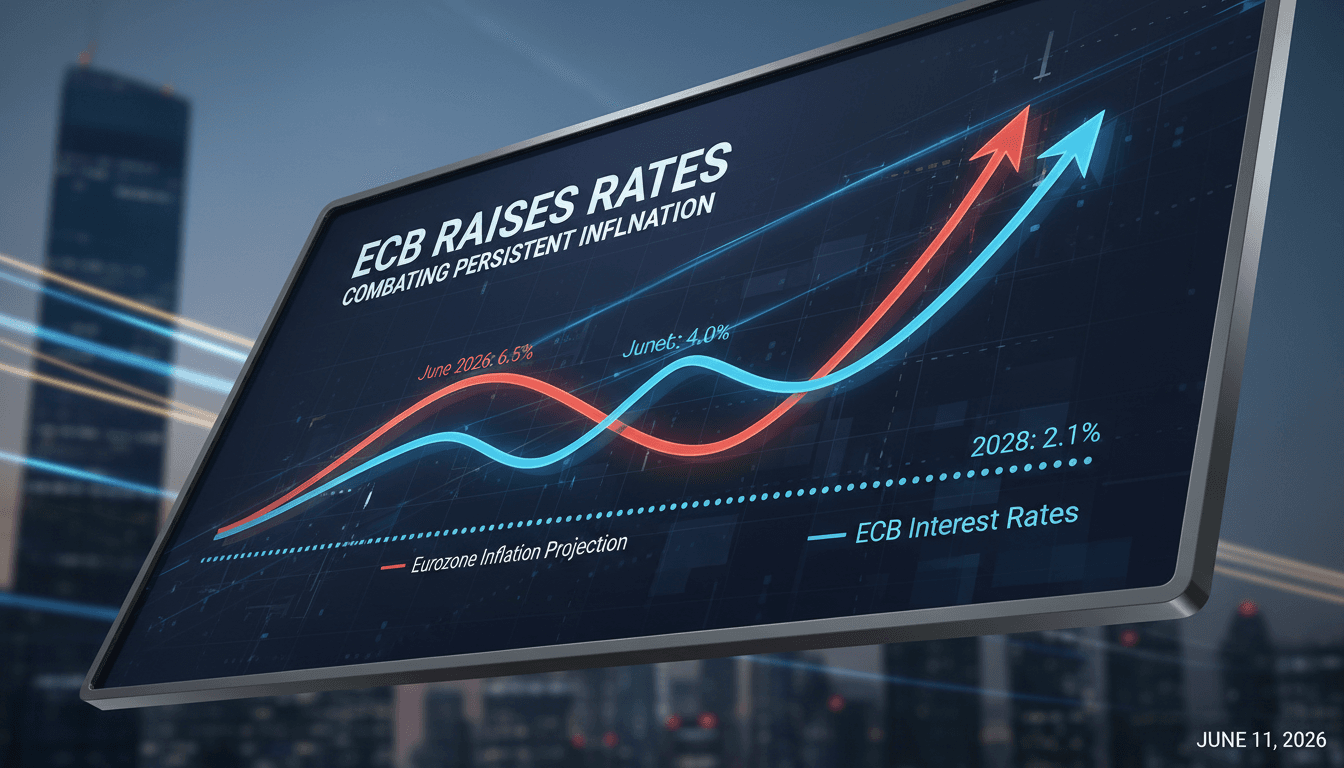
Here's what it means for you.
The European Central Bank's decision to raise interest rates signals a proactive approach to managing inflation, which is projected to remain above the target of 2% until 2028. This move may impact borrowing costs for consumers and businesses, potentially slowing economic growth in the Eurozone. Stakeholders should prepare for a period of tighter monetary policy as the ECB adapts to ongoing inflationary pressures.
What happened
On June 11, 2026, the European Central Bank raised interest rates in response to persistent inflationary pressures affecting the Eurozone. This decision was made unanimously by the governing council, reflecting a consensus on the need for tighter monetary policy. ECB President Christine Lagarde defended the rate hike, emphasizing that it was based on economic projections rather than immediate risks.
The inflation rate in the Eurozone is expected to remain above the ECB's target of 2% until the end of 2028, prompting the need for decisive action. Lagarde noted that the risks to the Eurozone economy have recently become more balanced, indicating a cautious optimism amid ongoing challenges.
The Context
The ECB's decision comes amid increasing inflationary pressures linked to energy shocks and geopolitical tensions. Policymakers are responding to a complex economic landscape where inflation has consistently outpaced targets. The unanimous decision by the governing council underscores the urgency felt by ECB officials to stabilize the economy.
As inflation continues to be a critical concern, the ECB is likely to monitor economic indicators closely. The timing of this rate hike reflects a strategic response to evolving economic conditions, with the potential for further adjustments in the future.
Takeaway
Looking ahead, stakeholders should monitor future ECB meetings for potential further rate adjustments. Economic indicators will play a crucial role in shaping the ECB's monetary policy as it seeks to navigate the challenges posed by persistent inflation. The central bank's commitment to adapting its approach will be essential for ensuring economic stability in the Eurozone.
As the situation develops, understanding the implications of these rate changes will be vital for businesses and consumers alike.
Global markets, investing, and macroeconomics from a premier financial newsroom.
"Bloomberg is respected for in-depth financial reporting and data-driven analysis."
— A47 Editor
ECB Made Right Choice on Rate Hike, Lagarde Tells Les Echos
European Central Bank (ECB) President Christine Lagarde affirmed that the decision to raise interest rates last month was appropriate, as reported in an interview with Les Echos. This rate hike was the ECB's first in nearly three years, reflecting a ...
Sports reporting with a focus on Saudi and regional competitions.
"Okaz sports coverage is broad and audience-friendly, with strong attention to Saudi teams and leagues."
— A47 Editor
«المركزي الأوروبي»: رفع أسعار الفائدة القرار الأنسب
European Central Bank President Christine Lagarde confirmed that the monetary conditions last month made the decision to raise interest rates clear, with the council voting unanimously in favor. This decision was influenced by rising inflation pressu...
Key macro releases (CPI, jobs, PMIs), surprise indexes, and market implications.
"Great for data-print awareness and instant read-through to rates and risk assets."
— A47 Editor
Lagarde says ECB rate hike was based on projections, not risk
European Central Bank (ECB) President Christine Lagarde stated that the recent interest rate hike was based on economic projections rather than perceived risks, emphasizing a data-driven approach to monetary policy. This statement reflects the ECB's ...
Pan-Arab news coverage spanning politics, business, sports, and regional affairs.
"Asharq Al-Awsat reflects a broad Arab editorial perspective with strong attention to regional geopolitics."
— A47 Editor
لاغارد تدافع عن رفع الفائدة: تحركنا لمواجهة ضغوط تضخمية
Christine Lagarde, President of the European Central Bank, defended the decision to raise interest rates on June 11, citing the need to address inflationary pressures. This move is part of the bank's strategy to stabilize the economy amid rising cost...