
U.S. Government Invests $2 Billion in Quantum Computing with Equity Stakes
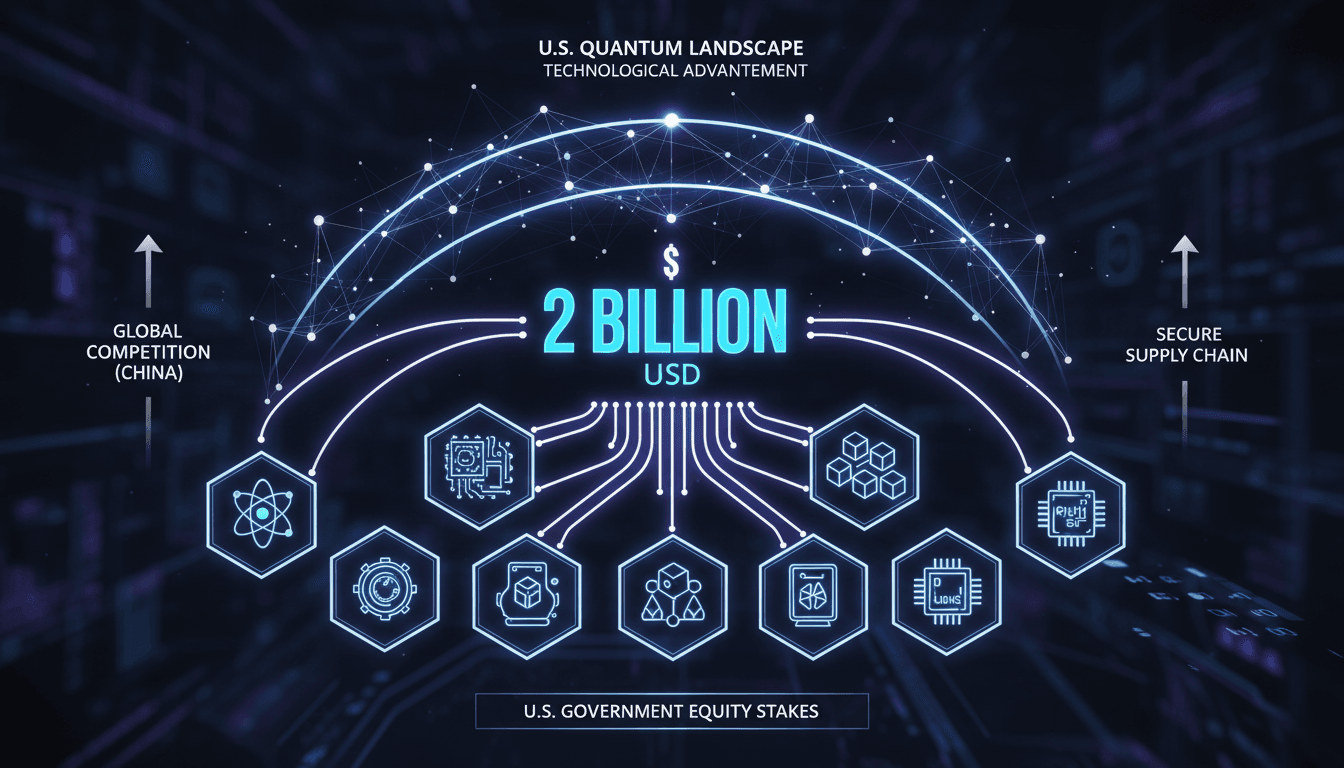
Here's what it means for you.
If you're in tech or finance, this investment could reshape market dynamics and innovation trajectories.
Why it matters
This investment signals a strategic pivot in U.S. policy towards equity stakes in critical technologies, enhancing national security and economic competitiveness.
What happened (in 30 seconds)
- On May 21, 2026, the U.S. Department of Commerce announced a $2 billion investment in nine quantum computing companies.
- IBM received the largest share of $1 billion, with other firms like GlobalFoundries and D-Wave Quantum also benefiting significantly.
- This initiative marks a shift from traditional grants to taking minority equity stakes in private firms, aiming to secure U.S. leadership in quantum technology.
The context you actually need
- Global competition: The U.S. is responding to increasing technological advancements from countries like China, particularly in quantum computing.
- CHIPS and Science Act: This funding is part of a broader strategy to strengthen domestic semiconductor manufacturing and related technologies.
- Market optimism: Following the announcement, stock prices for the involved companies surged, indicating investor confidence in the potential of quantum computing.
What's really happening
The U.S. government's $2 billion investment in quantum computing represents a significant shift in funding strategy, moving from traditional grants and contracts to taking minority equity stakes in private companies. This change is driven by a desire to enhance national security and maintain technological leadership in a rapidly evolving global landscape.
Historically, the U.S. government has favored grants and contracts, which provide funding without ownership stakes. However, the increasing competition from nations like China has prompted a reevaluation of this approach. By investing directly in companies, the U.S. aims to secure a foothold in critical technologies that are expected to shape the future of industries ranging from computing to telecommunications.
The investment is authorized under the CHIPS and Science Act, which seeks to bolster domestic semiconductor manufacturing and related technologies. This act reflects a broader recognition that technological leadership is essential for national security and economic competitiveness. By taking equity stakes, the government not only supports innovation but also positions itself to benefit financially from the success of these companies, potentially providing returns to taxpayers.
The nine companies receiving funding include industry leaders like IBM, which received the largest share of $1 billion, and GlobalFoundries, which secured $375 million. The remaining firms, including D-Wave Quantum and Rigetti Computing, each received $100 million. This distribution of funds is designed to enhance the domestic supply chain and ensure that the U.S. remains at the forefront of quantum technology development.
The announcement has already led to significant stock price increases for the involved companies, reflecting market optimism about the potential of quantum computing. Investors are betting on the transformative capabilities of quantum technology, which promises to revolutionize fields such as cryptography, materials science, and complex system modeling.
In summary, this investment not only aims to secure U.S. leadership in quantum technology but also represents a strategic pivot in how the government engages with the private sector in critical industries. By taking equity stakes, the U.S. is positioning itself to reap both technological and financial rewards in the burgeoning field of quantum computing.
Who feels it first (and how)
- Tech companies: Firms involved in quantum computing will see immediate financial support and potential growth in stock value.
- Investors: Those holding shares in the funded companies may experience increased portfolio value due to market optimism.
- Job seekers: The initiative is expected to create new jobs in the tech sector, particularly in quantum research and development.
- Government agencies: Agencies focused on national security and technology will benefit from enhanced capabilities and innovation.
What to watch next
- Stock performance: Monitor the stock prices of the involved companies to gauge market confidence in quantum technology.
- Job creation metrics: Keep an eye on employment statistics in the tech sector to see if the investment leads to significant job growth.
- International responses: Watch for reactions from other countries, particularly China, as they may ramp up their own investments in quantum technologies.
The U.S. government has committed $2 billion to quantum computing investments.
The investment will lead to increased stock prices and job creation in the tech sector.
The long-term financial returns for taxpayers from these equity stakes remain uncertain.
Frequently Asked Questions
- Why it matters?
- This investment signals a strategic pivot in U.S. policy towards equity stakes in critical technologies, enhancing national security and economic competitiveness.
- What happened (in 30 seconds)?
- On May 21, 2026, the U.S. Department of Commerce announced a $2 billion investment in nine quantum computing companies. IBM received the largest share of $1 billion, with other firms like GlobalFoundries and D-Wave Quantum also benefiting significantly. This initiative marks a shift from traditional grants to taking minority equity stakes in private firms, aiming to secure U.S. leadership in quantum technology.
- What's really happening?
- The U.S. government's $2 billion investment in quantum computing represents a significant shift in funding strategy, moving from traditional grants and contracts to taking minority equity stakes in private companies. This change is driven by a desire to enhance national security and maintain technological leadership in a rapidly evolving global landscape. Historically, the U.S. government has favored grants and contracts, which provide funding without ownership stakes. However, the increasing
- Who feels it first (and how)?
- Tech companies: Firms involved in quantum computing will see immediate financial support and potential growth in stock value. Investors: Those holding shares in the funded companies may experience increased portfolio value due to market optimism. Job seekers: The initiative is expected to create new jobs in the tech sector, particularly in quantum research and development. Government agencies: Agencies focused on national security and technology will benefit from enhanced capabilities and
- What to watch next?
- Stock performance: Monitor the stock prices of the involved companies to gauge market confidence in quantum technology. Job creation metrics: Keep an eye on employment statistics in the tech sector to see if the investment leads to significant job growth. International responses: Watch for reactions from other countries, particularly China, as they may ramp up their own investments in quantum technologies.
Tech news, hardware, and AI tools coverage.
"PC/tech site increasingly covering AI hardware and apps."
— A47 Editor
The US government is spending $2 billion on quantum computing, while taking stock in the companies it funds
The US government has announced a significant investment of $2 billion in quantum computing, with IBM receiving the largest share of $1 billion. This funding is part of a broader initiative to enhance the United States' capabilities in this emerging ...
Electronics industry news including AI chips.
"Covers semiconductors and embedded AI trends."
— A47 Editor
U.S. Injects $2B into Quantum Computing Companies
The U.S. government has announced a significant $2 billion investment in quantum computing companies, signaling its commitment to leading the quantum computing revolution and acquiring equity stakes in these firms. This funding is part of the broader...
Tech business coverage, major deals, product launches, and Silicon Valley trends.
"WSJ’s tech section offers authoritative reporting on the intersection of technology and business, including exclusive industry analysis."
— A47 Editor
U.S. to Award Quantum-Computing Firms $2 Billion and Take Equity Stakes
The U.S. government has announced a $2 billion funding initiative aimed at supporting quantum computing firms, with IBM set to receive $1 billion as part of this package. This investment is part of a broader strategy to enhance the U.S. position in t...
Market-moving headlines impacting equities, bonds, and related risk assets.
"Real-time catalysts and volatility drivers across indices and sectors."
— A47 Editor
US to invest $2 billion in IBM, other quantum computing firms
The U.S. government has announced a significant investment of $2 billion in quantum computing firms, with $1 billion specifically allocated to IBM. This initiative aims to enhance the nation's capabilities in the rapidly advancing field of quantum te...
Opinionated AI coverage for general audiences.
"TNW’s AI vertical covering tools, ethics, and trends."
— A47 Editor
IBM lands $1bn as US backs nine quantum companies for $2bn
The US Department of Commerce has signed nine letters of intent to allocate $2.013 billion in CHIPS Act funding to quantum computing companies, with IBM receiving $1 billion of this package. This funding is part of a broader initiative to enhance the...
Business, investment, entrepreneurship, leadership, and innovation.
"Forbes is known for its coverage of business leaders, market trends, and entrepreneurial ventures with a pro-business editorial stance."
— A47 Editor
U.S. Will Invest $2 Billion In Quantum Computing Firms And Take Equity, Report Says
The U.S. government is set to invest $2 billion in quantum computing firms, with a significant portion, $1 billion, allocated specifically for IBM. This investment aims to bolster the nation's capabilities in the rapidly evolving field of quantum tec...
Editor-curated FT homepage stories spanning markets, business, world, and opinion.
"The Financial Times is a globally respected business publication with a centrist/center-left tone and strong markets focus."
— A47 Editor
US quantum investment includes groups tied to Trump administration
The Trump administration has announced a $2 billion investment aimed at acquiring equity stakes in nine quantum computing companies, including a start-up backed by a firm linked to the Trump family and another that was taken public by a Pentagon offi...
Curated tech headlines including AI stories.
"Influential aggregator surfacing the day’s top tech/AI links."
— A47 Editor
The US Commerce Department plans to award $2B in grants to nine quantum computing companies and will take equity stakes; IBM is set to get $1B of the package (Wall Street Journal)
The US Commerce Department has announced plans to allocate $2 billion in grants to nine quantum computing companies, with IBM receiving $1 billion of this funding. This initiative aims to foster innovation in quantum technology as part of the Trump a...