
NASA study reveals Earth microorganisms can survive in lunar south pole shadowed regions
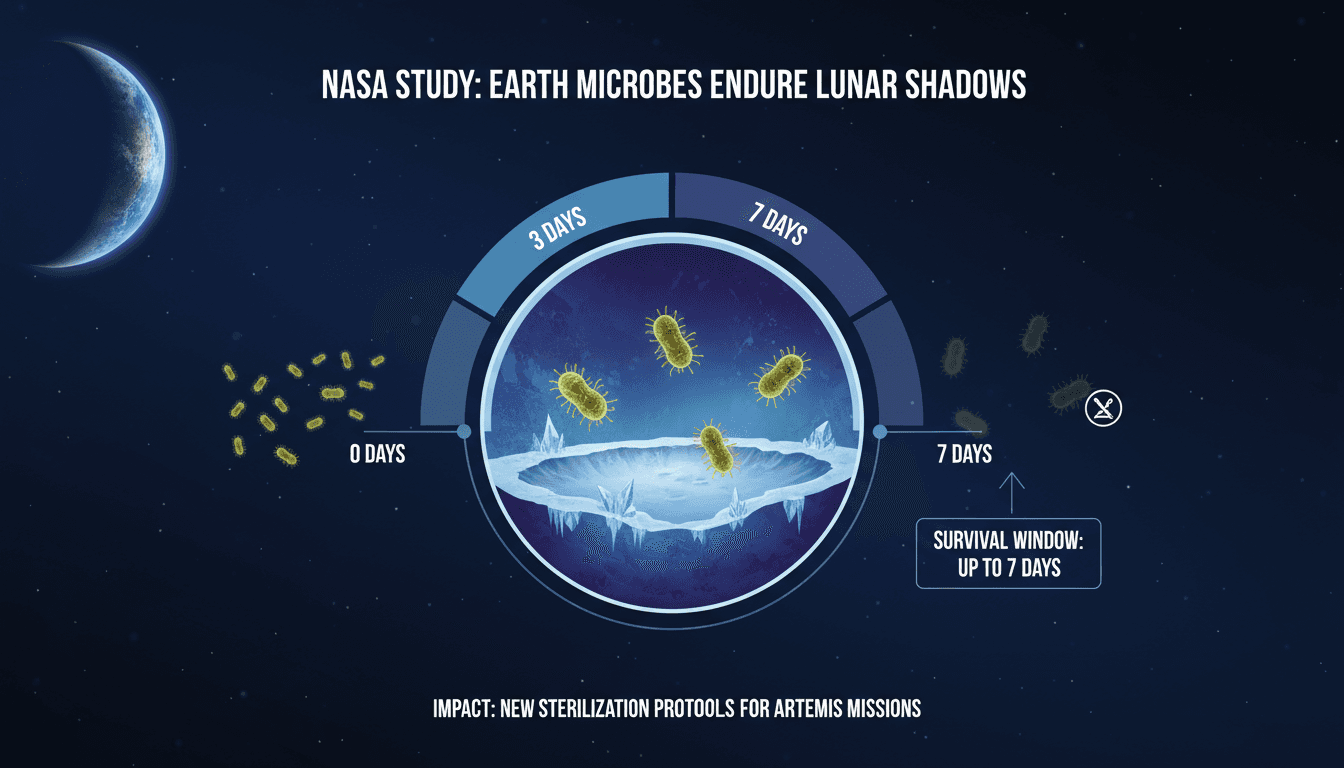
Here's what it means for you.
As lunar exploration ramps up, understanding microbial survival is crucial for maintaining scientific integrity in space missions.
What happened
A NASA-led study revealed that five Earth microorganisms can survive for up to seven days in the Moon's permanently shadowed regions.
The Context
- Planetary protection is critical: The study addresses contamination risks for NASA's Artemis program, which aims for crewed lunar landings by 2028.
- Microbial resilience modeled: Researchers simulated lunar conditions to assess how common cleanroom microbes persist in extreme environments.
- Implications for future missions: Findings suggest enhanced sterilization protocols are necessary to protect lunar environments from Earth-derived organisms.
The Number
— This is the maximum survival time for Aspergillus fungi in select lunar micro-PSRs, highlighting the need for stringent sterilization measures in space missions.
Takeaway
As exploration efforts intensify, expect ongoing discussions about balancing scientific discovery with contamination prevention.
Space science news, astronomy updates, and spaceflight developments.
"Space.com delivers space science news, astronomy updates, and spaceflight developments with engaging coverage."
— A47 Editor
Microbes from Earth may survive on the moon, scientists find
Recent research indicates that microbes from Earth may have the potential to survive on the moon, suggesting that even small disturbances like a bootprint or rover's tread could create habitable areas. This finding raises important questions about th...
Tech news, hardware, and AI tools coverage.
"PC/tech site increasingly covering AI hardware and apps."
— A47 Editor
NASA study finds Earth fungi could survive up to 7 days near lunar south pole
A recent NASA study published in Science Advances indicates that certain Earth fungi could survive for up to seven days in the extreme conditions near the lunar south pole, particularly in areas like Nobile Rim and Connecting Ridge. Researchers utili...
Science and technology stories including AI.
"Longstanding science magazine with thoughtful AI coverage."
— A47 Editor
Some microbes could survive on the moon—that’s a big problem for NASA
A recent study has revealed that five common microorganisms from Earth could potentially survive in the harsh conditions of the lunar south pole, posing a significant contamination risk for NASA's future human missions to the Moon.
Scientific research, technology, environment, and society.
"Scientific American is one of the oldest and most authoritative science magazines, known for deep dives into science, technology, and society."
— A47 Editor
Some microbes could survive on the moon—that’s a big problem for NASA
A recent study has revealed that five common microorganisms from Earth could potentially survive in the harsh conditions of the lunar south pole, posing a significant contamination risk for NASA's future human missions to the Moon.