
Japan Explores Blockchain for Real-Time Securities Settlement
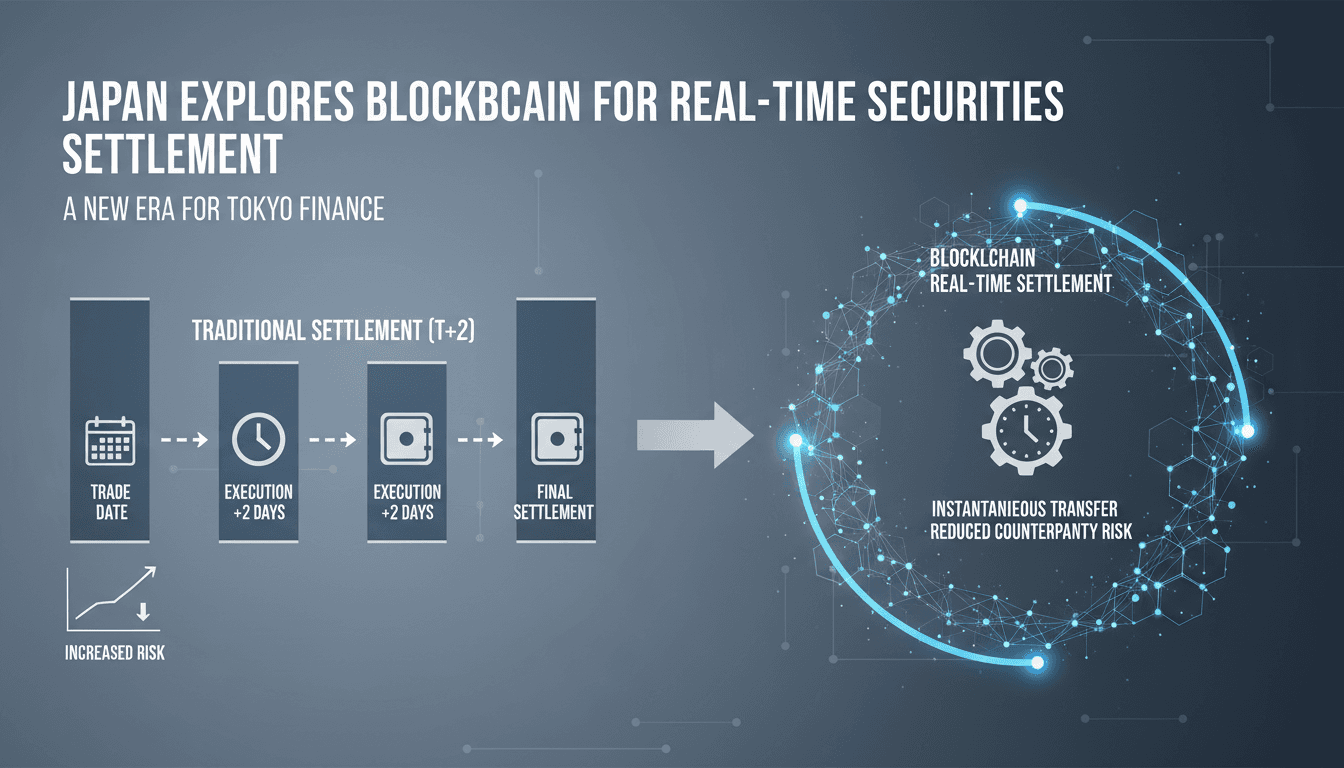
Here's what it means for you.
If you’re involved in finance or investment, this initiative could redefine how quickly you can execute trades.
Why it matters
This move could significantly enhance Japan's position as a global financial hub by modernizing its securities settlement process.
What happened (in 30 seconds)
- On August 27, 2026, Japan announced plans to study blockchain technology for near-instant settlement of stock and government bond trades.
- A joint study group involving the Financial Services Agency, Ministry of Finance, and Bank of Japan will design a new system to replace the current T+2 and T+1 settlement cycles.
- The initiative aims to reduce counterparty risk and free up capital, with a potential rollout in the early 2030s.
The context you actually need
- Japan has already shortened settlement cycles, moving to T+1 for government bonds in 2018 and T+2 for equities in 2019, aligning with global trends.
- Previous blockchain pilots in Japan, including stablecoin transactions for tokenized securities, have laid the groundwork for this initiative.
- International efforts, such as Project Stella with the European Central Bank, have influenced Japan's approach to blockchain-based settlement systems.
What's really happening
Japan's financial authorities are taking a significant step toward modernizing their securities settlement infrastructure by exploring blockchain technology. The initiative, spearheaded by the Financial Services Agency (FSA), the Ministry of Finance, and the Bank of Japan (BOJ), aims to replace the traditional settlement cycles of T+2 for equities and T+1 for government bonds with a real-time, 24/7 processing system. This shift is not merely about speed; it addresses critical issues such as counterparty risk and capital efficiency.
The current T+2 and T+1 cycles mean that trades can take up to two days to settle, which can tie up capital and expose investors to risks during that period. By moving to a near-instantaneous settlement model, Japan hopes to free up approximately $7 trillion tied up in its government bond market alone. This capital could then be reinvested or utilized more effectively, enhancing liquidity in the market.
The study group formed in summer 2026 will focus on defining the blockchain architecture and responsibilities necessary for this transition. The groundwork has already been laid through previous domestic experiments, including the FSA's Payment Innovation Project, which tested blockchain transfers of rights to various financial instruments paired with stablecoin payments. These pilots have demonstrated the feasibility of using distributed ledger technology for securities transactions, providing a solid foundation for the current initiative.
Moreover, Japan's approach is informed by international collaborations, such as Project Stella, which explored atomic delivery-versus-payment mechanisms on blockchain networks. This global perspective ensures that Japan's initiative is not developed in isolation but is part of a broader movement toward modernizing financial systems worldwide.
As the initiative progresses, it could also extend to international remittances, further enhancing Japan's financial ecosystem. However, the current phase is still in planning, with no formal governmental announcements or market shifts recorded as of late August 2026. Private sector pilots, such as MUFG's proof-of-concept for 24/7 JGB repo settlement, continue to operate independently under regulatory sandboxes, indicating a cautious yet optimistic approach to blockchain integration.
Who feels it first (and how)
- Financial institutions: Banks and securities firms will need to adapt to new technologies and processes.
- Investors: Both retail and institutional investors will benefit from faster trade execution and reduced risks.
- Regulatory bodies: They will play a crucial role in overseeing the transition and ensuring compliance with new systems.
What to watch next
- Pilot program outcomes: Keep an eye on results from ongoing private sector pilots, as they will inform the feasibility of the proposed system.
- Regulatory developments: Watch for any formal announcements from the FSA or BOJ regarding the initiative's approval and timeline.
- International collaborations: Monitor how Japan's initiative interacts with global blockchain efforts, particularly in Europe and the U.S.
Japan is exploring blockchain for securities settlement.
The initiative will enhance capital efficiency and reduce counterparty risk.
The exact timeline for implementation and regulatory approval remains uncertain.
Frequently Asked Questions
- Why it matters?
- This move could significantly enhance Japan's position as a global financial hub by modernizing its securities settlement process.
- What happened (in 30 seconds)?
- On August 27, 2026, Japan announced plans to study blockchain technology for near-instant settlement of stock and government bond trades. A joint study group involving the Financial Services Agency, Ministry of Finance, and Bank of Japan will design a new system to replace the current T+2 and T+1 settlement cycles. The initiative aims to reduce counterparty risk and free up capital, with a potential rollout in the early 2030s.
- What's really happening?
- Japan's financial authorities are taking a significant step toward modernizing their securities settlement infrastructure by exploring blockchain technology. The initiative, spearheaded by the Financial Services Agency (FSA), the Ministry of Finance, and the Bank of Japan (BOJ), aims to replace the traditional settlement cycles of T+2 for equities and T+1 for government bonds with a real-time, 24/7 processing system. This shift is not merely about speed; it addresses critical issues such as coun
- Who feels it first (and how)?
- Financial institutions: Banks and securities firms will need to adapt to new technologies and processes. Investors: Both retail and institutional investors will benefit from faster trade execution and reduced risks. Regulatory bodies: They will play a crucial role in overseeing the transition and ensuring compliance with new systems.
- What to watch next?
- Pilot program outcomes: Keep an eye on results from ongoing private sector pilots, as they will inform the feasibility of the proposed system. Regulatory developments: Watch for any formal announcements from the FSA or BOJ regarding the initiative's approval and timeline. International collaborations: Monitor how Japan's initiative interacts with global blockchain efforts, particularly in Europe and the U.S.
Global business headlines with AI angles.
"General business outlet that frequently covers AI."
— A47 Editor
Settling Stock Trades Takes Two Days In Japan. Blockchain Could Make The Process Almost Instant.
The Bank of Japan, along with the Finance Ministry and financial regulator, is expected to develop a plan to utilize blockchain technology to expedite the stock trade settlement process, which currently takes two days, by as early as 2027.
Covers blockchain, cryptocurrency news, project analysis, and market insights.
"CoinDesk is a well-established cryptocurrency and blockchain news provider, offering comprehensive insights, market data, and industry research."
— A47 Editor
Japan to start stocks and bonds tokenization development plans this year
Japan is set to initiate development plans for the tokenization of stocks and bonds this year, as regulators aim to modernize national settlement systems. This move is part of a broader strategy to retain institutional investors and foreign capital, ...
Real-time updates, analysis, and reports on the blockchain and cryptocurrency sectors.
"Crypto News delivers real-time updates, analysis, and reports on the blockchain and cryptocurrency sectors."
— A47 Editor
Japan eyes 24/7 blockchain settlement for stocks, JGBs
Japan is set to explore a 24/7 blockchain settlement system for stocks and government bonds, with a development roadmap anticipated by early 2027. This initiative aims to enhance the efficiency and transparency of financial transactions within the co...
Market-moving headlines impacting equities, bonds, and related risk assets.
"Real-time catalysts and volatility drivers across indices and sectors."
— A47 Editor
Japan to develop blockchain payment system for stocks and bonds
Japan is set to develop a blockchain payment system for stocks and bonds, aiming to modernize its financial infrastructure and enhance transaction efficiency. This initiative reflects a strategic move to integrate advanced technology into the financi...