
2026 Nobel Prize in Physiology or Medicine Awarded for Optogenetics Discoveries
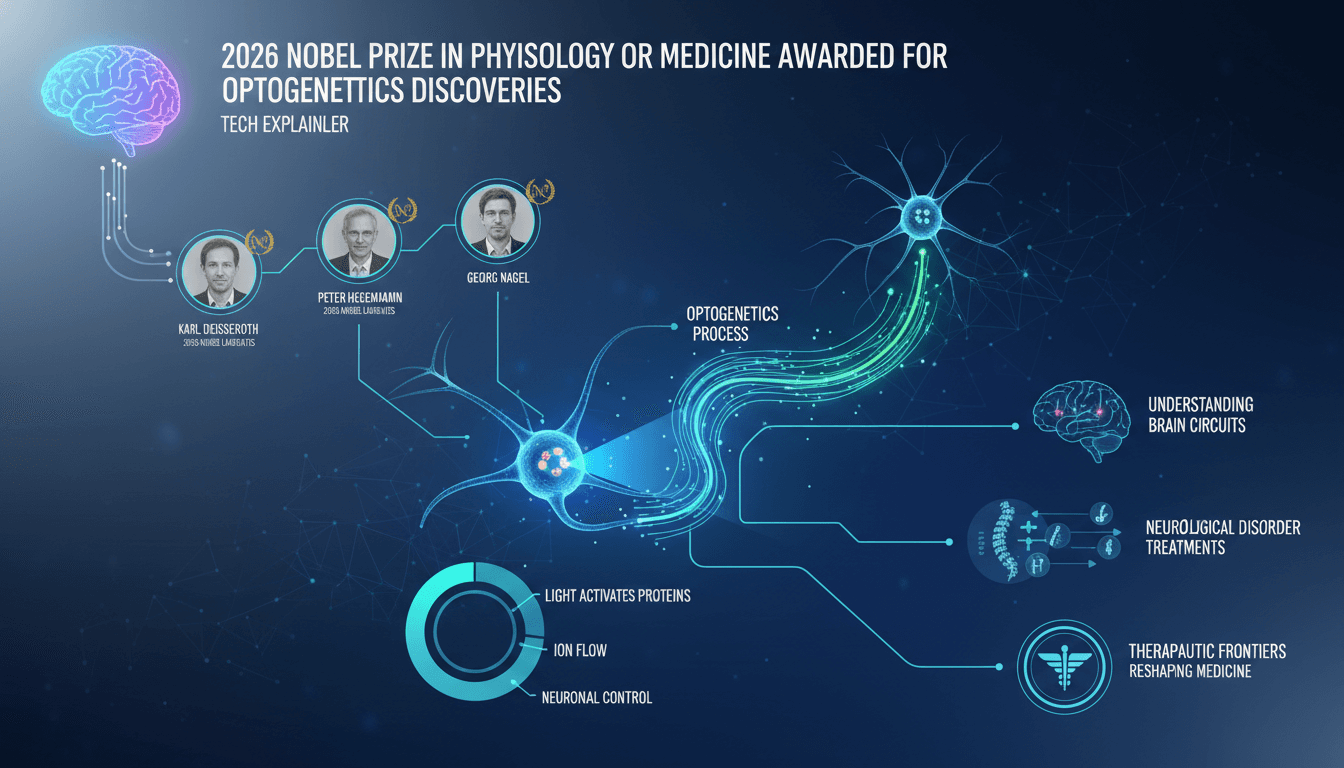
Why it matters
This Nobel Prize highlights a pivotal moment in neuroscience, potentially transforming how we understand and treat brain-related conditions.
What happened (in 30 seconds)
- The Nobel Prize in Physiology or Medicine was awarded on October 5, 2026, to Karl Deisseroth, Peter Hegemann, and Georg Nagel for their groundbreaking work in optogenetics.
- Optogenetics allows scientists to control individual nerve cells in living brains using light, revolutionizing neuroscience research and applications.
- The prize recognizes foundational discoveries that could lead to new therapies for neurological conditions, emphasizing the importance of interdisciplinary research.
The context you actually need
- Prior research focused on algae: Hegemann and Nagel's work on light-sensitive proteins in algae laid the groundwork for optogenetics.
- Deisseroth's engineering: He transformed these proteins into a controllable switch for mammalian neurons, enabling precise brain cell manipulation.
- Widespread adoption: Optogenetics is now a standard method in laboratories for mapping brain circuits related to memory, behavior, and disease.
What's really happening
The 2026 Nobel Prize in Physiology or Medicine awarded to Karl Deisseroth, Peter Hegemann, and Georg Nagel marks a significant milestone in neuroscience, particularly through the development of optogenetics. This technique, which utilizes light to control specific neurons, has emerged from a series of foundational discoveries that began with the isolation of channelrhodopsin from algae in the early 2000s. Hegemann and Nagel's initial research focused on understanding how these light-sensitive proteins functioned in algae, which ultimately led to the identification of channelrhodopsin as a key player in this field.
Deisseroth's contribution was pivotal; he engineered these proteins into a tool that could activate mammalian neurons with precision. This advancement was not merely an academic exercise; it opened the door to practical applications in neuroscience, allowing researchers to manipulate brain activity in real-time. The implications of this technology are vast, as it enables scientists to explore the intricate workings of the brain, mapping circuits involved in various cognitive functions and behaviors.
The award highlights the importance of interdisciplinary collaboration in scientific research. The integration of molecular biology, neuroscience, and engineering has led to breakthroughs that were previously unimaginable. As optogenetics becomes more widely adopted in laboratories around the world, its applications are expanding beyond basic research. Potential therapeutic uses for neurological disorders such as Parkinson's disease, epilepsy, and depression are being explored, which could lead to more effective treatments and improved patient outcomes.
The recognition of these scientists by the Nobel Assembly not only celebrates their individual contributions but also underscores the collective effort required to advance our understanding of the brain. As the scientific community embraces these innovations, the potential for new discoveries and applications continues to grow, promising a future where brain-related conditions can be treated more effectively.
Who feels it first (and how)
- Neuroscientists: Researchers will adopt optogenetics to enhance their studies on brain functions and disorders.
- Medical professionals: Neurologists may integrate optogenetic techniques into clinical practices for treating patients with neurological conditions.
- Patients with neurological disorders: Individuals suffering from conditions like epilepsy or depression could benefit from new therapies developed through this research.
- Pharmaceutical companies: Firms may invest in developing drugs or therapies that leverage optogenetic techniques for better treatment outcomes.
What to watch next
- Research funding trends: Increased investment in neuroscience research could lead to more breakthroughs in brain-related therapies.
- Clinical trials: Watch for new clinical trials utilizing optogenetics to treat neurological disorders, which could validate its therapeutic potential.
- Interdisciplinary collaborations: The emergence of partnerships between neuroscience, engineering, and biotechnology sectors may accelerate innovation in brain research.
The Nobel Prize was awarded for optogenetics discoveries that enable precise brain cell control.
New therapies for neurological disorders will emerge from ongoing research in optogenetics.
The long-term impact of these discoveries on patient outcomes and healthcare costs remains to be seen.
Frequently Asked Questions
- Why it matters?
- This Nobel Prize highlights a pivotal moment in neuroscience, potentially transforming how we understand and treat brain-related conditions.
- What happened (in 30 seconds)?
- The Nobel Prize in Physiology or Medicine was awarded on October 5, 2026, to Karl Deisseroth, Peter Hegemann, and Georg Nagel for their groundbreaking work in optogenetics. Optogenetics allows scientists to control individual nerve cells in living brains using light, revolutionizing neuroscience research and applications. The prize recognizes foundational discoveries that could lead to new therapies for neurological conditions, emphasizing the importance of interdisciplinary research.
- What's really happening?
- The 2026 Nobel Prize in Physiology or Medicine awarded to Karl Deisseroth, Peter Hegemann, and Georg Nagel marks a significant milestone in neuroscience, particularly through the development of optogenetics. This technique, which utilizes light to control specific neurons, has emerged from a series of foundational discoveries that began with the isolation of channelrhodopsin from algae in the early 2000s. Hegemann and Nagel's initial research focused on understanding how these light-sensitive pr
- Who feels it first (and how)?
- Neuroscientists: Researchers will adopt optogenetics to enhance their studies on brain functions and disorders. Medical professionals: Neurologists may integrate optogenetic techniques into clinical practices for treating patients with neurological conditions. Patients with neurological disorders: Individuals suffering from conditions like epilepsy or depression could benefit from new therapies developed through this research. Pharmaceutical companies: Firms may invest in developing drugs
- What to watch next?
- Research funding trends: Increased investment in neuroscience research could lead to more breakthroughs in brain-related therapies. Clinical trials: Watch for new clinical trials utilizing optogenetics to treat neurological disorders, which could validate its therapeutic potential. Interdisciplinary collaborations: The emergence of partnerships between neuroscience, engineering, and biotechnology sectors may accelerate innovation in brain research.
Top international stories selected by The Guardian editors.
"The Guardian is known for its progressive editorial stance and in-depth analysis."
— A47 Editor
Nobel prize in medicine 2026: unlocking the mysteries of the brain
The 2026 Nobel Prize in Medicine has been awarded to Karl Deisseroth, Peter Hegemann, and Georg Nagel for their pioneering research in optogenetics, a technique that enables the control of neurons using light. This groundbreaking work is pivotal in a...
Reports on science policy, discoveries, and public debate in the scientific realm.
"The Guardian’s science section is known for thoughtful and critical reporting on global research, ethics, and public understanding of science."
— A47 Editor
Nobel prize in medicine 2026: unlocking the mysteries of the brain
The 2026 Nobel Prize in Physiology or Medicine has been awarded to Karl Deisseroth, Peter Hegemann, and Georg Nagel for their groundbreaking research on light-gated ion channels and the development of optogenetics, a technique that allows scientists ...
Public health, medical research, healthcare policy, and pharmaceutical developments.
"Dow Jones is a major financial news provider with a professional tone and broad coverage, including specialized health-sector reporting."
— A47 Editor
Karl Deisseroth, Peter Hegemann and Georg Nagel share the Nobel Prize in physiology or medicine for their work in optogenetics
Karl Deisseroth, Peter Hegemann, and Georg Nagel have been awarded the Nobel Prize in Physiology or Medicine for their pioneering research in optogenetics, a technique that enables the manipulation of neurons using light. This groundbreaking work has...
Canadian and international health news, medicine, public policy, and research.
"Global News is a mainstream Canadian outlet generally considered to have a centrist editorial stance, covering news with a focus on factual reporting and national interest."
— A47 Editor
Nobel prize in medicine goes to U.S., German scientists for brain research
The Nobel Assembly of Sweden's Karolinska Institute has awarded the Nobel Prize in Medicine to a trio of scientists from the U.S. and Germany for their groundbreaking discoveries related to light-gated ion channels and the field of optogenetics. This...
International coverage of politics, security, and social issues.
"Global News is a mainstream Canadian outlet with a centrist editorial stance, focusing on factual reporting."
— A47 Editor
Nobel prize in medicine goes to U.S., German scientists for brain research
The Nobel Assembly of Sweden's Karolinska Institute has awarded the Nobel Prize in Medicine to a trio of scientists from the U.S. and Germany for their groundbreaking discoveries related to light-gated ion channels and the field of optogenetics. This...
English-language reporting on Saudi politics, policy, and society.
"Saudi Gazette reflects mainstream Saudi institutional perspectives."
— A47 Editor
Nobel Prize in medicine awarded to trio for research into mysteries of brain
The 2026 Nobel Prize in Physiology or Medicine has been awarded to American Karl Deisseroth and Germans Peter Hegemann and Georg Nagel for their groundbreaking research in decoding brain functions through optogenetics. The announcement was made by th...
International coverage of politics, culture, and current affairs.
"BBC News is widely regarded as a reputable international news organization, known for its impartial tone and public service mandate."
— A47 Editor
Nobel Prize awarded for revealing inner workings of the brain
The Nobel Prize has been awarded to US psychiatrist and neurologist Karl Deisseroth, along with German colleagues Peter Hegemann and Georg Nagel, for their significant contributions to understanding the inner workings of the brain. Their research has...
UK and global health news, medicine, and public health research.
"BBC News is widely regarded as a reputable international news organization, known for its impartial tone and public service mandate."
— A47 Editor
Nobel Prize awarded for revealing inner workings of the brain
The Nobel Prize has been awarded to US psychiatrist and neurologist Karl Deisseroth, along with German colleagues Peter Hegemann and Georg Nagel, for their significant contributions to understanding the inner workings of the brain. Their research has...
International stories from NPR’s global desk.
"NPR is an American public media organization known for thoughtful reporting and a slightly left-leaning editorial tone."
— A47 Editor
Nobel medicine prize goes to 3 scientists for research into brain activity
The Nobel Prize in medicine was awarded to three scientists for their groundbreaking research on how the brain regulates the activity of individual nerve cells. This recognition highlights the significance of understanding the mechanisms that control...
Global coverage of politics, crises, and international affairs.
"HuffPost provides progressive-oriented reporting on international developments, often focusing on humanitarian and social justice issues."
— A47 Editor
Nobel Medicine Prize Goes To 3 Scientists For Research Into Brain Activity
The Nobel Prize in Medicine has been awarded to Karl Deisseroth, Peter Hegemann, and Georg Nagel for their pioneering research in optogenetics, a technique that allows for the control of neurons using light. This groundbreaking work has significantly...