
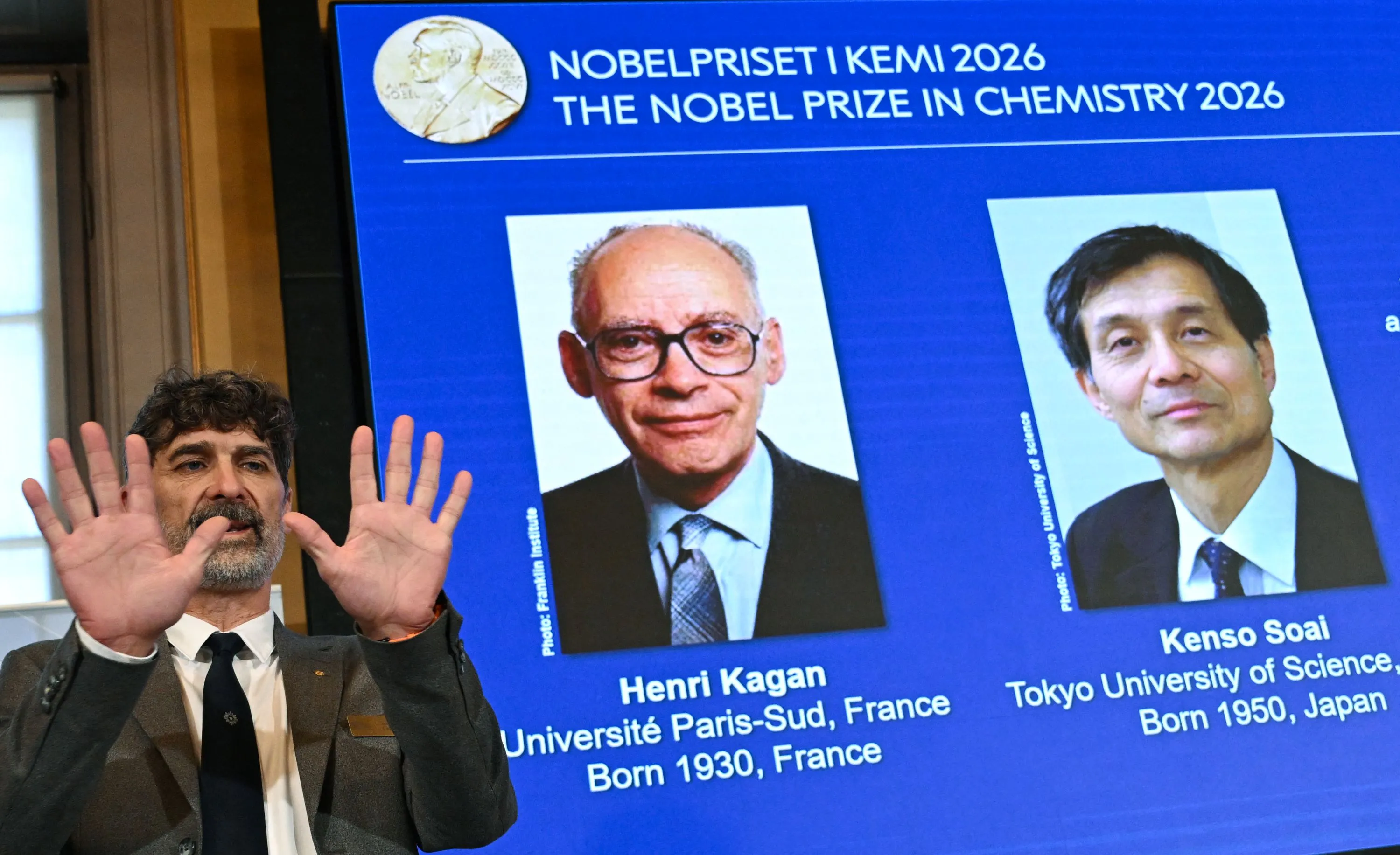
2026 Nobel Prize in Chemistry Awarded to Kagan and Soai for Breakthrough in Molecular Homochirality
Why it matters
This breakthrough in asymmetric synthesis could revolutionize drug manufacturing, enhancing the precision of single-enantiomer drugs.
What happened (in 30 seconds)
- The 2026 Nobel Prize in Chemistry was awarded to Henri Kagan and Kenso Soai for their work on spontaneous molecular homochirality.
- Their discoveries enable precise control in pharmaceutical synthesis, addressing a century-old mystery in chemistry.
- The implications include potential market shifts toward advanced asymmetric synthesis technologies, impacting drug safety and efficacy.
The context you actually need
- Chirality is the property of molecules that exist as non-superimposable mirror images, crucial for biological functions.
- Historically, asymmetric synthesis produced racemic mixtures, limiting the effectiveness of drugs that rely on specific molecular forms.
- Kagan and Soai's work allows for the production of drugs with high enantiomeric excess, significantly improving therapeutic outcomes.
What's really happening
The 2026 Nobel Prize in Chemistry awarded to Henri Kagan and Kenso Soai marks a pivotal moment in the field of asymmetric synthesis, a process that has long been a cornerstone of organic chemistry. Chirality, the property of molecules that exist as non-superimposable mirror images, is fundamental to the functioning of biological systems. Living organisms predominantly utilize one enantiomer of amino acids and sugars, a phenomenon known as homochirality.
Historically, the challenge has been to replicate this natural selectivity in laboratory settings. Early attempts at asymmetric catalysis yielded only slight excesses of one enantiomer over another, resulting in racemic mixtures that often lacked the desired biological activity. Kagan's identification of nonlinear effects in chiral catalysis in the early 1980s was a breakthrough, revealing that mixing enantiomers could lead to unexpected selectivity due to the formation of hetero-dimeric species that inhibit certain pathways.
Building on this foundation, Kenso Soai's development of autocatalytic reactions with 5-pyrimidylalkanol in the early 2000s demonstrated the potential for significant amplification of enantiomeric excess. Soai achieved an astonishing 99.99% enantiomeric excess from achiral starting materials, marking the first successful laboratory replication of spontaneous homochirality. This achievement not only solved a century-old mystery but also opened new avenues for pharmaceutical synthesis.
The implications of Kagan and Soai's discoveries are profound. By enabling the production of single-enantiomer drugs, pharmaceutical manufacturers can reduce side effects and enhance the efficacy of treatments. This shift towards advanced asymmetric synthesis technologies is likely to reshape the pharmaceutical landscape, driving innovation and potentially leading to the development of new therapies that were previously unattainable.
As the industry adapts to these advancements, the focus will shift towards integrating these techniques into existing manufacturing processes. This transition will require investment in new technologies and training for chemists, but the long-term benefits could be substantial, including improved patient outcomes and reduced healthcare costs.
Who feels it first (and how)
- Pharmaceutical companies: They will need to adapt their manufacturing processes to incorporate these new techniques.
- Healthcare providers: Improved drug efficacy and reduced side effects will enhance treatment options for patients.
- Patients: Those requiring specific medications will benefit from safer, more effective single-enantiomer drugs.
- Research institutions: Increased funding and interest in asymmetric synthesis research could lead to further innovations.
What to watch next
- Market shifts: Monitor how pharmaceutical companies adapt their manufacturing processes to incorporate asymmetric synthesis technologies.
- Regulatory changes: Watch for updates in drug approval processes that may favor single-enantiomer drugs due to their enhanced safety profiles.
- Research funding: Keep an eye on increased investment in chirality research, which could lead to new therapeutic discoveries.
Kagan and Soai's discoveries will enhance pharmaceutical synthesis.
The pharmaceutical industry will shift towards advanced asymmetric synthesis technologies.
The full extent of market changes and regulatory adaptations in response to these discoveries.
Frequently Asked Questions
- Why it matters?
- This breakthrough in asymmetric synthesis could revolutionize drug manufacturing, enhancing the precision of single-enantiomer drugs.
- What happened (in 30 seconds)?
- The 2026 Nobel Prize in Chemistry was awarded to Henri Kagan and Kenso Soai for their work on spontaneous molecular homochirality. Their discoveries enable precise control in pharmaceutical synthesis, addressing a century-old mystery in chemistry. The implications include potential market shifts toward advanced asymmetric synthesis technologies, impacting drug safety and efficacy.
- What's really happening?
- The 2026 Nobel Prize in Chemistry awarded to Henri Kagan and Kenso Soai marks a pivotal moment in the field of asymmetric synthesis, a process that has long been a cornerstone of organic chemistry. Chirality, the property of molecules that exist as non-superimposable mirror images, is fundamental to the functioning of biological systems. Living organisms predominantly utilize one enantiomer of amino acids and sugars, a phenomenon known as homochirality. Historically, the challenge has been to
- Who feels it first (and how)?
- Pharmaceutical companies: They will need to adapt their manufacturing processes to incorporate these new techniques. Healthcare providers: Improved drug efficacy and reduced side effects will enhance treatment options for patients. Patients: Those requiring specific medications will benefit from safer, more effective single-enantiomer drugs. Research institutions: Increased funding and interest in asymmetric synthesis research could lead to further innovations.
- What to watch next?
- Market shifts: Monitor how pharmaceutical companies adapt their manufacturing processes to incorporate asymmetric synthesis technologies. Regulatory changes: Watch for updates in drug approval processes that may favor single-enantiomer drugs due to their enhanced safety profiles. Research funding: Keep an eye on increased investment in chirality research, which could lead to new therapeutic discoveries.
Emerging technologies, digital transformation, IT, and cultural impact of tech.
"WIRED covers the intersection of technology, culture, and politics with a progressive, forward-looking editorial stance."
— A47 Editor
Life Is Asymmetric. The Scientists Who Figured Out Why Won the 2026 Nobel Prize in Chemistry
Henri Kagan and Kensō Soai have been awarded the 2026 Nobel Prize in Chemistry for their groundbreaking work in designing chemical reactions that yield only one of the two mirror-image forms of a molecule. This significant discovery is crucial for th...
Tech, science, and startup news including AI.
"Irish tech outlet covering innovation and AI."
— A47 Editor
Pioneering molecular reaction duo win Nobel Prize in Chemistry
Henri Kagan and Kenso Soai have been awarded the 2026 Nobel Prize in Chemistry for their pioneering discoveries in asymmetric organic synthesis, specifically focusing on non-linear effects and autocatalysis. This recognition highlights their signific...
Reports on science policy, discoveries, and public debate in the scientific realm.
"The Guardian’s science section is known for thoughtful and critical reporting on global research, ethics, and public understanding of science."
— A47 Editor
This is what the 2026 Nobel prize for chemistry is all about
The 2026 Nobel Prize in Chemistry has been awarded to Henri B Kagan from Paris-Sud University and Kensō Soai from Tokyo University of Science for their significant discoveries regarding mirror-image molecules. Their research demonstrates how chemical...
Global political, business, and cultural coverage from WSJ international desks.
"The Wall Street Journal offers extensive international reporting with a reputation for financial insight and a center-right editorial stance."
— A47 Editor
Nobel Prize for Chemistry Awarded for Breakthroughs That Advanced Modern Pharmaceuticals
Henri Kagan from France and Kenso Soai from Japan have been jointly awarded the Nobel Prize in Chemistry for their groundbreaking contributions to asymmetric organic synthesis, specifically their work on non-linear effects and autocatalysis. This pre...
Scientific research, space, environment, and health coverage.
"The New York Times is a globally recognized newspaper offering authoritative reporting with a center-left editorial stance."
— A47 Editor
Nobel Prize in Chemistry Is Awarded to Henri Kagan and Kenso Soai
The Nobel Committee awarded the 2026 Nobel Prize in Chemistry to Henri Kagan and Kenso Soai for their significant contributions in resolving a long-standing mystery regarding chiral molecules, which have mirror-image forms. This recognition took plac...
Reports on science policy, discoveries, and public debate in the scientific realm.
"The Guardian’s science section is known for thoughtful and critical reporting on global research, ethics, and public understanding of science."
— A47 Editor
Nobel prize in chemistry awarded for work on mirror-image molecules
The Nobel Prize in Chemistry 2026 has been awarded to Henri B Kagan from Paris-Sud University and Kensō Soai from Tokyo University of Science for their groundbreaking discoveries related to mirror-image molecules. Their work has significantly enhance...
International coverage of politics, security, and social issues.
"Global News is a mainstream Canadian outlet with a centrist editorial stance, focusing on factual reporting."
— A47 Editor
Nobel Prize in chemistry goes to Kagan and Saoi for solving molecular mystery
The Nobel Prize in Chemistry has been awarded to Henri B. Kagan and Kenso Soai for their innovative research in asymmetric organic synthesis, specifically their work on non-linear effects and autocatalysis. This achievement has been recognized by the...
Reports on climate change, environmental science, sustainability, and nature.
"BBC News is widely regarded as a reputable international news organization, known for its impartial tone and public service mandate."
— A47 Editor
Chemistry Nobel awarded for solving mystery of life's asymmetry
The Nobel Prize in Chemistry has been awarded to a group of French and Japanese scientists for their groundbreaking work in solving the mystery of life's asymmetry. This recognition highlights the significance of their research in understanding funda...
International coverage of politics, culture, and current affairs.
"BBC News is widely regarded as a reputable international news organization, known for its impartial tone and public service mandate."
— A47 Editor
Chemistry Nobel awarded for solving mystery of life's asymmetry
The Nobel Prize in Chemistry has been awarded to a group of French and Japanese scientists for their groundbreaking work in solving the mystery of life's asymmetry. This recognition highlights the significance of their research in understanding funda...
Global coverage of politics, crises, and international affairs.
"HuffPost provides progressive-oriented reporting on international developments, often focusing on humanitarian and social justice issues."
— A47 Editor
Henri B. Kagan And Kenso Soai Win Nobel Prize In Chemistry
Henri B. Kagan from France and Kenso Soai from Japan have been awarded the Nobel Prize in Chemistry for their groundbreaking work on asymmetric organic synthesis, particularly their contributions to non-linear effects and autocatalysis. This recognit...
International stories from NPR’s global desk.
"NPR is an American public media organization known for thoughtful reporting and a slightly left-leaning editorial tone."
— A47 Editor
Henri B. Kagan and Kenso Soai win Nobel Prize in chemistry
Henri B. Kagan and Kenso Soai have been awarded the Nobel Prize in chemistry for their groundbreaking work on non-linear effects and autocatalysis in asymmetric organic synthesis, a significant advancement in the field. This recognition highlights th...
International news coverage curated for readers in the UAE and Gulf region.
"Emirates 24|7 world coverage presents global developments through a UAE-facing and Gulf-relevant editorial lens."
— A47 Editor
Henri Kagan and Kenso Soai win 2026 Nobel chemistry prize
Henri Kagan and Kenso Soai have been awarded the 2026 Nobel Prize in Chemistry for their groundbreaking work in creating a method to form a single molecular mirror image, a significant advancement for pharmaceutical manufacturing. This announcement w...
European current affairs, EU politics, and regional developments.
"France 24 is viewed as a globally focused outlet with balanced coverage and a European perspective."
— A47 Editor
Nobel Prize in Chemistry awarded to France's Henri Kagan, Japan's Kenso Soai
Henri Kagan from France and Kenso Soai from Japan have been jointly awarded the Nobel Prize in Chemistry for their significant contributions in solving a century-old chemical mystery, as announced by the Royal Swedish Academy of Sciences. This presti...
Science and technology stories including AI.
"Longstanding science magazine with thoughtful AI coverage."
— A47 Editor
2026 Nobel Prize in Chemistry is awarded to Henri Kagan and Kenso Soai for their work in ‘mirror’ chemistry
The 2026 Nobel Prize in Chemistry has been awarded to Henri Kagan and Kenso Soai for their groundbreaking work in ‘mirror’ chemistry, specifically their discoveries related to nonlinear effects and autocatalysis in asymmetric organic synthesis. This ...
Scientific research, technology, environment, and society.
"Scientific American is one of the oldest and most authoritative science magazines, known for deep dives into science, technology, and society."
— A47 Editor
2026 Nobel Prize in Chemistry is awarded to Henri Kagan and Kenso Soai for their work in ‘mirror’ chemistry
The 2026 Nobel Prize in Chemistry has been awarded to Henri Kagan and Kenso Soai for their groundbreaking work in ‘mirror’ chemistry, specifically their discoveries related to nonlinear effects and autocatalysis in asymmetric organic synthesis. This ...