
James Webb Space Telescope Identifies Host Galaxy of Most Distant Fast Radio Burst
Why it matters
This finding enhances our grasp of cosmic phenomena and may influence future astronomical research and funding.
What happened (in 30 seconds)
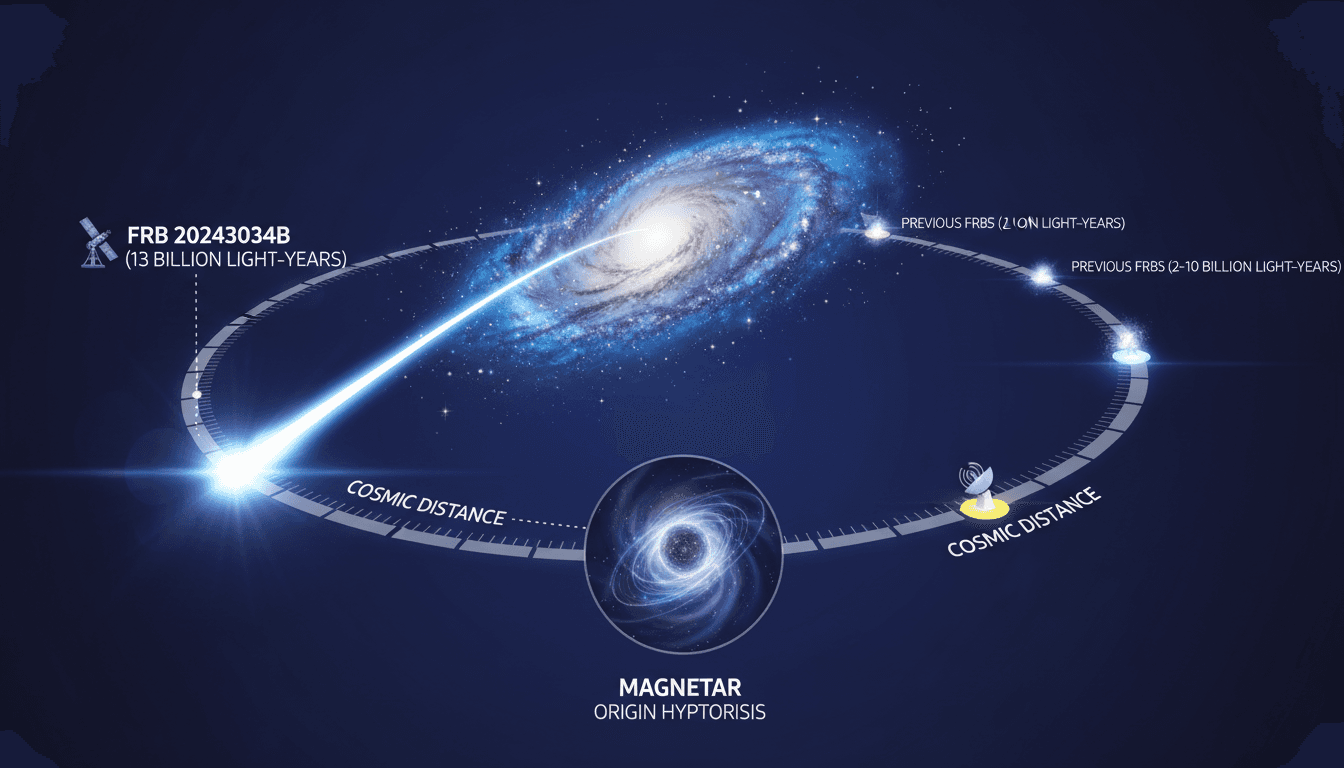
- On October 8, 2026, astronomers using the James Webb Space Telescope pinpointed the host galaxy of FRB 20240304B, the most distant fast radio burst detected.
- The event originated from a small, metal-poor dwarf galaxy, actively forming stars when the universe was about 3 billion years old.
- The findings support a magnetar origin for FRBs, favoring energetic events from young stellar populations over neutron star mergers.
The context you actually need
- Fast radio bursts (FRBs) are brief, intense radio emissions first discovered in 2007, with origins still largely unknown.
- Prior to this discovery, detected FRBs were mostly from more recent cosmic epochs within massive star-forming galaxies.
- The detection of FRB 20240304B by the MeerKAT telescope in March 2024 allowed for targeted follow-up observations with Webb, leading to this significant finding.
What's really happening
The identification of FRB 20240304B marks a pivotal moment in astrophysics, as it provides a clearer picture of the universe's early stages. The event was first detected by the MeerTRAP project on the MeerKAT radio telescope in March 2024, which localized the burst with precision. This localization enabled astronomers to conduct follow-up observations using the James Webb Space Telescope (JWST) in 2026.
The JWST's Near Infrared Camera (NIRCam) imaging revealed a faint galaxy at the precise location of the burst, confirmed by spectroscopy from the Near Infrared Spectrograph (NIRSpec), yielding a redshift of 2.148. This measurement indicates that the host galaxy is approximately 10.7 billion light-years away, meaning it existed when the universe was only about 3 billion years old, or roughly 20% of its current age.
The host galaxy is characterized as a low-mass dwarf galaxy, significantly less massive than typical FRB hosts—about 1,000 times less. It is actively forming stars, with most of its stellar population having formed within the last 30 million years. These characteristics challenge the prevailing theories that FRBs originate from older galaxies through neutron star mergers, which require billions of years to occur. Instead, the findings support the hypothesis that at least some FRBs are produced by young magnetars, which are highly magnetized neutron stars formed in supernova explosions.
This discovery not only enhances our understanding of FRBs but also opens new avenues for research into the conditions of the early universe. The implications for stellar evolution models are significant, as they suggest that the environments in which these bursts occur are more dynamic and varied than previously thought. The international astronomical community has recognized Webb's expanded observational capabilities, which allow for the exploration of early-universe phenomena that were previously beyond reach.
Who feels it first (and how)
- Astronomers and astrophysicists: They will leverage this data to refine models of stellar evolution and cosmic phenomena.
- Research institutions: Increased funding and interest in high-redshift studies may arise as a result of these findings.
- Space agencies: Organizations like NASA and ESA may prioritize missions that further explore early cosmic environments.
What to watch next
- Future FRB discoveries: Keep an eye on new FRB detections and their host galaxies, which could provide additional insights into cosmic evolution.
- Advancements in telescope technology: Innovations in observational technology may enhance our ability to study distant cosmic events.
- Research publications: Look for upcoming studies that build on these findings, particularly those exploring the implications for stellar formation and evolution.
FRB 20240304B is the most distant fast radio burst identified to date.
Future research will focus on the implications of magnetar origins for FRBs and their role in the early universe.
The full impact of these findings on funding and research priorities in astrophysics remains to be seen.
Frequently Asked Questions
- Why it matters?
- This finding enhances our grasp of cosmic phenomena and may influence future astronomical research and funding.
- What happened (in 30 seconds)?
- On October 8, 2026, astronomers using the James Webb Space Telescope pinpointed the host galaxy of FRB 20240304B, the most distant fast radio burst detected. The event originated from a small, metal-poor dwarf galaxy, actively forming stars when the universe was about 3 billion years old. The findings support a magnetar origin for FRBs, favoring energetic events from young stellar populations over neutron star mergers.
- What's really happening?
- The identification of FRB 20240304B marks a pivotal moment in astrophysics, as it provides a clearer picture of the universe's early stages. The event was first detected by the MeerTRAP project on the MeerKAT radio telescope in March 2024, which localized the burst with precision. This localization enabled astronomers to conduct follow-up observations using the James Webb Space Telescope (JWST) in 2026. The JWST's Near Infrared Camera (NIRCam) imaging revealed a faint galaxy at the precise loc
- Who feels it first (and how)?
- Astronomers and astrophysicists: They will leverage this data to refine models of stellar evolution and cosmic phenomena. Research institutions: Increased funding and interest in high-redshift studies may arise as a result of these findings. Space agencies: Organizations like NASA and ESA may prioritize missions that further explore early cosmic environments.
- What to watch next?
- Future FRB discoveries: Keep an eye on new FRB detections and their host galaxies, which could provide additional insights into cosmic evolution. Advancements in telescope technology: Innovations in observational technology may enhance our ability to study distant cosmic events. Research publications: Look for upcoming studies that build on these findings, particularly those exploring the implications for stellar formation and evolution.
Consumer technology news with AI coverage.
"Gadget and tech site reporting on AI in products."
— A47 Editor
Webb telescope detects galaxy origin of the farthest fast radio burst we've seen to date
Astronomers utilizing the Webb telescope have successfully traced the origin of the farthest fast radio burst detected to date, marking a significant achievement in the field of astrophysics. This discovery enhances understanding of cosmic phenomena ...
Covers consumer technology, electronics, gadgets, and product reviews.
"Engadget is a trusted source for gadget reviews and consumer tech news, known for its hands-on analysis and industry coverage."
— A47 Editor
Webb telescope detects galaxy origin of the farthest fast radio burst we've seen to date
Astronomers utilizing the Webb telescope have successfully traced the origin of the farthest fast radio burst detected to date, marking a significant achievement in the field of astrophysics. This discovery enhances understanding of cosmic phenomena ...
Reports on science policy, discoveries, and public debate in the scientific realm.
"The Guardian’s science section is known for thoughtful and critical reporting on global research, ethics, and public understanding of science."
— A47 Editor
Astronomers detect mysterious burst of energy from a galaxy far, far away
Astronomers have detected a mysterious burst of radio waves, believed to be the most distant fast radio burst (FRB) ever recorded, originating from a galaxy over 10 billion years ago. This intense flash of energy has traveled through approximately 80...
International coverage from The Guardian's global desks.
"The Guardian is known for its progressive editorial stance and in-depth analysis."
— A47 Editor
Astronomers detect mysterious burst of energy from a galaxy far, far away
Astronomers have detected a mysterious burst of radio waves, believed to be the most distant fast radio burst (FRB) ever recorded, originating from a galaxy over 10 billion years ago. This intense flash of energy has traveled through approximately 80...
Scientific discoveries, health, technology, and natural phenomena.
"Live Science reports on scientific discoveries, health, technology, and natural phenomena with a popular science tone."
— A47 Editor
James Webb telescope pinpoints the most distant 'fast radio burst' ever seen
The James Webb Space Telescope has successfully detected the most distant 'fast radio burst' ever observed, marking a significant milestone in the study of these enigmatic cosmic phenomena. This discovery provides new insights into the nature and ori...