
Google's Gemini 4 Carbon Model Matches Anthropic's Opus 5.5 in Coding Performance
Why it matters
The competition between AI models is intensifying, potentially reshaping coding practices and job roles in the tech industry.
What happened (in 30 seconds)
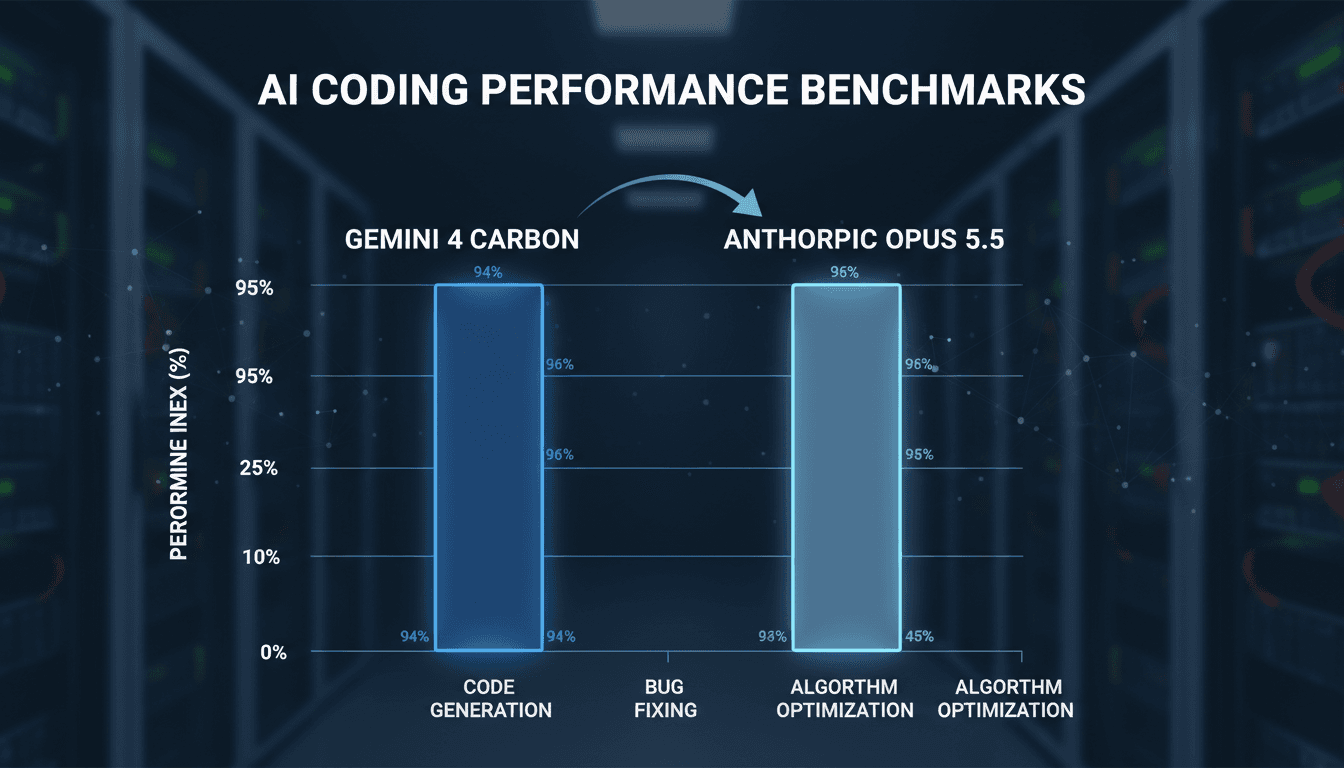
- On October 10, 2026, internal Google documents revealed that the Gemini 4 'Carbon' variant matches Anthropic's Opus 5.5 in coding performance.
- Testing on Google's Jetski platform highlighted Carbon's superior capabilities over earlier Argon versions, indicating rapid model iteration.
- The AI landscape is evolving, with Google and Anthropic pushing boundaries in AI-assisted development, impacting how coding tasks are approached.
The context you actually need
- AI model releases are accelerating: In 2026, companies like Google and Anthropic are rapidly iterating their AI models, enhancing capabilities through advanced techniques.
- Gemini 4's development: Google is preparing for the public launch of Gemini 4, with internal testing revealing significant improvements in coding tasks.
- Competitive benchmarks: The performance of AI models is increasingly measured against agentic coding benchmarks, influencing market dynamics and pricing strategies.
What's really happening
The recent internal evaluation of Google's Gemini 4 'Carbon' variant marks a significant milestone in the AI coding landscape. This model has reportedly achieved coding performance comparable to Anthropic's Opus 5.5, a notable competitor in the AI space. The testing was conducted on Google's Jetski coding platform, where Carbon demonstrated superior capabilities over its predecessor, Argon. This shift is not merely a product of incremental improvements; it reflects a broader trend of recursive self-improvement techniques employed by AI developers.
The rapid iteration of AI models is driven by the need to stay competitive in a market that is evolving at an unprecedented pace. Companies like Google and Anthropic are not just releasing new models; they are continuously refining existing ones to enhance performance metrics. For instance, the Gemini 4 Carbon variant's performance aligns closely with Anthropic's Opus 5.5, which scored 66.4% on the Terminal-Bench 4.0 agentic coding benchmark. This benchmark is crucial as it sets the standard for evaluating AI's coding capabilities, influencing both market positioning and pricing strategies.
The implications of these developments extend beyond mere performance metrics. As AI models become more capable, they are likely to change the nature of coding work itself. Developers may find themselves collaborating more with AI, leveraging these tools to enhance productivity and creativity. However, this also raises questions about job security and the evolving skill sets required in the tech industry. As AI takes on more complex coding tasks, the demand for traditional coding skills may shift, necessitating a reevaluation of educational and training programs.
Moreover, the internal testing phase of Gemini 4 indicates that Google is strategically positioning itself to compete aggressively in the AI market. The emphasis on coding performance suggests that Google is not only focused on consumer applications but also on enterprise solutions where coding efficiency can lead to significant cost savings and productivity gains. This dual focus could reshape how businesses approach software development, potentially leading to a greater reliance on AI-assisted coding solutions.
In summary, the advancements in Google's Gemini 4 Carbon model reflect a broader trend in the AI industry towards rapid iteration and performance enhancement. As these models become more capable, they will likely redefine coding practices, influence job roles, and reshape the competitive landscape of AI development.
Who feels it first (and how)
- Software developers: They will need to adapt to new AI tools that can handle more complex coding tasks.
- Tech companies: Firms will likely reassess their development strategies and workforce requirements in light of AI advancements.
- Educational institutions: They may need to update curricula to prepare students for a future where AI plays a central role in coding.
What to watch next
- Public release of Gemini 4: Monitoring its launch will provide insights into its real-world performance and adoption rates.
- Market reactions to AI model comparisons: Observing how companies position themselves against Gemini 4 and Opus 5.5 will indicate competitive dynamics.
- Shifts in coding job requirements: Tracking changes in job postings and skill demands will reveal how AI is reshaping the workforce.
Gemini 4 Carbon has achieved coding performance comparable to Anthropic's Opus 5.5.
The competitive landscape among AI models will continue to evolve, influencing pricing and development strategies.
The long-term impact on job roles and required skills in the tech industry remains to be fully understood.
Frequently Asked Questions
- Why it matters?
- The competition between AI models is intensifying, potentially reshaping coding practices and job roles in the tech industry.
- What happened (in 30 seconds)?
- On October 10, 2026, internal Google documents revealed that the Gemini 4 'Carbon' variant matches Anthropic's Opus 5.5 in coding performance. Testing on Google's Jetski platform highlighted Carbon's superior capabilities over earlier Argon versions, indicating rapid model iteration. The AI landscape is evolving, with Google and Anthropic pushing boundaries in AI-assisted development, impacting how coding tasks are approached.
- What's really happening?
- The recent internal evaluation of Google's Gemini 4 'Carbon' variant marks a significant milestone in the AI coding landscape. This model has reportedly achieved coding performance comparable to Anthropic's Opus 5.5, a notable competitor in the AI space. The testing was conducted on Google's Jetski coding platform, where Carbon demonstrated superior capabilities over its predecessor, Argon. This shift is not merely a product of incremental improvements; it reflects a broader trend of recursive s
- Who feels it first (and how)?
- Software developers: They will need to adapt to new AI tools that can handle more complex coding tasks. Tech companies: Firms will likely reassess their development strategies and workforce requirements in light of AI advancements. Educational institutions: They may need to update curricula to prepare students for a future where AI plays a central role in coding.
- What to watch next?
- Public release of Gemini 4: Monitoring its launch will provide insights into its real-world performance and adoption rates. Market reactions to AI model comparisons: Observing how companies position themselves against Gemini 4 and Opus 5.5 will indicate competitive dynamics. Shifts in coding job requirements: Tracking changes in job postings and skill demands will reveal how AI is reshaping the workforce.
Daily AI news: models, tools, and policy.
"Independent outlet tracking the fast pace of AI."
— A47 Editor
Google's Gemini 4 "Carbon" model reportedly feels like Anthropic's Opus 5.5 coding performance
Google is reportedly preparing to launch a more advanced version of its AI model, Gemini 4, codenamed Carbon, which has been compared to Anthropic's Opus 5.5 in terms of coding performance. This follows the initial rollout of Gemini 4 Argon, which ha...
Curated tech headlines including AI stories.
"Influential aggregator surfacing the day’s top tech/AI links."
— A47 Editor
Sources: as Google prepares to roll out its Gemini 4 Argon, staff are testing a new version internally named Carbon; one staffer says it "feels like Opus 5.5" (Hugh Langley/Business Insider)
Google is preparing to launch its new AI model, Gemini 4 Argon, while internally testing a variant named Carbon, which has received positive feedback from employees. Staff describe Carbon as feeling similar to a previous model, Opus 5.5.
Business and tech news excluding paywalled content.
"High-volume business/tech outlet with frequent AI coverage."
— A47 Editor
Google is about to roll out a new AI model. Employees say they're testing another that's way better.
Google is set to roll out its new AI model, Gemini 4, to employees, with a particular focus on a variant named Carbon that has garnered positive feedback from staff. This rollout comes amidst the introduction of another model, Gemini 4 Argon, which h...