
Astronomers Detect Most Distant Fast Radio Burst FRB 20240304B
Why it matters
The detection of FRB 20240304B opens new avenues for studying the early universe and the nature of fast radio bursts.
What happened (in 30 seconds)
- On March 4, 2024, astronomers detected FRB 20240304B using South Africa's MeerKAT telescope, marking it as the most distant known fast radio burst.
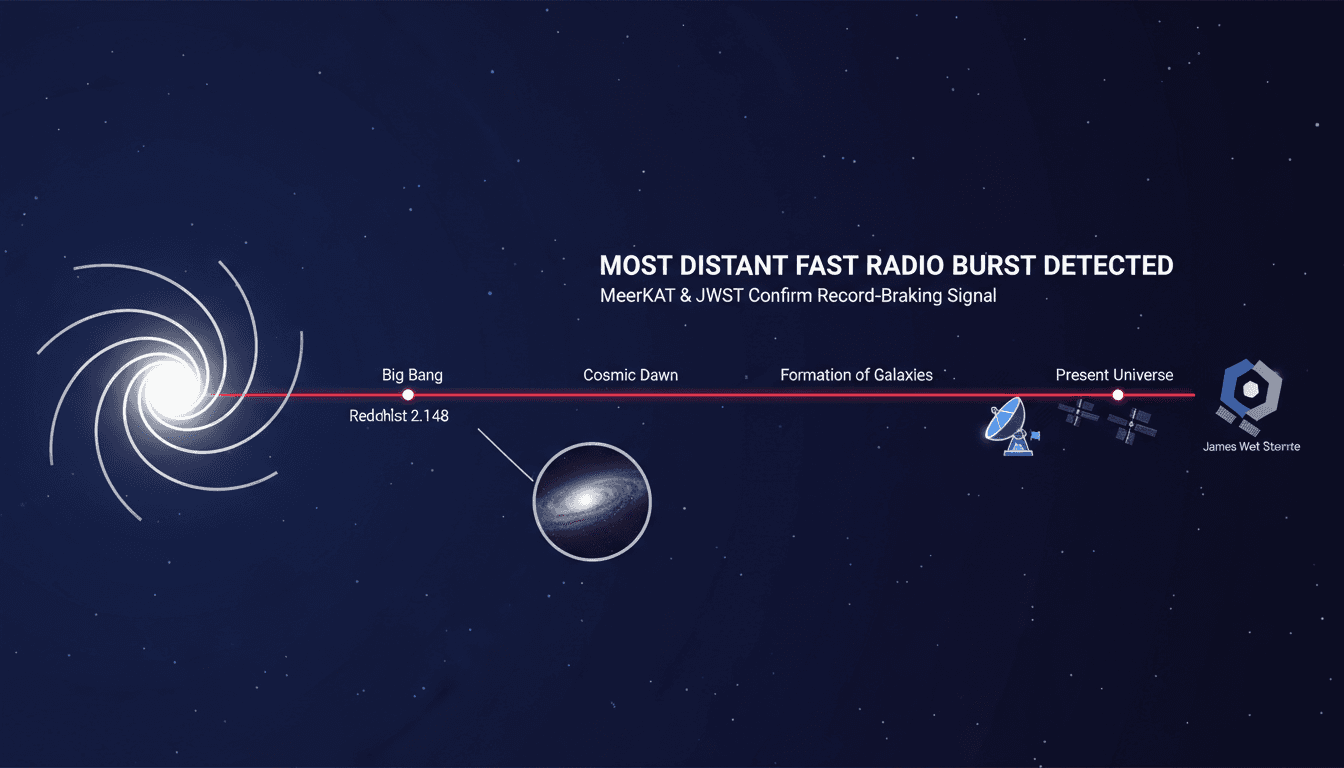
- Follow-up observations with the James Webb Space Telescope confirmed the burst's origin from a low-mass star-forming galaxy at redshift 2.148, approximately 10 billion light years away.
- Published in October 2026, the findings attributed the burst to a likely magnetar origin, enhancing our understanding of intergalactic medium properties.
The context you actually need
- Fast radio bursts (FRBs) were first discovered in 2007 and remain a mystery regarding their origins, with most previous detections occurring at lower redshifts.
- Prior to this detection, FRB host galaxies were predominantly identified at redshifts less than 0.5, limiting insights into cosmic evolution.
- The MeerTRAP team utilized advanced observational techniques to capture this high-redshift FRB, contributing to ongoing research into the intergalactic medium and magnetar progenitors.
What's really happening
The detection of FRB 20240304B represents a significant milestone in the field of astrophysics, particularly in the study of fast radio bursts. These brief, energetic signals have puzzled scientists since their discovery, primarily due to their unknown origins and the challenges associated with observing them at great distances. The MeerKAT telescope's ability to capture this FRB at a redshift of 2.148—equating to about 10 billion light years—marks a leap in observational capabilities, allowing researchers to probe deeper into the universe's history.
The follow-up observations conducted with the James Webb Space Telescope (JWST) were crucial in confirming the burst's distance and characterizing its host galaxy. The identification of the host as a low-mass, clumpy, star-forming galaxy provides insights into the conditions under which FRBs may occur. This finding supports the hypothesis that magnetars—highly magnetized neutron stars—could be responsible for generating these bursts, particularly in environments rich in star formation.
The implications of this discovery extend beyond mere curiosity; they enhance our understanding of cosmic evolution and the intergalactic medium. By extending the observational reach of FRBs to higher redshifts, scientists can gather data that may reveal how galaxies formed and evolved in the early universe. This knowledge is vital for constructing a comprehensive picture of cosmic history and understanding the fundamental processes that govern star formation and galaxy dynamics.
Moreover, the detection of FRB 20240304B is expected to stimulate further research into high-redshift FRBs, potentially leading to new discoveries about the universe's structure and the nature of dark matter and dark energy. As observational technologies improve, the scientific community anticipates a surge in high-redshift FRB studies, which could redefine our understanding of the universe.
Who feels it first (and how)
- Astronomers and astrophysicists: They will leverage this discovery to refine models of cosmic evolution and the behavior of fast radio bursts.
- Research institutions: Enhanced funding and interest in high-redshift studies may lead to new projects and collaborations.
- Technology developers: Innovations in telescope technology and data analysis methods will be driven by the need to observe distant cosmic phenomena.
What to watch next
- Future FRB detections: Monitoring for additional high-redshift FRBs will be crucial in understanding the early universe and the conditions that lead to their formation.
- Advancements in observational technology: Innovations in telescope design and data processing will likely emerge as researchers seek to capture more distant signals.
- Research publications: Keep an eye on upcoming studies that build on the findings of FRB 20240304B, as they may reveal new insights into cosmic evolution.
FRB 20240304B is the most distant fast radio burst detected to date.
Future research will focus on high-redshift FRBs and their implications for cosmic evolution.
The exact mechanisms behind FRB generation and their relationship with host galaxies remain a topic of ongoing investigation.
Frequently Asked Questions
- Why it matters?
- The detection of FRB 20240304B opens new avenues for studying the early universe and the nature of fast radio bursts.
- What happened (in 30 seconds)?
- On March 4, 2024, astronomers detected FRB 20240304B using South Africa's MeerKAT telescope, marking it as the most distant known fast radio burst. Follow-up observations with the James Webb Space Telescope confirmed the burst's origin from a low-mass star-forming galaxy at redshift 2.148, approximately 10 billion light years away. Published in October 2026, the findings attributed the burst to a likely magnetar origin, enhancing our understanding of intergalactic medium properties.
- What's really happening?
- The detection of FRB 20240304B represents a significant milestone in the field of astrophysics, particularly in the study of fast radio bursts. These brief, energetic signals have puzzled scientists since their discovery, primarily due to their unknown origins and the challenges associated with observing them at great distances. The MeerKAT telescope's ability to capture this FRB at a redshift of 2.148—equating to about 10 billion light years—marks a leap in observational capabilities, allowing
- Who feels it first (and how)?
- Astronomers and astrophysicists: They will leverage this discovery to refine models of cosmic evolution and the behavior of fast radio bursts. Research institutions: Enhanced funding and interest in high-redshift studies may lead to new projects and collaborations. Technology developers: Innovations in telescope technology and data analysis methods will be driven by the need to observe distant cosmic phenomena.
- What to watch next?
- Future FRB detections: Monitoring for additional high-redshift FRBs will be crucial in understanding the early universe and the conditions that lead to their formation. Advancements in observational technology: Innovations in telescope design and data processing will likely emerge as researchers seek to capture more distant signals. Research publications: Keep an eye on upcoming studies that build on the findings of FRB 20240304B, as they may reveal new insights into cosmic evolution.
Independent journalism covering technology, AI, and digital culture.
"An independent newsroom by veteran tech reporters known for critical, investigative coverage of AI and tech power."
— A47 Editor
Scientists Detect Record-Breaking Radio Signal from the Ancient Universe
Scientists have detected a record-breaking fast radio burst that traveled across 10 billion light years, reaching Earth in 2024. This discovery doubles the previous distance record for these enigmatic and powerful signals from the universe, highlight...
Science and technology stories including AI.
"Longstanding science magazine with thoughtful AI coverage."
— A47 Editor
Astronomers discover record-breaking ancient cosmic outburst
Astronomers have detected a record-breaking ancient cosmic outburst, identified as a fast radio burst, using the MeerKAT array. This event occurred three billion years after the big bang and offers new insights into the universe's intergalactic matte...
Scientific research, technology, environment, and society.
"Scientific American is one of the oldest and most authoritative science magazines, known for deep dives into science, technology, and society."
— A47 Editor
Astronomers discover record-breaking ancient cosmic outburst
Astronomers have detected a record-breaking ancient cosmic outburst, identified as a fast radio burst, using the MeerKAT array. This event occurred three billion years after the big bang and offers new insights into the universe's intergalactic matte...
Reports on science policy, discoveries, and public debate in the scientific realm.
"The Guardian’s science section is known for thoughtful and critical reporting on global research, ethics, and public understanding of science."
— A47 Editor
Astronomers detect mysterious burst of energy from a galaxy far, far away
Astronomers have detected a mysterious burst of radio waves, believed to be the most distant fast radio burst (FRB) ever recorded, originating from a galaxy over 10 billion years ago. This intense flash of energy has traveled through approximately 80...
International coverage from The Guardian's global desks.
"The Guardian is known for its progressive editorial stance and in-depth analysis."
— A47 Editor
Astronomers detect mysterious burst of energy from a galaxy far, far away
Astronomers have detected a mysterious burst of radio waves, believed to be the most distant fast radio burst (FRB) ever recorded, originating from a galaxy over 10 billion years ago. This intense flash of energy has traveled through approximately 80...