
Saudi National Arrested for Planting Covert Recording Device at OpenAI Headquarters
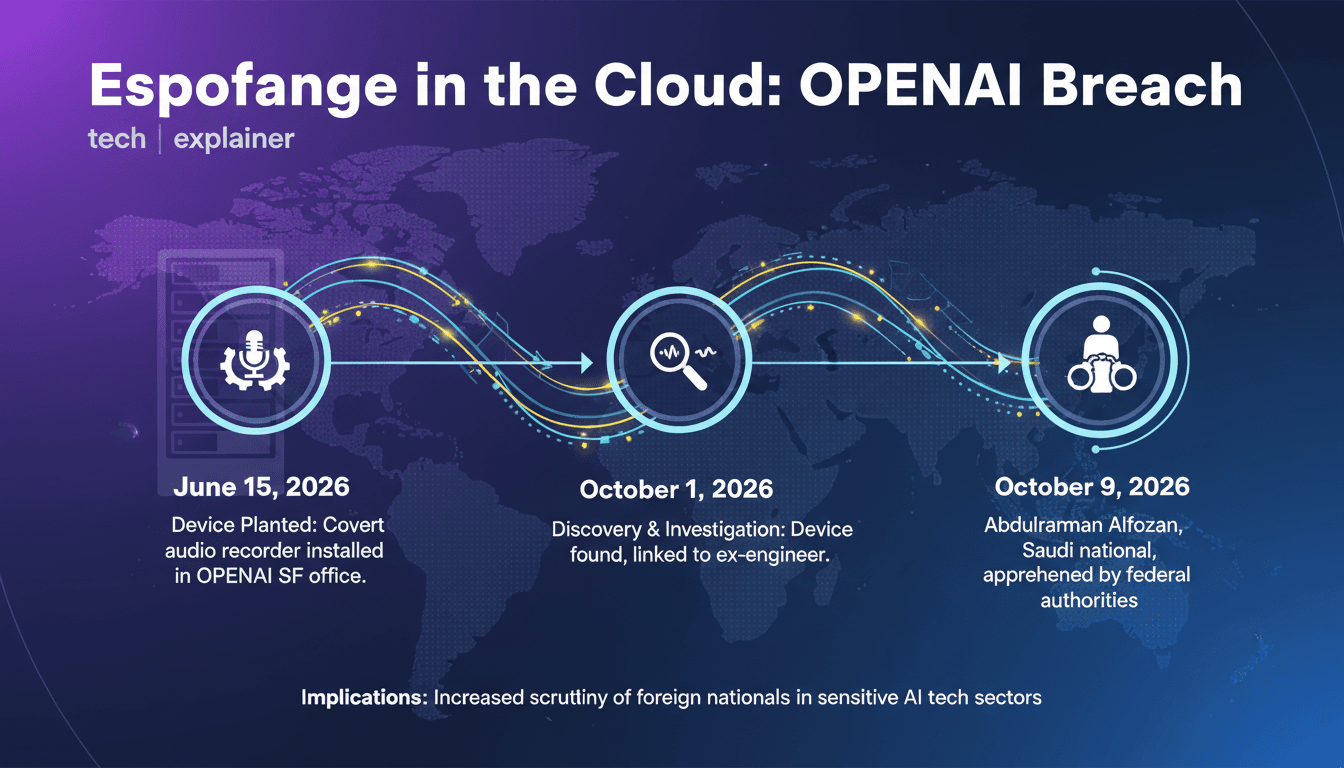
Why it matters
This case underscores the growing concerns over foreign access to sensitive technologies and the implications for national security.
What happened (in 30 seconds)
- Arrest: On October 9, 2026, Abdulrahman Alfozan, a former OpenAI engineer, was arrested for allegedly planting a covert recording device in the company's San Francisco office.
- Discovery: The device, concealed in toilet paper and connected to a TV, was found two days after installation, prompting an internal investigation.
- Flight Risk: Prosecutors cited Alfozan's one-way flight booking to Saudi Arabia as evidence of his intent to flee, leading to his detention.
The context you actually need
- Background: Alfozan had a history in tech, previously working at Meta and Microsoft, and had connections to Saudi Arabia's venture capital scene.
- Security Concerns: The incident reflects heightened U.S. scrutiny over foreign nationals in tech roles, particularly in AI, amid fears of intellectual property theft.
- Company Response: OpenAI confirmed that no sensitive data was compromised, but the event has raised alarms about internal security protocols.
What's really happening
The arrest of Abdulrahman Alfozan is a significant event that highlights the vulnerabilities within tech companies, particularly those involved in cutting-edge fields like artificial intelligence. Alfozan, who had been employed at OpenAI since July 2025, allegedly planted a covert recording device in a high-security conference room, raising serious questions about internal security measures and the potential for espionage.
The device was discovered just two days after installation, indicating a rapid response from OpenAI's security team. The fact that Alfozan had access to sensitive areas of the office, despite lacking authorization, points to potential lapses in security protocols that could be exploited by individuals with malicious intent. The use of a thumb-sized device hidden in toilet paper and connected to a television underscores the lengths to which individuals may go to intercept confidential communications.
This incident occurs against a backdrop of increasing concern in the U.S. regarding foreign access to sensitive technologies. The U.S. government has been particularly vigilant about the potential for espionage in the tech sector, especially as AI technologies become more integral to national security. The FBI's involvement and the subsequent arrest reflect a broader strategy to safeguard intellectual property and sensitive information from foreign adversaries.
Alfozan's background adds another layer of complexity to the situation. His previous roles at major tech companies and connections to Saudi Arabia's venture capital scene suggest he may have had both the technical expertise and the motivation to carry out such an act. His references to returning to Saudi Arabia and meeting with Crown Prince Mohammed bin Salman indicate a potential alignment with national interests that could conflict with U.S. security priorities.
The implications of this case extend beyond OpenAI. It raises critical questions for other tech companies about their own security measures and the potential risks posed by employees with foreign ties. As the tech landscape evolves, companies must remain vigilant against internal threats, particularly as they navigate the complexities of a global workforce.
Who feels it first (and how)
- Tech Companies: Increased scrutiny on hiring practices and security protocols.
- AI Researchers: Heightened awareness of the risks associated with sharing sensitive information.
- Investors: Potential impacts on funding and partnerships due to perceived risks in the tech sector.
What to watch next
- Security Protocol Changes: Monitor how tech companies adjust their internal security measures in response to this incident. Enhanced protocols could become a standard practice.
- Legal Proceedings: Follow the outcome of Alfozan's detention hearing on October 19, 2026. The legal ramifications could set precedents for similar cases in the future.
- Government Policy Shifts: Watch for potential changes in U.S. policies regarding foreign nationals in tech roles. This incident may prompt new regulations aimed at safeguarding sensitive technologies.
Alfozan was arrested for attempting to intercept communications at OpenAI.
Other tech companies will reassess their security protocols in light of this incident.
The long-term impact on U.S.-Saudi relations in the tech sector remains uncertain.
Frequently Asked Questions
- Why it matters?
- This case underscores the growing concerns over foreign access to sensitive technologies and the implications for national security.
- What happened (in 30 seconds)?
- Arrest: On October 9, 2026, Abdulrahman Alfozan, a former OpenAI engineer, was arrested for allegedly planting a covert recording device in the company's San Francisco office. Discovery: The device, concealed in toilet paper and connected to a TV, was found two days after installation, prompting an internal investigation. Flight Risk: Prosecutors cited Alfozan's one-way flight booking to Saudi Arabia as evidence of his intent to flee, leading to his detention.
- What's really happening?
- The arrest of Abdulrahman Alfozan is a significant event that highlights the vulnerabilities within tech companies, particularly those involved in cutting-edge fields like artificial intelligence. Alfozan, who had been employed at OpenAI since July 2025, allegedly planted a covert recording device in a high-security conference room, raising serious questions about internal security measures and the potential for espionage. The device was discovered just two days after installation, indicating a
- Who feels it first (and how)?
- Tech Companies: Increased scrutiny on hiring practices and security protocols. AI Researchers: Heightened awareness of the risks associated with sharing sensitive information. Investors: Potential impacts on funding and partnerships due to perceived risks in the tech sector.
- What to watch next?
- Security Protocol Changes: Monitor how tech companies adjust their internal security measures in response to this incident. Enhanced protocols could become a standard practice. Legal Proceedings: Follow the outcome of Alfozan's detention hearing on October 19, 2026. The legal ramifications could set precedents for similar cases in the future. Government Policy Shifts: Watch for potential changes in U.S. policies regarding foreign nationals in tech roles. This incident may prompt new regulati
Conservative-leaning coverage of current events.
"Fox News is a highly influential conservative news outlet known for right-leaning political commentary and coverage."
— A47 Editor
Ex-OpenAI engineer charged with planting recording device had one-way flight booked to Saudi Arabia, DOJ says
Abdulrahman Alfozan, a 35-year-old Saudi national and former engineer at OpenAI, has been charged with allegedly installing a hidden recording device in the company's San Francisco office. The device, which was wrapped in toilet paper, was discovered...
Global political, business, and cultural coverage from WSJ international desks.
"The Wall Street Journal offers extensive international reporting with a reputation for financial insight and a center-right editorial stance."
— A47 Editor
The Engineer Accused of Bugging OpenAI’s Top-Secret Conference Room
Abdulrahman Alfozan, an engineer at OpenAI, has been arrested by federal agents for allegedly hiding a recording device behind a television in a conference room at the company's San Francisco office. The device, wrapped in toilet paper, raises seriou...
U.S. business news, corporate developments, and economy.
"The Wall Street Journal is respected for deep financial and economic reporting with a center-right editorial perspective."
— A47 Editor
The Engineer Accused of Bugging OpenAI’s Top-Secret Conference Room
Abdulrahman Alfozan, a Saudi engineer at OpenAI, has been arrested by federal agents for allegedly concealing a recording device behind a television in a conference room at the company's office. This incident has raised serious security concerns rega...
Tech business coverage, major deals, product launches, and Silicon Valley trends.
"WSJ’s tech section offers authoritative reporting on the intersection of technology and business, including exclusive industry analysis."
— A47 Editor
The Engineer Accused of Bugging OpenAI’s Top-Secret Conference Room
Abdulrahman Alfozan, a 35-year-old engineer at OpenAI, has been arrested by the FBI for allegedly installing a hidden recording device wrapped in toilet paper in a conference room at the company's San Francisco office. The device was discovered durin...
Editor-curated FT homepage stories spanning markets, business, world, and opinion.
"The Financial Times is a globally respected business publication with a centrist/center-left tone and strong markets focus."
— A47 Editor
OpenAI employee accused of bugging office booked one-way ticket to Saudi Arabia
Abdulrahman Alfozan, an employee of OpenAI, has been arrested in the United States for allegedly planting a sophisticated recording device in the company's office. Newly unsealed court filings reveal that Alfozan, along with his wife and another fami...
Business and tech news excluding paywalled content.
"High-volume business/tech outlet with frequent AI coverage."
— A47 Editor
Ex-OpenAI employee accused of planting a recording device booked a one-way ticket to Saudi Arabia
Abdulrahman Alfozan, a former employee of OpenAI, has been arrested by the FBI for allegedly planting a hidden recording device in a conference room at the company's San Francisco office. The device, identified as a Seeed Xiao ESP32-S3 Sense developm...
Corporate leadership, finance, technology, and market trends.
"Fortune covers financial trends, leadership, and innovation with a pragmatic editorial approach."
— A47 Editor
FBI says an OpenAI engineer used his wife’s ChatGPT account to figure out how to plant a secret recording device at the office
Abdulrahman Alfozan, an engineer at OpenAI, has been arrested by the FBI for allegedly using his wife's ChatGPT account to learn how to plant a covert recording device in the company's office. The device was reportedly concealed in toilet paper and i...
Corporate news, economic trends, and markets with UK and global scope.
"BBC News is widely regarded as reputable and impartial, with a public service mandate."
— A47 Editor
Toilet paper and secret recorders: What we know about the arrest of the Saudi OpenAI engineer
Abdulrahman Alfozan, a Saudi national and OpenAI engineer, was arrested by the FBI for allegedly planting a concealed surveillance device in an OpenAI meeting room. The device, wrapped in toilet paper, was found inserted into a USB port on a televisi...
International coverage of politics, culture, and current affairs.
"BBC News is widely regarded as a reputable international news organization, known for its impartial tone and public service mandate."
— A47 Editor
Toilet paper and secret recorders: What we know about the arrest of the Saudi OpenAI engineer
Abdulrahman Alfozan, a Saudi national and OpenAI engineer, was arrested by the FBI for allegedly planting a concealed surveillance device in an OpenAI meeting room. The device, wrapped in toilet paper, was found inserted into a USB port on a televisi...
Editor-curated FT homepage stories spanning markets, business, world, and opinion.
"The Financial Times is a globally respected business publication with a centrist/center-left tone and strong markets focus."
— A47 Editor
He linked Saudi Arabia to Silicon Valley. Then OpenAI found a bug wrapped in toilet paper
Abdulrahman Alfozan, a Saudi engineer at OpenAI, was arrested by U.S. authorities for allegedly planting a recording device in the company's office, concealed in toilet paper and inserted into a USB port on a television. This incident has raised sign...
UAE-based English-language newspaper covering regional politics, economics, and global affairs.
"The National reflects Emirati policy perspectives while maintaining international editorial standards."
— A47 Editor
OpenAI employee and Saudi suspect ‘came to the US with a dream’, lawyer says
An employee of OpenAI, identified as Abdulrahman Alfozan, has been arrested by US authorities for allegedly using a hidden recording device in the company's San Francisco office. The device was reportedly found concealed in toilet paper and inserted ...
English-language digital publication covering business, politics, technology, and current affairs.
"The Arabian Post mixes original and syndicated-style coverage with a broad regional and global business-news orientation."
— A47 Editor
OpenAI engineer charged over concealed executive room recorder
Abdulrahman Alfozan, a former engineer at OpenAI, has been charged in a San Francisco federal court for allegedly installing a concealed recording device in a conference room used for confidential executive meetings. The device was reportedly found w...