
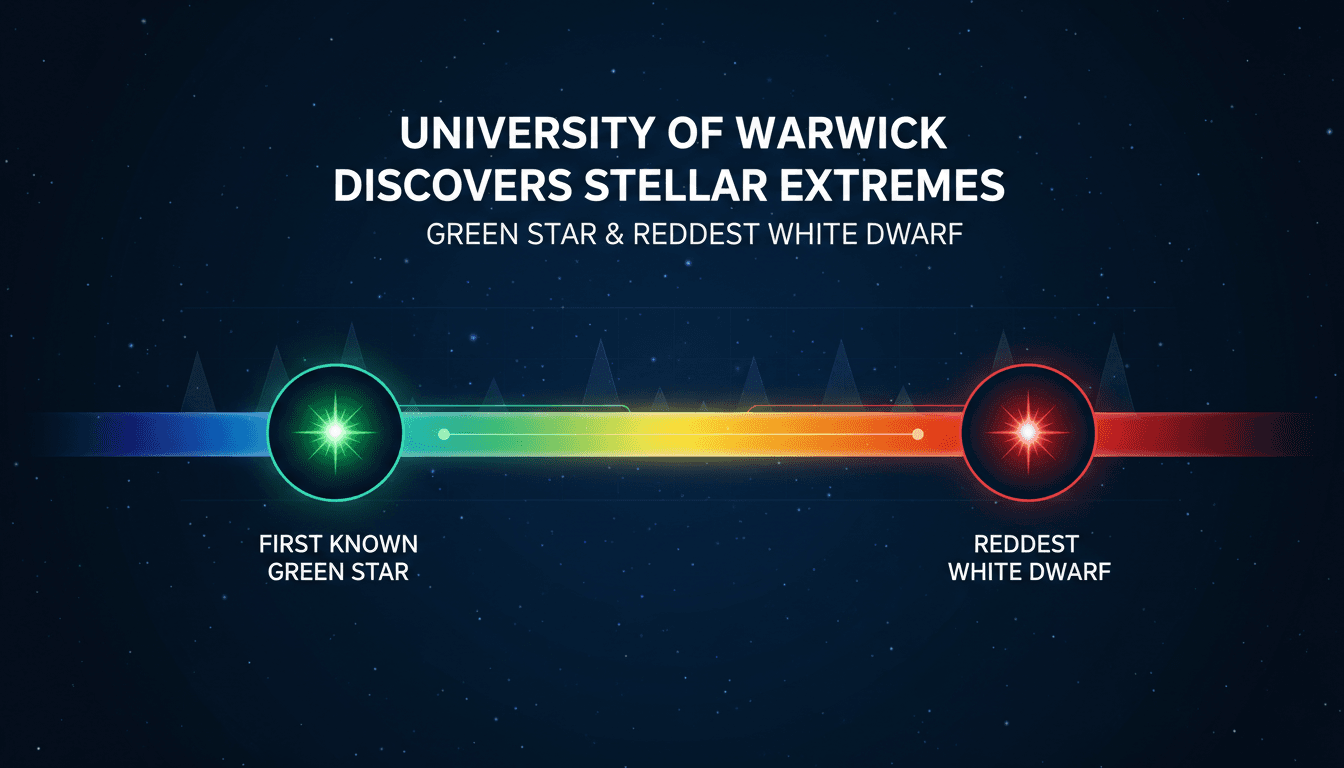
University of Warwick Discovers First Known Green Star and Reddest White Dwarf
Why it matters
The identification of unusual stellar colors challenges existing models of white dwarf characteristics, potentially influencing future astronomical research and technology.
What happened (in 30 seconds)
- On October 16, 2026, astronomers from the University of Warwick announced the discovery of the first credible green star and the reddest white dwarf.
- Spectroscopic surveys of 151 white dwarfs revealed that chemical enrichment and convection can produce non-white colors, including chartreuse green and salmon pink.
- The study concluded that approximately one in 30 white dwarfs exhibit unusual colors due to these effects, challenging prior assumptions about their uniform appearance.
The context you actually need
- White dwarfs are the dense remnants of Sun-like stars after they exhaust their nuclear fuel, typically appearing white due to their temperature.
- Previous observations noted minor color variations, but no systematic study had quantified perceived colors across a large sample of nearby stars.
- The new findings suggest that factors like accreted planetary debris and internal convection can lead to significant color deviations, expanding our understanding of stellar atmospheres.
What's really happening
The recent discoveries by the University of Warwick stem from a comprehensive spectroscopic survey of 151 white dwarfs located within approximately 65 light-years of Earth. Traditionally, white dwarfs have been treated as near-perfect blackbody radiators, with their color primarily determined by surface temperature. This conventional view led to the assumption that they would appear uniformly white to human observers. However, the research team, led by Mark Hollands, employed advanced atmospheric modeling that incorporated temperature, composition, and molecular absorption to predict the apparent colors of these stars.
The results were surprising. While most of the observed white dwarfs conformed to the expected white appearance, outliers emerged that exhibited striking colors. For instance, WD J1330+6435, located about 280 light-years away in the Draco constellation, was identified as a chartreuse green star. This unusual coloration is attributed to the star's accretion of sodium-rich rocky material, which broadened its absorption spectrum across the yellow-orange-red wavelengths. Similarly, WD J1011+2845, situated 48 light-years away in Leo Minor, displayed a deep salmon pink hue. This color was linked to carbon molecules that were lifted by convection processes, suppressing shorter wavelengths.
The implications of these findings are significant. The study suggests that such peculiarities in color occur in roughly one in 30 white dwarfs across the galaxy, indicating that the diversity of stellar remnants is greater than previously understood. This challenges the long-held notion that white dwarfs are homogenous in appearance and opens new avenues for research into stellar evolution and atmospheric processes within the Milky Way. The scientific community is now poised to expand modeling efforts to further explore the atmospheres of white dwarfs, potentially leading to new discoveries about the lifecycle of stars and the chemical processes at play in their remnants.
Who feels it first (and how)
- Astronomers and astrophysicists: They will likely adjust their models of stellar evolution and atmospheric chemistry based on these findings.
- Research institutions: Increased funding and interest in studies related to stellar atmospheres and chemical enrichment may arise.
- Students and educators: The discoveries could influence curriculum changes in astrophysics and astronomy programs, emphasizing the complexity of stellar remnants.
What to watch next
- Further studies on white dwarf atmospheres: Continued research may reveal more about the chemical processes affecting stellar colors, which could lead to new theories in astrophysics.
- Technological advancements in spectroscopy: Innovations in observational technology may enhance our ability to study distant stars, potentially uncovering more unusual stellar phenomena.
- Public interest in astronomy: As media coverage of these discoveries grows, increased public engagement with astronomy could lead to more funding and support for space research initiatives.
The identification of the first credible green star and reddest white dwarf has been peer-reviewed and published.
Future research will expand on these findings, leading to a deeper understanding of stellar evolution.
The long-term implications for technology and funding in astrophysics remain to be seen.
Frequently Asked Questions
- Why it matters?
- The identification of unusual stellar colors challenges existing models of white dwarf characteristics, potentially influencing future astronomical research and technology.
- What happened (in 30 seconds)?
- On October 16, 2026, astronomers from the University of Warwick announced the discovery of the first credible green star and the reddest white dwarf. Spectroscopic surveys of 151 white dwarfs revealed that chemical enrichment and convection can produce non-white colors, including chartreuse green and salmon pink. The study concluded that approximately one in 30 white dwarfs exhibit unusual colors due to these effects, challenging prior assumptions about their uniform appearance.
- What's really happening?
- The recent discoveries by the University of Warwick stem from a comprehensive spectroscopic survey of 151 white dwarfs located within approximately 65 light-years of Earth. Traditionally, white dwarfs have been treated as near-perfect blackbody radiators, with their color primarily determined by surface temperature. This conventional view led to the assumption that they would appear uniformly white to human observers. However, the research team, led by Mark Hollands, employed advanced atmospheri
- Who feels it first (and how)?
- Astronomers and astrophysicists: They will likely adjust their models of stellar evolution and atmospheric chemistry based on these findings. Research institutions: Increased funding and interest in studies related to stellar atmospheres and chemical enrichment may arise. Students and educators: The discoveries could influence curriculum changes in astrophysics and astronomy programs, emphasizing the complexity of stellar remnants.
- What to watch next?
- Further studies on white dwarf atmospheres: Continued research may reveal more about the chemical processes affecting stellar colors, which could lead to new theories in astrophysics. Technological advancements in spectroscopy: Innovations in observational technology may enhance our ability to study distant stars, potentially uncovering more unusual stellar phenomena. Public interest in astronomy: As media coverage of these discoveries grows, increased public engagement with astronomy could
Scientific discoveries, health, technology, and natural phenomena.
"Live Science reports on scientific discoveries, health, technology, and natural phenomena with a popular science tone."
— A47 Editor
Astronomers discover the first-ever green star, plus the reddest 'white dwarf' ever seen
Astronomers have made a groundbreaking discovery by identifying the first-ever green star and the reddest white dwarf ever observed, revealing the diverse color spectrum of stellar remnants. This study highlights the complex processes involved in ste...
International news coverage curated for readers in the UAE and Gulf region.
"Emirates 24|7 world coverage presents global developments through a UAE-facing and Gulf-relevant editorial lens."
— A47 Editor
Astronomers discover first green star: White Dwarf WD J1330+6435 turns green after eating planet debris
Astronomers have identified the first green star, a white dwarf named WD J1330+6435, which turned green after consuming rocky debris from planets that once orbited it. This white dwarf is located approximately 280 light-years from Earth in the conste...
Space science news, astronomy updates, and spaceflight developments.
"Space.com delivers space science news, astronomy updates, and spaceflight developments with engaging coverage."
— A47 Editor
Astronomers discover the 1st ever green star, a cosmic zombie just in time for Halloween
Astronomers have made a groundbreaking discovery by identifying the first-ever green star, a phenomenon described as a cosmic zombie, which could occur when the sun transitions after its death in billions of years. This discovery coincides with the H...
News in science and technology, with a focus on consumer and innovation stories.
"Popular Science simplifies complex scientific topics for general audiences and celebrates innovation."
— A47 Editor
Astronomers discover first green star and the reddest star ever recorded
Astronomers have made a groundbreaking discovery with the identification of WDJ1330+6435, the first green star, and WDJ0902+2010, the reddest star ever recorded. This finding challenges existing theories about star colors and their classifications in...